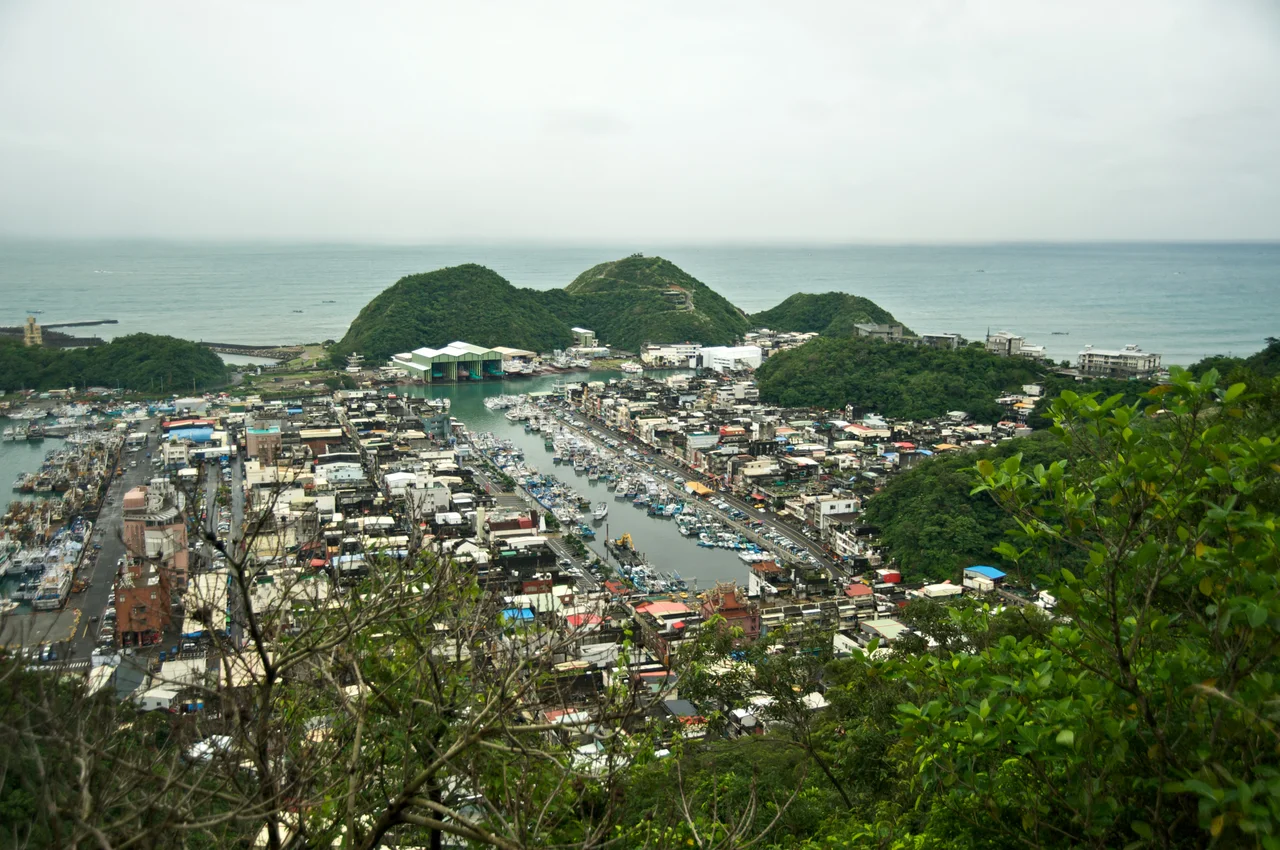

Suao
National Highway 5 ends at Suao. After cutting through the mountains from Taipei in a long expressway tunnel, it runs out of road here, at the edge of Yilan County's coastal plain, where the Central Mountain Range pushes almost to the Pacific and a small city holds its ground between the cliffs and the sea. Suao is not a destination in the tourism-brochure sense — it has a large commercial port, some industry, a railway station, and the kind of seafood restaurants that exist to feed people who actually live near the ocean. What it also has, improbably, is a naturally carbonated cold spring that draws visitors from across Taiwan and makes a morning here feel worth the detour.
The Railway at the End of the Line
Getting to Suao by train requires attention. The Taiwan Railway Yilan Line runs from Taipei along the northeastern coast, but Suao itself sits on a short branch off the main line — most long-distance services stop at Suao New Station (Suao-xin), and a separate local train covers the final few kilometres into Suao proper. The distinction matters: the two stations are not the same place. On weekdays the platforms are quiet; on weekends and holidays they fill with day-trippers from Taipei, many of them headed directly for the cold spring park a few minutes' walk from the station. The railway journey itself is worth doing — the line traces the coast past fishing villages and tea-covered hillsides, with the Pacific appearing and disappearing between headlands.
Fizzing Water and How to Find It
The cold springs discovered by Japanese army surveyors in 1928 are Suao's most talked-about feature. Naturally carbonated at 22°C — cool enough to refresh, warm enough to linger in — the water rises from the ground already fizzing, the bubbles clinging to bathers' skin in a sensation that no artificially carbonated bath can quite reproduce. Two public bathing facilities operate near the train station. The main cold spring park has both open-air covered pools and private indoor rooms, and a drinking tap where you can taste the water directly — mildly sparkling, faintly mineral. The Alishin Spring, a short walk further along the same road, is quieter and less formal, drawing a more local crowd. Neither is expensive. Both draw from the same deep geology.
The Port and What It Brings In
The harbour is the other reason to stay past lunchtime. Suao is a working fishing port, and the seafood restaurants near the waterfront operate on the principle that freshness is the only preparation you really need. Crab, lobster, filefish, oyster fritters, shrimp pancakes, and fish ball soup are the staples — served at the kind of informal restaurants where the tanks are visible from the table and the prices are determined by weight. English menus are rare and the ordering process can be approximate, but the quality makes navigation worthwhile. The main street near the train station has cheaper eateries for those who want a quick meal before catching a train back north.
What Suao Is and Isn't
Suao is not a resort. The tourism infrastructure is modest — finding hotels with English-language websites has always been difficult, and many visitors treat it as a day trip from Hualien or Taipei rather than an overnight stop. That relative quietness is a quality, not a deficiency. The town functions on its own terms: industry along the port, local commerce on the main streets, fishing boats coming and going on schedules driven by fish rather than tourists. There is a Baimi Clog Village on the outskirts where traditional wooden clogs are still made and sold. The cold springs are famous enough to bring weekend crowds; the rest of the time, Suao belongs to the people who live here.
Gateway to the Coast Beyond
South of Suao, Taiwan's geography becomes dramatic in a different way. The Su-Hua Highway — one of the most scenic and vertiginous roads in Asia — begins here, clinging to coastal cliffs for 118 kilometres before reaching Hualien. The highway has been progressively replaced by tunnels in the Su-Hua Highway Improvement Project, but sections of the original cliff-edge road remain. Suao thus occupies a hinge point in Taiwan's geography: the northern end of the east coast's rugged stretch, the southern end of Yilan's gentler plain. Arriving here on the train from Taipei, or departing by road toward Hualien, you feel the island change around you — the mountains pressing closer, the ocean asserting itself.
From the Air
Suao sits at 24.600°N, 121.850°E on Taiwan's northeastern coast, where Yilan County meets the Pacific. The port facilities are the most visible landmark from the air — large breakwaters extend into the ocean east of the town. Taipei Songshan Airport (RCSS) lies approximately 75 kilometres to the northwest; Hualien Airport is roughly 60 kilometres to the south. At 2,000–5,000 feet on a clear day, the contrast between the mountain spine to the west and the flat coastal strip is striking. The highway tunnel entrance for National Highway 5 is visible on the town's western edge where the mountains begin.
Nearby Stories
- Shihmen Dam 5.3 km away
- Jiaoxi 6.1 km away
- Mount Dabajian 6.9 km away
- Hehuanshan 8.5 km away
- Qingshui Cliff 13 km away
- Sinking of MV Sewol 1105 km away
- Yellow Sea 1167 km away
- Sibuyan Island 1317 km away