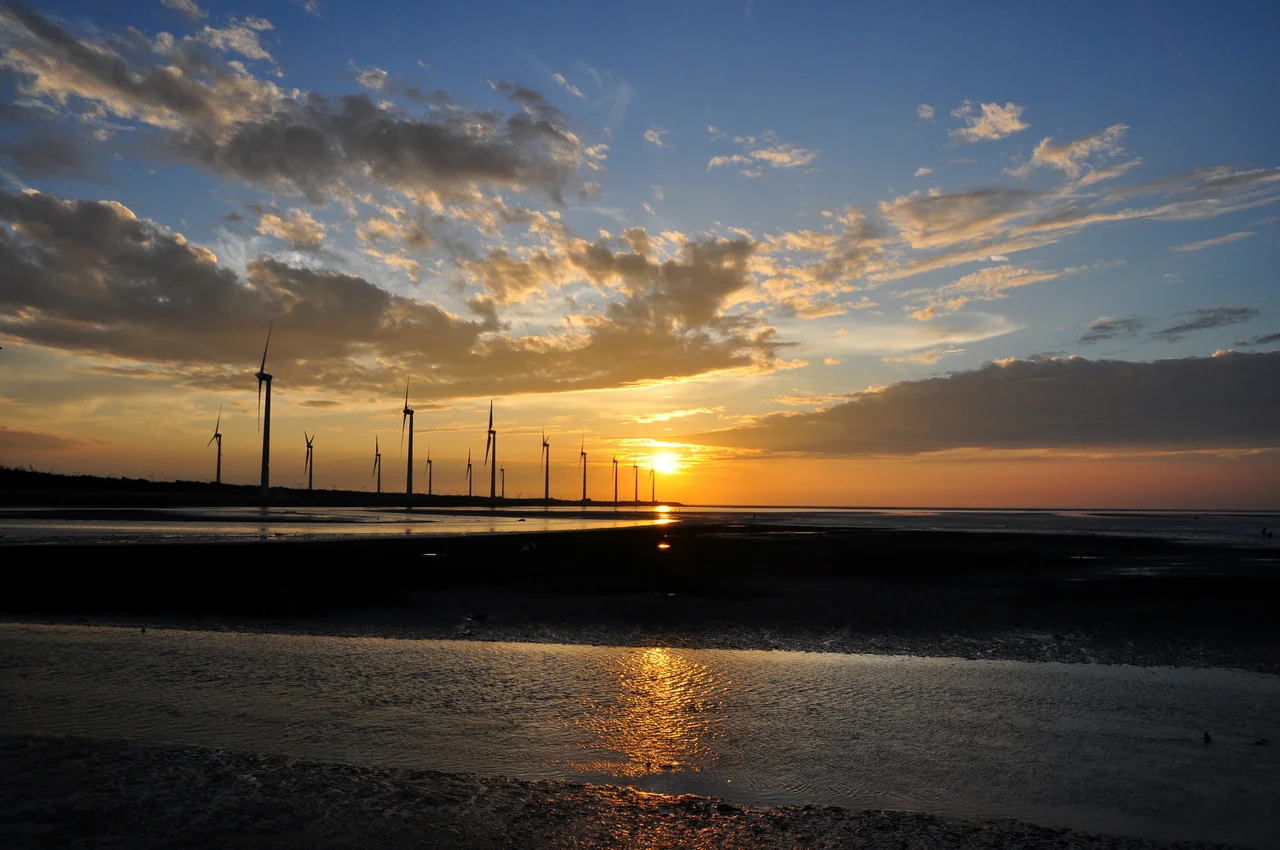

Gaomei Wetlands
At low tide, the mud stretches all the way to the horizon. Herons pick their way across the exposed flats, and in the distance, the turbines of the Taiwan Power Company turn slowly against a sky that, as evening approaches, has begun its daily color shift from blue to gold to orange to red. This is Gaomei, a 300-hectare wetland on the western edge of Taichung's Qingshui District, and whatever time of day you arrive, something is happening at the water's edge.
Ten Percent of Something Much Larger
The Gaomei Wetland Preservation Area — formally established on September 29, 2005 — covers roughly 300 hectares, which sounds large until you consider the context: this protected area represents only about 10 percent of the broader Dadu River wetlands that extend along this stretch of Taiwan's western coast. The Dadu River empties into the Taiwan Strait just to the south, and the meeting of freshwater and tidal seawater creates the particular ecology that characterizes the Gaomei area: mudflats, reed beds, tidal channels, and the mix of resident and migratory species that depend on these transitional zones. The designation as an Important Bird Area reflects the site's significance for migratory birds following the East Asian flyway, which routes millions of shorebirds and waterbirds along Taiwan's coasts each spring and autumn. What has been preserved at Gaomei is meaningful; what lies beyond the preservation boundary is a reminder of what wetland landscapes along Taiwan's coast once looked like before development.
Wind Over Water
Eighteen wind turbines belonging to the Taiwan Power Company stand in the Gaomei area, their rotors visible above the reed beds and tidal flats. They have become inseparable from the landscape in the popular imagination — photographs of Gaomei at sunset almost always include them, the turbine blades catching the last light above the silhouette of birds resting in the shallows. In August 2015, Typhoon Soudelor tore through the area and destroyed six of the eighteen turbines, leaving the row incomplete. The damage was a reminder of the physical vulnerability of this flat, exposed coastal zone to the typhoons that cross Taiwan regularly through the summer and autumn months. The surviving turbines remained in operation. The gap in the row has a different visual character from what came before, but the landscape absorbed it, as coastal landscapes do.
Infrastructure on a Fragile Coast
Visiting Gaomei requires crossing the Binhai Bridge, a 70-meter span connecting the mainland of Taichung with the wetlands area. In October 2019, following the collapse of the Nanfang'ao Bridge in Yilan County three weeks earlier, the Binhai Bridge underwent a safety inspection by the Taiwan International Ports Corporation — and failed it. The bridge was 45 years old at the time of inspection and was subsequently closed to vehicles. That inspection — and the awareness it brought of aging infrastructure along Taiwan's coast — added a layer of practical concern to a destination otherwise associated with serene natural beauty. Access to Gaomei is also possible by bus from Qingshui Station on the Taiwan Railway, for those arriving without a vehicle.
The Hour Before Dark
What draws the largest crowds to Gaomei is something the preservation designation does not account for: the light. The Taiwan Strait faces west, and Gaomei's flat, open expanse of tidal mudflat and shallow water provides an unobstructed view of the sun's descent into the strait. The colors that result — the orange and red reflections multiplied across the wet flats, the turbines rendered as silhouettes, the birds settling into the reeds as the temperature drops — have made Gaomei famous across Taiwan and, by one 2016 H.I.S. travel agency poll of Japanese tourists, the top-ranked travel destination in the world. Visitors stand along the boardwalk that extends into the wetlands, cameras raised, waiting for the moment when the light is exactly right. It comes every evening, different every time, reliable as the tides.
From the Air
Gaomei Wetlands lies at 24.31°N, 120.55°E on the western coast of Taichung's Qingshui District, directly adjacent to the Taiwan Strait. Approaching from the west at 4,000 feet over the strait, the wetlands are visible as a pale coastal expanse between the developed shoreline and the reed beds. The row of wind turbines provides an immediate visual marker. Taichung International Airport (RCMQ) sits approximately 15 kilometers to the southeast. At lower altitudes, the red-and-white Gaomei Lighthouse at the northern edge of the wetlands is clearly visible as a navigational landmark.
Nearby Stories
- Lukang Tianhou Temple 3.3 km away
- 1916–1917 Nantou Earthquakes 11 km away
- Beipu 15 km away
- Shei-Pa National Park 21 km away
- China Airlines Flight 611 23 km away
- 1991 Miaoli Train Collision 43 km away
- Mudouyu Lighthouse 69 km away
- Battle of Xiapi 1097 km away