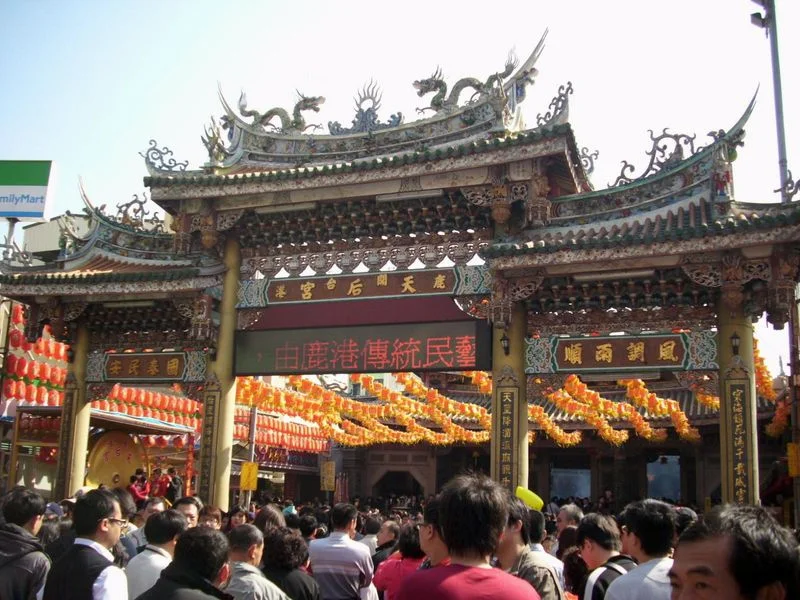

Lukang Tianhou Temple
The oldest statue in the Lukang Tianhou Temple has a face darkened almost to black. Generations of incense offerings have stained it, layer upon layer, until the wood beneath is invisible. Known as the Dark-Faced Mazu, or Heimian Ma, this figure is said to have been brought to Lukang by the Qing admiral Shi Lang after his 1683 conquest of Taiwan, or perhaps by a monk from Meizhou. No one is entirely certain. What is certain is that the statue has been venerated here for over three hundred years, and its discolored surface is not damage but devotion made visible.
A Temple Between Empires
The Lukang Tianhou Temple's origins are contested. Some claims place its founding as early as 1590, though the earliest verifiable structure dates to the late Ming dynasty in the 17th century. The temple was relocated to its current site in 1725, when Shi Shibang donated the land. From the beginning, Mazu's cult had political as well as spiritual significance. Already popular among Fujianese immigrants, the goddess was particularly patronized by the Qing dynasty, which credited her with assisting Shi Lang's naval campaign to wrest Taiwan from the Ming-loyalist Zheng clan. Devotion to Mazu was both genuine faith and imperial endorsement, a combination that made the Lukang Tianhou Temple one of the most important religious sites on the island.
Artisans from Across the Strait
The temple's woodwork was executed by local craftsmen and masters from Quanzhou and Chaozhou on the mainland, and the details reward close inspection. A ceiling plaque written by Wang Lan-pei in 1830 invokes Mazu's protection with the phrase Bo Hai Meng Xiu. Above it, a pair of carved toads perch atop the plaque, one gripping a chrysanthemum in its teeth to symbolize longevity, the other holding a camellia for a long and prosperous spring. The passages to the east and west wings are flanked by statues of Jing Zhu Gong and Zhu Sheng Niangniang, protective deities carved with the same precision. A 1963 renovation added two doors to the original three and expanded the balcony into a larger octagonal shape, but the temple's character remains rooted in the craftsmanship of its Qing-era builders.
A Museum of Mazus
What distinguishes the Lukang Tianhou Temple from Taiwan's many other Mazu shrines is its extraordinary collection of sacred statues, each with its own name, history, and ritual role. The Dark-Faced Mazu, the oldest, is usually kept in a separate hall. The Jinxiang Ma, commissioned in 1922 from the Quanzhou carver Lian Yong-chua before a mainland pilgrimage, serves as a traveling substitute and normally occupies the Main Hall. The Guda Ma has protected the crops of twelve surrounding villages since at least 1831. The diminutive Chuantou Ma, only eight inches tall, represents the many statues Taiwanese sailors once carried in bow shrines for protection at sea. And then there is the Gold Mazu, built in 2002 from over 150 kilograms of gold donated by pilgrims, inlaid with diamonds, emeralds, pearls, and rubies.
Faith in Gold and Wood
The Gold Mazu might seem like spectacle, but it represents something genuine: the accumulated devotion of ordinary people who gave their gold to honor the goddess who, they believe, protects their livelihoods and their lives. The same impulse that darkened the Heimian Ma with centuries of incense produced the glittering Jin Mazu through a different medium. Both are acts of offering. The rear hall houses statues of the Jade Emperor and the Sanguan Dadi, expanding the temple's spiritual reach beyond Mazu alone. Guardian figures carved by Lian Yong-chuan in Quanzhou -- Qianliyan and Shunfeng'er, Mazu's mythical protectors with the power to see a thousand miles and hear the wind -- flank the main hall's entrances. Every surface, every statue, every plaque tells a story of crossing: across the strait, across centuries, from mainland traditions to something distinctly Taiwanese.
From the Air
Located at 24.06°N, 120.43°E in the historic port town of Lukang, Changhua County, on Taiwan's western coastal plain. The temple complex sits within the dense historic center of Lukang, which faces the Taiwan Strait. Nearest airports: Taichung International Airport (RCMQ) approximately 30 km to the northeast. Best viewed at 2,000-3,000 ft AGL. The flat coastal terrain and distinctive grid of Lukang's old town are visible from altitude, with the Taiwan Strait to the immediate west.
Nearby Stories
- Huwei, Yunlin 2.8 km away
- Geographic Center of Taiwan 4.2 km away
- Gaomei Wetlands 15 km away
- China Airlines Flight 611 21 km away
- Shei-Pa National Park 25 km away
- Yushan Weather Station 27 km away
- TransAsia Airways Flight 222 30 km away
- Battle of Xiapi 1136 km away