.jpg)
Huwei, Yunlin
Before the Dutch arrived, before the Qing dynasty administrators gave the place a Chinese name, before the Japanese colonial government renamed it Kobi — this corner of the Yunlin plain was Favorolang, one of the largest and most powerful indigenous villages on the island of Taiwan. The Babuza people who built it were Plains Aborigines, a Formosan indigenous group, and their settlement was substantial enough that 17th-century Dutch colonizers documented it carefully. Favorolang's river, the Chinese later called How-boe-khe. The settlement itself, the Qing eventually renamed Go-keng-chhu. By 1920, Japanese administration had reshaped it into Kobi Town. Today it is Huwei — a name that has outlasted every colonial regime that tried to overwrite it.
A Name Worn Through History
The Taiwanese place name Huwei carries the echoes of Favorolang — rendered in the various Dutch spellings of the 17th century as Favorlang, Favorlangh, and Vovorollang — but the phonetic connection takes some linguistic archaeology to trace. The name Favorolang itself is believed to derive from the ethnonym Babuza, the tribal designation of the Plains Aboriginal people who inhabited this part of central western Taiwan before sustained contact with Han Chinese settlers and European colonizers.
The Babuza people's village at Favorolang sat north of Tirosen, the settlement that would become modern Chiayi City. During the Dutch period, when the VOC administered the island's western plains, Favorolang was notable enough to appear repeatedly in colonial records. Missionaries documented its language; administrators counted its people. After the Dutch withdrew in 1662 and Han Chinese settlement accelerated, the indigenous presence diminished as land was cleared for agriculture and the Babuza people were gradually absorbed, displaced, or pushed toward the mountains. Huwei today has a population of about 70,000. The Babuza are remembered in the etymology of its name.
Sugar, Industry, and the Iron Bridge
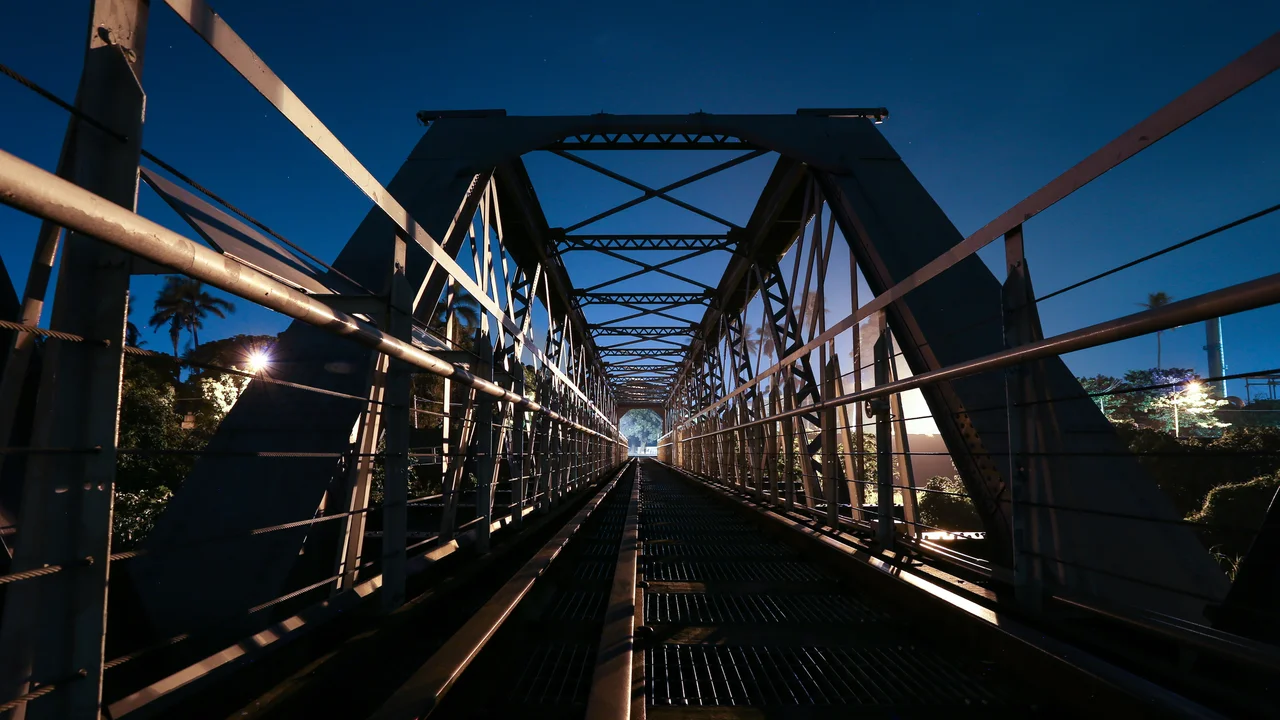
In the early twentieth century, under Japanese colonial administration, Huwei became a center of the sugar industry that shaped so much of lowland Taiwan's economic landscape. The Huwei Sugar Factory was established during this era, and the infrastructure built to service it — including the Huwei Sugar Factory Iron Bridge, which once carried narrow-gauge railway cars across the river — left a physical legacy that still anchors the town's identity.
The iron bridge, now a tourist attraction and heritage site, reflects the scale of investment the colonial sugar industry brought to the region. Narrow-gauge rail lines radiated outward from sugar factories across western Taiwan, connecting cane fields to processing plants. The bridge that once carried those cars through Huwei stands as a reminder of how thoroughly the sugar industry reorganized the landscape and economy of the region during the first half of the twentieth century. National Formosa University, established in the post-war period, now brings students and academic life to the township. Taiwan High Speed Rail's Yunlin Station, in Huwei's jurisdiction, places the township on the high-speed corridor linking Taipei to Kaohsiung.
The World of Budaixi
Ask what Huwei is known for among Taiwanese, and you'll often hear one word: puppets. Specifically, budaixi — glove-puppet theater, a performance tradition brought to Taiwan from Fujian Province in China and developed over centuries into something distinctly Taiwanese. Budaixi performances involve elaborately costumed hand puppets manipulated from below a small stage, with performers voice-acting multiple characters while percussion and brass instruments drive the action.
Huwei sits at the center of this tradition. The Yunlin Hand Puppet Museum, housed in the township's historic district, preserves the art form's history and hosts events that draw practitioners and enthusiasts from across Taiwan and internationally. The Yunlin Story House nearby anchors a cultural precinct that has become one of the more thoughtfully developed heritage areas in the county. For generations of Taiwanese families, budaixi was the theater of working-class life — performed at temple festivals, broadcast on television starting in the 1960s, and passed down through families who treated puppeteers with the same reverence given to opera singers. Huwei's claim to that tradition is well-documented and genuinely felt.
Living in the Present Tense
Huwei today functions as Yunlin County's main urban center, the commercial and administrative hub for the county seat area. Its round traffic circle — the 圓環, still visible in photographs of downtown Huwei — reflects urban planning decisions made during the Japanese period, when rotaries were a common feature of colonial-era township design. The county courthouse sits here, as does National Formosa University, which brings a student population that gives the town a livelier energy than many rural townships of comparable size.
Chen Po-chih, who served as Taiwan's Minister of the Council for Economic Planning and Development from 2000 to 2002, was born here. Actor and television host Frankie Huang is another Huwei native. The township also maintains a sister city relationship with Ōma in Aomori Prefecture, Japan — a connection that gestures toward the complex historical ties between Taiwan and Japan, ties that are neither straightforwardly warm nor straightforwardly adversarial. Huwei lives with its history in the same way most of Yunlin does: by continuing.
From the Air
Huwei is centered at approximately 23.72°N, 120.435°E in northwestern Yunlin County. From the air at 3,000 feet, the township's urban core is visible as the densest concentration of buildings in the northern Yunlin plain, with the circular road pattern of downtown Huwei distinguishable in the street grid. The Yunlin HSR Station is visible as a large transport hub on the township's periphery. Chiayi Airport (RCKU) lies approximately 40 kilometers to the south. The Taiwan Strait coastline lies roughly 15 kilometers to the west, and the foothills of the Central Mountain Range rise to the east. Recommended viewing altitude is 2,500–5,000 feet for a full appreciation of Huwei's position within the Yunlin lowland plain.
Nearby Stories
- Puli 7.3 km away
- Guanzihling 11 km away
- Fangyuan Lighthouse 11 km away
- Yakou Mountain Pass 13 km away
- 1999 Jiji Earthquake 15 km away
- China Airlines Flight 611 23 km away
- TransAsia Airways Flight 222 26 km away
- Dongji Island 26 km away