_(2).jpg)
Chippokes State Park
The name Chippokes is older than English Virginia. It comes from Choapoke, the contact-era weroance of the Quiyoughcohannock people, whose ancestral lands were bounded by Upper and Lower Chippokes Creek - nearly a hundred square miles, at least four towns, and an economy built on the river. The Quiyoughcohannock were part of the Powhatan Paramount Chiefdom. Their land was ceded to English colonists by 1619. The same year, the Virginia Company gave a 750-acre slice of it to Captain William Powell, an Ancient Planter, and named the tract Chippokes Plantation. Four centuries later, fields and orchards still spread across the land Choapoke once governed. It is one of the oldest continuously farmed properties in North America - and one of the few that still carries the name its first stewards used.
Choapoke's People
The Quiyoughcohannock built their lives around the south-bank tributaries of the James River. Agriculture, trade, and the local waterways gave their territory enough wealth to support at least four towns within a hundred-square-mile range. When the English arrived in 1607, the Quiyoughcohannock were one node in the larger Powhatan Paramount Chiefdom that dominated the Tidewater. The pressure of English settlement, disease, and the violence that culminated in the 1622 and 1644 attacks on colonists and the brutal Anglo-Powhatan wars that followed broke the chiefdom's political structure. The Quiyoughcohannock as a distinct group dissolved into the longer, sadder history of Powhatan dispossession. But Choapoke's name stayed on the creeks and on the land. The English wrote it as Chippokes. They kept the name even as they took the country.
Ancient Planters and Absentee Lords
Captain William Powell, who received the original 750-acre grant in 1619, was an Ancient Planter - a settler who had survived ten years at the Jamestown settlement. He died four years later, and Chippokes passed through his infant son George, the Osburne family, and back into the hands of Governor William Berkeley around the time of Bacon's Rebellion. When Berkeley died in 1677, his widow Lady Frances Culpeper Berkeley remarried, this time to Philip Ludwell I, and the Ludwell family would own Chippokes for nearly 150 years. They operated it as nonresidents, running the plantation through local overseers and enslaved laborers. Philip Ludwell III became the first known Orthodox Christian in America. His daughter Lucy Ludwell Paradise, who spent most of her life in England, somehow managed to become close friends with Thomas Jefferson and John and Abigail Adams. She returned to Virginia in 1805 and lived in the Ludwell-Paradise House in Williamsburg - across the river from the plantation that bore her family name.
The Brandy and the Civil War
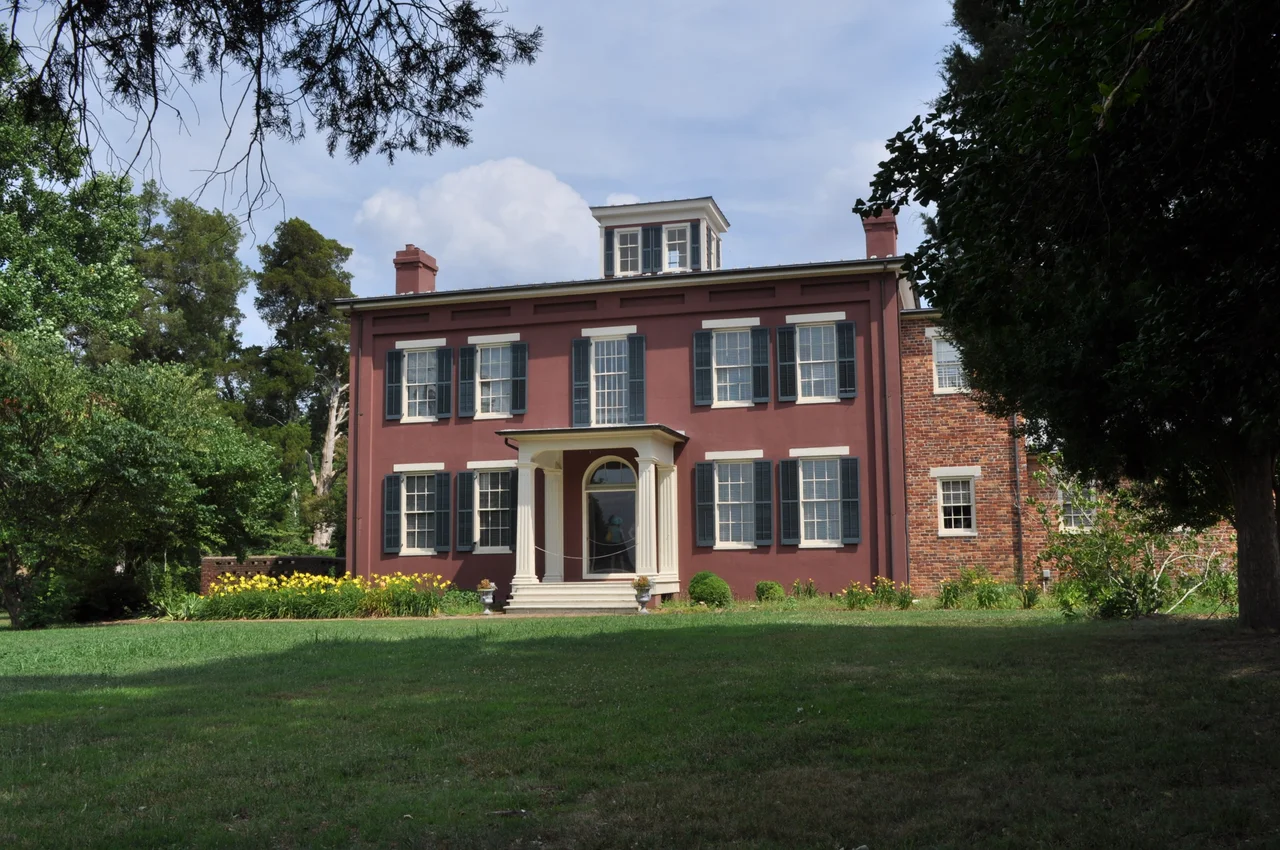
Chippokes got its first non-absentee owner in centuries in 1837, when 22-year-old Albert Carroll Jones moved in. He doubled the footprint of the c. 1830 River House in 1847 and planted orchards of apple and fig, distilling brandy from the fruit. After his first wife died in 1850, he began building a grand Italianate manor that became known as the Jones-Stewart Mansion. Just before the Civil War, when Jones was at his most prosperous as a planter and distiller, 47 enslaved people worked at Chippokes. Their names, mostly, did not enter the historical record. At least one stayed on after the war. Local tradition holds that the farm was spared by both Federal and Confederate troops - who were busy raiding and destroying plantations nearby - because Jones gave brandy to both sides. Whether that story is fully true or partly legend, Chippokes survived the war intact while neighbors burned.
The Stewarts' Gift
In 1918, Victor Stewart and Thornton Jeffress, co-proprietors of the Petersburg-based Colonial Pine Company, bought Chippokes at auction. They intended to log it. But Victor and his wife Evelyn moved in instead, restoring the historic mansion and the formal gardens through the 1920s. The Stewarts had no children, and they decided to leave the property to the Commonwealth of Virginia on the condition that it become a state park. Chippokes Plantation State Park opened to the public in 1970. In 2004, the 550-acre Walnut Valley Plantation was added to the park. Established in 1636, Walnut Valley contains the oldest plantation house in the park, built around 1770, and a restored 1816 slave quarter - among the oldest still standing in Virginia. The little brick building is now interpreted alongside the mansion. Both houses, in their own way, tell the truth about how Tidewater Virginia was built.
Fossils and Farm
Today the park covers more than 1,400 acres, including the original Chippokes tract and Walnut Valley. The Chippokes Farm and Forestry Museum, opened in June 1990, spreads across five buildings interpreting Tidewater farming from 1619 to 1950, with reconstructed farmhouse interiors, workshops of rural craftspeople, heritage breed animals, and a Cultural Garden. The riverfront beach is one of the best Miocene and Pliocene marine fossil sites on the East Coast - sharks teeth, shells, and bones eroding out of the bank with every tide. As of 2020, the park drew 173,110 visitors a year. Since 2007, it has been part of the 3,000-mile Captain John Smith Chesapeake National Historic Trail, the first national water trail. To stand on the Chippokes bluff at low tide, fossils underfoot and the James River sliding past, is to stand in the same view Choapoke knew - changed in every detail except the angle of the light and the breadth of the water.
From the Air
Coordinates 37.1367°N, 76.7275°W. The park is in Surry County on the south bank of the James River, opposite Jamestown Island. From the air, look for the long open fields of the plantation along the river, the dark woods inland, the James River bridge structure to the southeast, and the white forms of the historic houses near the bluff. Best viewed 1,500-2,500 feet AGL. Nearest airports: Williamsburg-Jamestown (KJGG) about 4 nm north across the river, Newport News/Williamsburg International (KPHF) about 13 nm northeast.
Nearby Stories
- Siege of Petersburg 5.4 km away
- Battle of Gwynn's Island 7 km away
- Norfolk: The Navy's Capital Where the Fleet Calls Home 7 km away
- Southside (Richmond, Virginia) 11 km away
- Chesapeake Bay Bridge-Tunnel 24 km away
- White House (plantation) 25 km away
- Suffolk, Virginia 27 km away
- Fort Christanna 52 km away