
Church of Hosios David
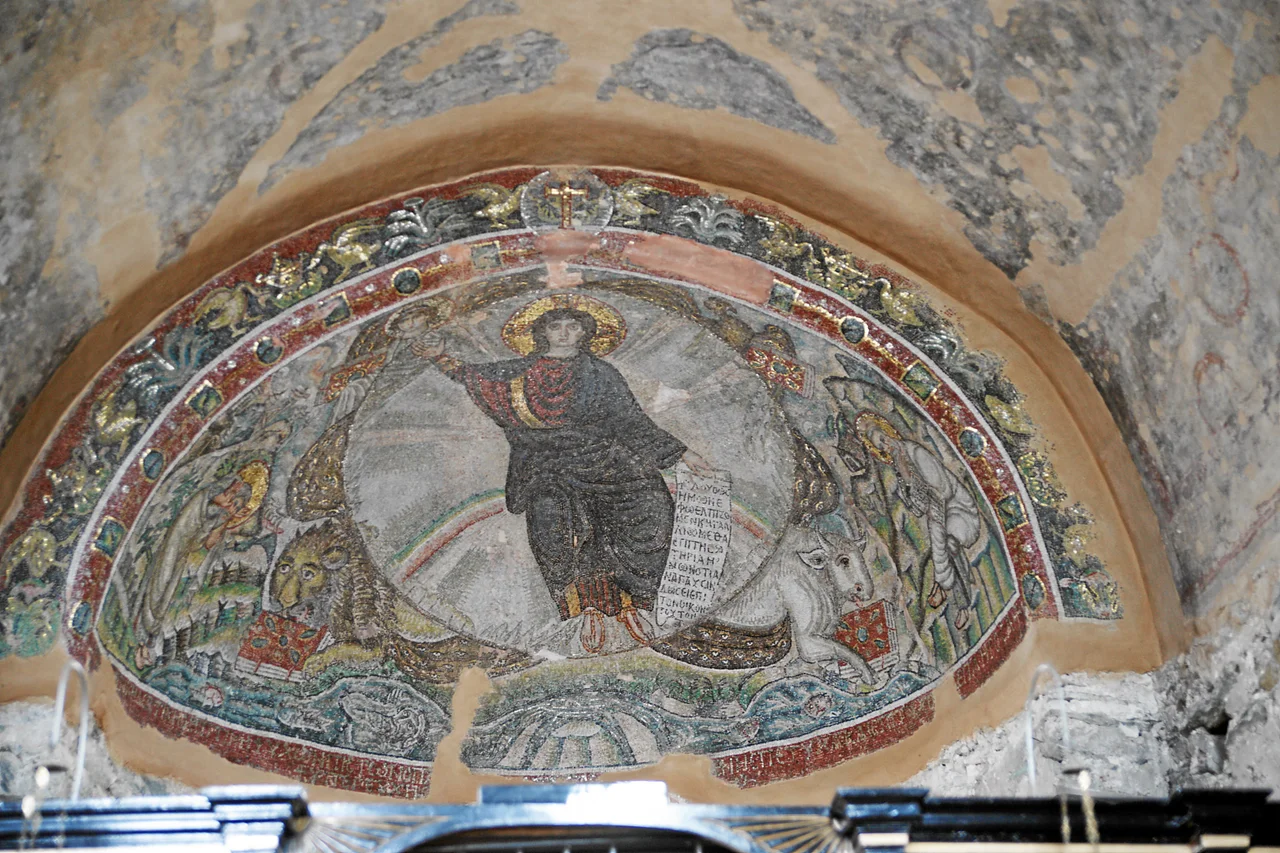
The legend says it was made overnight, by no human hand. Sometime in the third or fifth century - traditions vary - the apse mosaic of the Church of Hosios David was supposed to have appeared miraculously, finished, in the hour before dawn. Christ stands in the center on a rainbow, holding a scroll, surrounded by the symbols of the Four Evangelists. The colours are violently alive, the proportions oddly tender, the gaze unforgettable. The mosaic is, in fact, the work of patient human craftsmen, dated by modern scholars to the late fifth century. But standing in the small upper-town church in Thessaloniki and looking up at the apse, you can understand why people who saw it in its first centuries needed an explanation that was bigger than craft.
The Hill Above the City
Thessaloniki spreads down from a steep hillside to the Aegean, with the upper city - the Ano Poli - clinging to the slope just below the Byzantine walls. The Church of Hosios David sits high on that slope, deliberately removed from the busy harbour neighbourhoods below. It was built in the late fifth century as the katholikon - the main church - of the Latomos Monastery. The cross-in-square plan, with four corner bays opening into a central cross, was unusual for its time and would only become a Byzantine standard later. The dedication is to David the Dendrite, a sixth-century Thessalonian saint who reportedly lived in the branches of an almond tree for three years as an act of devotion. Dendrite means tree-dweller. The church grew up around his memory and around the older mosaic that is its true wonder.
The Apse
The Icon of Christ of Latomos - to give the apse mosaic its formal name - shows Christ standing on a rainbow against a vivid blue sky, holding an open scroll. The Greek inscription reads: Behold our God, in whom we hope and we rejoice in our salvation, that he may grant rest to this home. Around him, the symbols of the Four Evangelists: the angel of Matthew, the lion of Mark, the bull of Luke, the eagle of John. Below him, the prophets Habakkuk and Ezekiel watch his appearing - the Theophany, the manifestation of the divine. What sets the mosaic apart from later Byzantine work is its naturalism. Christ's body has weight. His face is specific - young, intent, unidealised in a way that later, more abstract Byzantine icons would deliberately move away from. The colours are saturated rather than gilded. Modern art historians place the mosaic in the late fifth century, contemporaneous with similar work in Ravenna and Rome. The medieval stories about its miraculous origin are easier to credit when you stand below it: nothing else in the building, before the painters of the twelfth century filled the vaults with frescoes, prepared the eye for what waits in the apse.
The Frescoes That Followed
Sometime around 1160 to 1170, in the middle Byzantine period, painters returned to the church and added a second layer of decoration to the vaults and barrel arches. The frescoes show the Nativity, the Presentation in the Temple, the Baptism, the Transfiguration, the Entry into Jerusalem, Christ on the Mount of Olives. They imitate, in places, the look of marble revetment with painted patterns - a clever solution where actual marble was unavailable. A few of the scenes - Our Lady of the Passion, the Entry into Jerusalem, Christ on the Mount of Olives - were probably added later, in the Palaiologan period of the thirteenth and fourteenth centuries, the same artistic movement that produced the Boyana Church frescoes in Bulgaria and the famous mosaics at Constantinople's Chora Monastery. The Hosios David frescoes are unusual in that they have few painted borders separating one scene from the next. The narrative flows continuously around the upper walls.
The Mosque Years
When the Ottomans took Thessaloniki in 1430, they immediately converted the largest, best-located churches into mosques. The Church of Hosios David - small, tucked away on the upper hillside, far from the central streets where the city's commerce ran - was left alone for nearly a century. Sometime in the sixteenth century, finally, it was converted as well, and given the names Suluca Mosque or Murad Mosque. The new occupants whitewashed and plastered over the frescoes, as Islamic prohibition required, and added a small minaret at the southwestern corner. The plaster, paradoxically, became the frescoes' protector. Sealed beneath whitewash, they were spared the centuries of candle smoke, breath, and incidental damage that other churches absorbed. When the city was returned to Greek control after the Balkan Wars, and the church reconsecrated in 1921, restorers began removing the plaster. The frescoes underneath were damaged - earthquakes had cracked the walls, water had seeped in - but they had survived. The base of the minaret remains today, with its spiral staircase still climbing partway up its hollow shell, a physical record of the four centuries the building spent serving another faith.
What the Mosaic Sees
In 1988 UNESCO inscribed the Church of Hosios David, along with fourteen other early Christian and Byzantine monuments of Thessaloniki, on the World Heritage List. The recognition is fitting: this building is a small, intact piece of Mediterranean Christianity from the period when the Roman Empire was becoming the Byzantine Empire, when the visual language of icon painting was still being invented, and when the artistic ambition of provincial cities like Thessaloniki rivalled anything in Constantinople. Visit the church now and you can stand directly under the apse - the building is small enough that there is no real distance between worshipper and image. Christ on his rainbow looks back. The eye that the fifth-century craftsman set into a glass tessera holds, somehow, the same question the medieval Greeks asked of it. How was this made. Who saw what they were doing. The answer, the legend insists, is that no one saw. A truer answer is that someone did, and that we have lost their name.
From the Air
The Church of Hosios David sits at 40.6418 N, 22.9523 E in the upper city (Ano Poli) of Thessaloniki, Greece. Thessaloniki Airport Makedonia (LGTS) is about 14 km southeast. Recommended viewing altitude 1,500-3,000 m AGL. The church is small and best located by orienting on Thessaloniki's distinctive crescent-shaped bay along the Aegean and the line of Byzantine walls that snake along the upper slope. The White Tower on the waterfront and the rotunda of Galerius are larger nearby landmarks. The hillside above the old town, where Hosios David sits, is the navigational anchor.
Nearby Stories
- Battle of Kilkis (1944) 14 km away
- Byzantine Empire under the Palaiologos Dynasty 15 km away
- Vergina 28 km away
- Battle of Spartolos 28 km away
- Mount Olympus 41 km away
- Battle of Philippi 62 km away
- Battle of Athos 124 km away
- Ohrid 144 km away