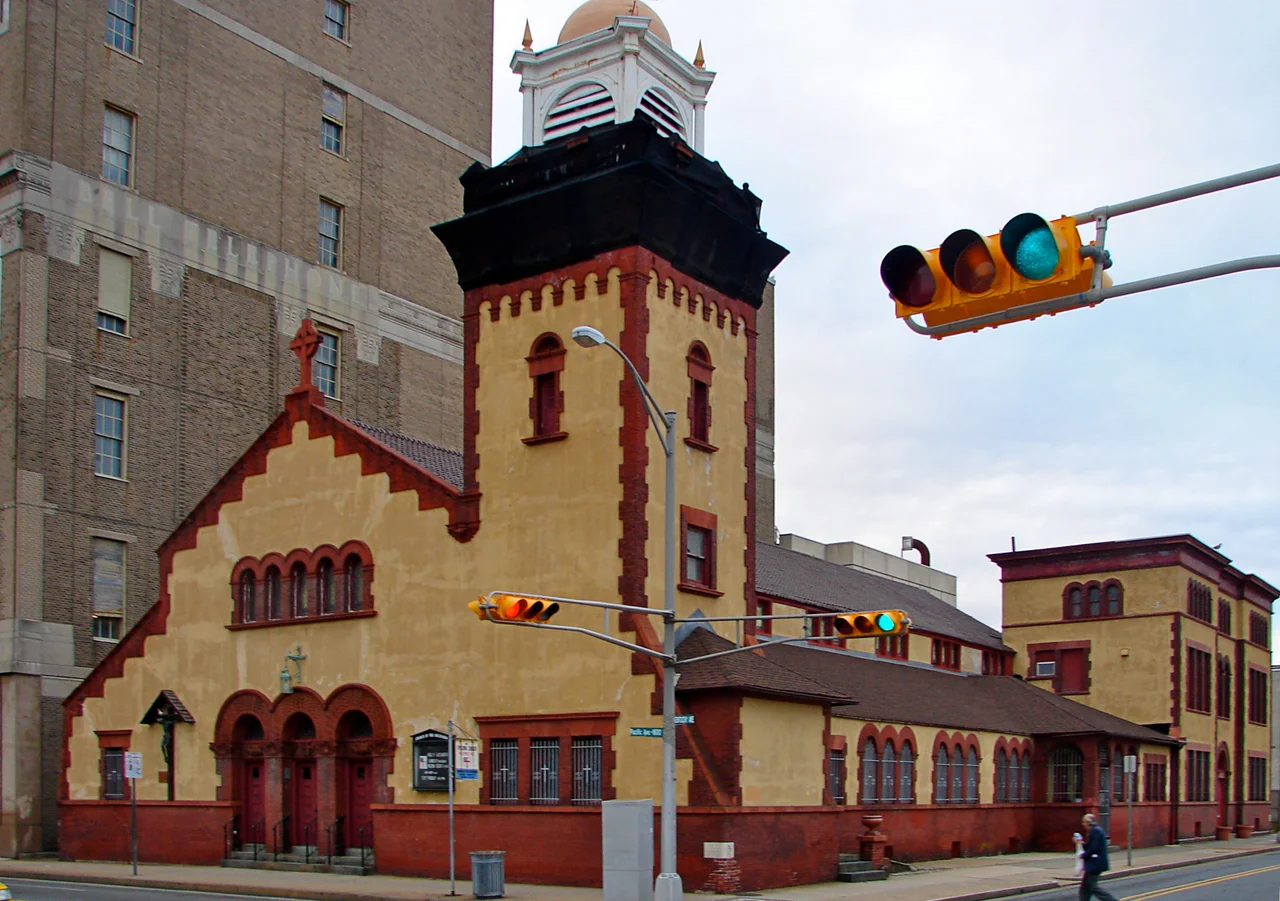

Church of the Ascension (Atlantic City, New Jersey)
In 1879, Mrs. Francis Hemsley walked into the vestry meeting at St. Mark's Episcopal Church in Atlantic City and laid out her case. Atlantic City had become a year-round resort - her husband's Hotel Brighton had recently announced it would operate through the winter, the first hotel in town to do so - and the religious life of the city should match the change. Summer-only churches were no longer sufficient. The Episcopalians needed a year-round parish. Mrs. Hemsley was the daughter of Bishop Underdonk of Pennsylvania and not someone the vestry could easily dismiss. The Church of the Ascension was organized that year as Atlantic City's first all-year Episcopal congregation. Reverend J. Rice Taylor held the first services in June 1880 in a small frame chapel at Michigan and Pacific Avenues. The parish was incorporated on January 3, 1881. The frame chapel was moved in 1886 to Pacific and Kentucky Avenues. The grand brick church that finally replaced it opened on May 13, 1894 - Whitsunday - and stood until July 2017.
Lindley Johnson's Design
Reverend J.H. Townsend became the third rector in December 1891 and immediately began planning a permanent church building. The vestry hired Philadelphia architect Lindley Johnson, who designed the new structure in Spanish Renaissance style - an unusual choice for an Episcopal church in New Jersey, but one that fit Atlantic City's resort architectural vocabulary. The cornerstone was laid April 27, 1893. The completed church opened to worshipers on Whitsunday, May 13, 1894. Johnson had previously designed houses for the Hemsley family in Germantown, Philadelphia, and six cottages in the Chelsea section of Atlantic City. The connection ran through the parishioner network. The building used hard fire-resistant materials, an explicit response to the catastrophic boardwalk fires that had repeatedly destroyed Atlantic City's earlier wooden structures. The first chimes were a gift from the Hemsley family. The first pipe organ was installed in 1896, played by Albert Dietz of New York. In 1900 Alger E. Weeden took over as organist and choir master and stayed for forty years.
The Stained Glass
Originally the church windows were made by Lavers and Westlake, a respected London-based stained glass firm. When a hotel fire next door damaged ten of the panels in the early twentieth century, Lavers and Westlake re-executed identical replacements from their original drawings. Each replacement was installed in kind. In 1922 the Philadelphia ecclesiastical architect Frank Rushmore Watson completed substantial improvements to the chancel and added four new stained glass windows by D'Ascenzo Studios - a Philadelphia firm run by the Italian-born Nicola D'Ascenzo whose work appears in churches and university buildings throughout the Mid-Atlantic. The Church of the Ascension thus held two generations of high-quality ecclesiastical stained glass, English Victorian and American Art Nouveau, in the same building. The combined collection was, at the time of demolition, recognized as one of the finer ecclesiastical glass collections in southern New Jersey.
The Mother Church
Under Father Townsend's leadership the Church of the Ascension grew into what its parishioners called the mother church of Atlantic City Episcopalianism. The parish founded daughter congregations: St. Augustine's Chapel, All Saints' Chapel, and the Church of the Good Shepherd in the Inlet section. By the early twentieth century there were five Episcopal churches in Atlantic City, all linked through Ascension. Townsend's vision was that the city's growing year-round population would need a network of neighborhood churches under a single ecclesiastical hierarchy. The network functioned through the first half of the twentieth century. The decline came with the city itself. By the time the parish celebrated its centennial in 1984, only two Episcopal congregations remained in Atlantic City: Ascension and St. Augustine's. The 1984 centennial nomination form to the National Register of Historic Places, drafted by the parish, included the wistful and accurate observation that the Church of the Ascension being the mother church must survive and become a landmark in the ever-changing facade of Atlantic City.
Listed and Doomed
The church was inscribed on the National Register of Historic Places in 1986, two years after the parish completed the nomination as a centennial project. The designation did not save it. In mid-2014 an engineering firm determined that the church's condition - particularly the bell tower - presented a danger to the surrounding community. The cost to repair the structure to safe and habitable code condition was estimated at a minimum of $2.5 million. The Episcopal Diocese of New Jersey did not have the funds. The Atlantic City congregation had dwindled to a small enough number that they could not raise the funds either. The church was closed. Various preservation groups campaigned for a rescue. Various developers expressed interest in adaptive reuse but did not commit. The diocesan director of communications, Jonathan Elliott, told the Press of Atlantic City in 2016 that the building was structurally unsound and that the diocese could no longer maintain it.
The 2017 Demolition
The Church of the Ascension was demolished in July 2017. Photographers documented the building thoroughly in the months before the wrecking crews arrived. The Lavers and Westlake glass was salvaged where possible. The D'Ascenzo windows were carefully removed and held in storage. The pipe organ was removed. The 1893 Hemsley chimes were saved. The building came down with a wrecking ball over the course of several weeks. The lot at 1601 Pacific Avenue is now empty. There is no plaque. There is no remaining building. There is no monument to the fact that what stood there was a building listed on the National Register of Historic Places - one of relatively few in Atlantic City - that the state was unable to keep standing. The Church of the Ascension is one of several major Atlantic City demolitions that closed the gap between the city's preservation ambitions and its preservation budgets. The mother church, in the end, did not survive.
From the Air
The former site of the Church of the Ascension is at 1601 Pacific Avenue in Atlantic City, at approximately 39.36 degrees north, 74.43 degrees west. From cruising altitude, the site appears as an open lot in the dense urban grid between Bally's and Caesars to the south and the Resorts casino to the north. Atlantic City International (KACY) lies about 7 nautical miles northwest. Nothing of the original church remains - the property is currently undeveloped.
Nearby Stories
- Cape May 8.1 km away
- A. J. Meerwald 14 km away
- The Pine Barrens: Home of America's Oldest Monster 25 km away
- Hereford Inlet Lighthouse 38 km away
- Constitutional Convention (United States) 50 km away
- PS General Slocum 143 km away
- Wardenclyffe Tower 201 km away
- USS Atik 493 km away