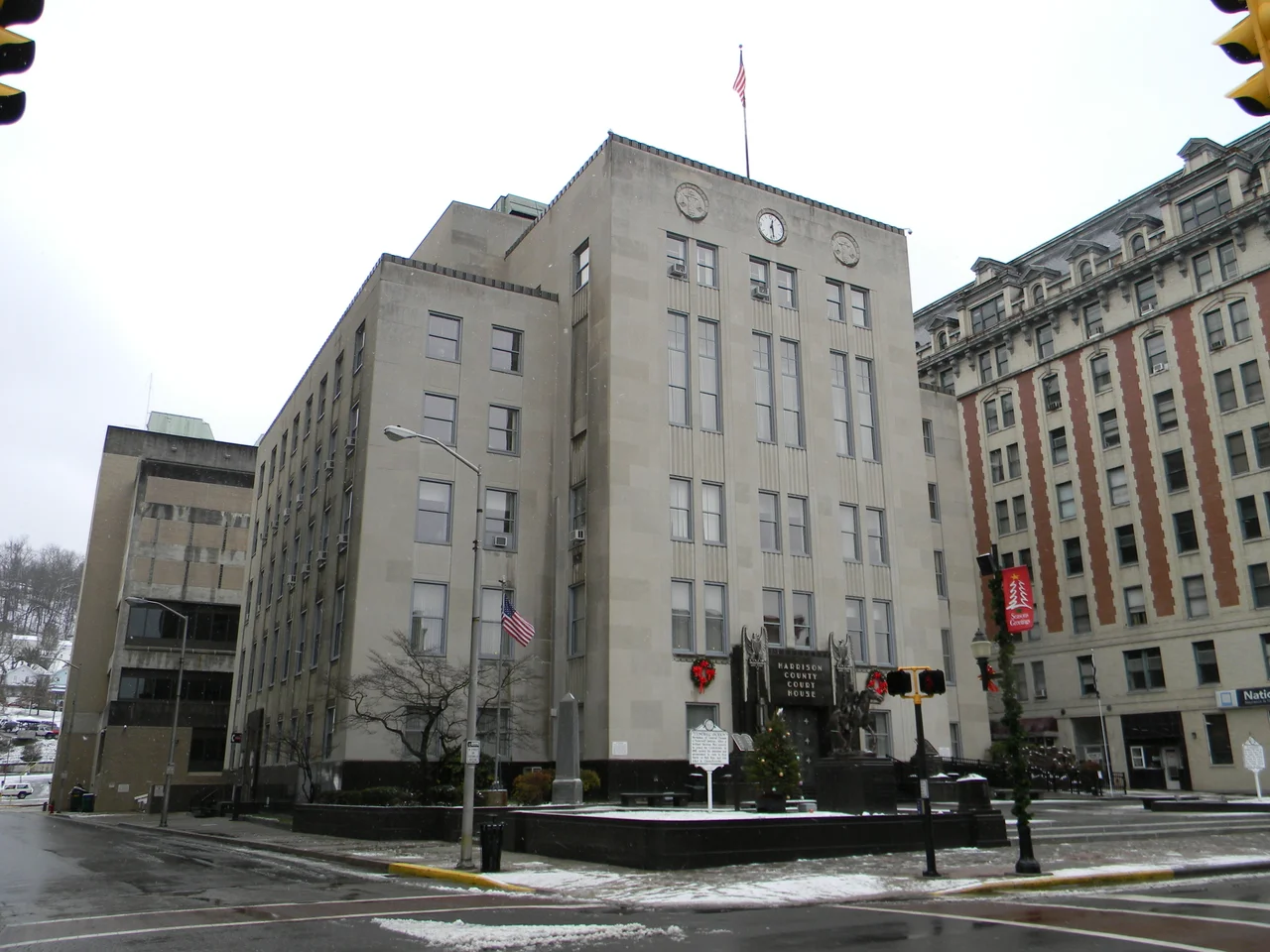

Clarksburg Downtown Historic District
When the railroad reached Clarksburg in the 1850s, the town was small and county-seat sleepy. When natural gas and oil were discovered in the surrounding hills in the 1890s, it became one of the boomtowns of the Appalachian basin. The buildings the boom produced - bank towers, hotels, a Renaissance Revival courthouse, the Robinson Grand theater, the Waldo Hotel - still occupy sixteen blocks of central Clarksburg, in a remarkably intact concentration of late-Victorian and early-twentieth-century commercial architecture. The Clarksburg Downtown Historic District, added to the National Register in 1982, covers 76 acres around the Harrison County Courthouse and contains 119 contributing buildings. It is one of the more substantial intact downtowns of its size and era in the eastern United States.
From Crossroads to Railroad Town
Clarksburg was founded in 1785 at a crossing of the West Fork River, near where Elk Creek joins it. For the first sixty years of its existence it was a modest county seat, dependent on the agricultural economy of the surrounding hills. The decisive change came with the Baltimore and Ohio Railroad's Parkersburg Branch, completed through Clarksburg in 1857, which connected the town to Baltimore in the east and to the Ohio River at Parkersburg in the west. The railroad transformed Clarksburg into a transshipment point for the coal, timber, and agricultural products of north-central West Virginia, and almost immediately the population began to grow. By 1880 the town had filled in the blocks around the courthouse with substantial brick commercial buildings, and the architectural ambition of the new construction was visibly higher than what the antebellum town had known.
Gas, Oil, and the 1907 Boom
The second wave came in the 1890s, when Pittsburgh-based geologists realized the country around Clarksburg sat atop major natural gas and oil reservoirs. Drilling began. Pipelines and pumping stations followed. By the early 1900s, Clarksburg had become one of the principal gas towns of the Appalachian basin, with derricks visible on the hillsides around the city and the smell of crude in the air. The wealth of the boom produced an extraordinary wave of urban construction. The Empire National Bank Building went up in 1907, the Goff Building in 1911, the Waldo Hotel in 1904, the Masonic Temple in 1914. Each was substantially larger and more architecturally ambitious than what the town had needed before. Banks competed to build the most impressive tower; merchants competed to occupy the most prestigious storefronts; civic buildings followed in the same scale.
Architecture Across Sixty Years
The district's contributing buildings span styles and decades. The Stealey-Goff-Vance House at the edge of downtown is a 1807 Federal-period residence that survived as the city grew around it. Waldomore, an 1839 brick mansion, is the oldest substantial residence in the city core. The First Presbyterian Church dates to 1894, the First Methodist to 1909, both in solid Late Victorian Gothic styles. The bank buildings of the 1900s and 1910s tend toward Renaissance Revival and Beaux-Arts, with arched windows, bracketed cornices, and formal classical facades that signaled stability and seriousness to depositors. The 1932 Harrison County Courthouse, designed in the Stripped Classical style of the Depression-era federal building program, anchors the civic core. The 1932 Post Office, in similar style, completes the depression-era civic ensemble. The Robinson Grand Theatre, rebuilt in 1939 in the Streamline Moderne style, is the boldest architectural statement in the district.
The Waldo and the Robinson Grand
Two buildings in particular have come to represent downtown Clarksburg. The Waldo Hotel, opened in 1904 and substantially expanded in 1907, was the largest and most prestigious hotel between Pittsburgh and Charleston for the first half of the twentieth century. Its lobby hosted oil barons, traveling salesmen, governors, and senators; its rooftop garden held dance bands; its function rooms were the venue for the city's principal social events. The Robinson Grand Performing Arts Center opened in 1913, was substantially enlarged in 1927, and was rebuilt after a 1939 fire in its present Streamline Moderne form. The theater seats about 1,100 and hosted vaudeville, silent film, talkies, and, after a major 2018 restoration, a renewed program of live performance. Together, the Waldo and the Robinson Grand testify to the cultural ambition of early-twentieth-century Clarksburg.
A Working Downtown
Unlike many small Appalachian cities, Clarksburg has not seen its downtown commercial core completely abandoned. The Harrison County Courthouse still operates; the Post Office still operates; the churches still hold Sunday services; the Robinson Grand still puts on shows. Several of the bank buildings have been repurposed - to law offices, restaurants, or mixed retail and residential. Vacancy is real but not pervasive. The 1982 National Register listing helped: it triggered federal tax credits for rehabilitation work and brought money and attention to historic preservation in a city that had previously been losing buildings to neglect. Three of the district's properties - the Nathan Goff Jr. House, the Stealey-Goff-Vance House, and Waldomore - are also individually listed on the Register, giving them additional protections. The cumulative effect, across forty years of preservation work, is a downtown that still reads as the substantial regional center it was when the gas boom built it.
From the Air
The Clarksburg Downtown Historic District covers a 76-acre area at approximately 39.28 N, 80.34 W in Harrison County, north-central West Virginia. Best viewed at 2,500-4,000 feet AGL; the dense concentration of multi-story commercial and civic buildings makes the downtown easy to identify against the surrounding residential blocks. Nearest airport: North Central West Virginia Airport (KCKB) about 5 nm east at Bridgeport. The West Fork River loops around the western edge of downtown; Elk Creek joins it at the southern edge. I-79 passes about 4 nm east of downtown; US-50 passes through the city.
Nearby Stories
- Buckhannon 9.3 km away
- North Bend Rail Trail 9.6 km away
- State of Kanawha 12 km away
- West Virginia Maneuver Area 13 km away
- Cathedral State Park 23 km away
- Battle of Fort Necessity 35 km away
- West Virginia Penitentiary 54 km away
- Gnadenhutten Massacre 102 km away