
Clarksburg, West Virginia
Stonewall Jackson was born in Clarksburg in 1824. So were a great many of the Italian-American grandparents whose descendants now populate the West Virginia Italian Heritage Festival, the largest such festival in the eastern United States, which takes over downtown Clarksburg every Labor Day weekend. The connection between the Confederate general and the Italian immigrants is geography, not biography: both belonged to Clarksburg at different stages of its history. The town began as an 1785 frontier settlement named for George Rogers Clark, became a railroad town in the 1850s, exploded into a gas-and-oil boomtown in the 1900s, and has spent the past sixty years trying to figure out what to do as suburbanization in nearby Bridgeport drained downtown of its retail and population.
Named for a General Who Never Came Back
George Rogers Clark was a Revolutionary War officer who led the audacious 1778-1779 campaign that captured the British forts at Kaskaskia and Vincennes in what is now Illinois and Indiana, securing the Old Northwest for the new United States. He was a household name in the years after the Revolution and a logical figure to name a new western settlement after - though Clark himself spent the rest of his life in Kentucky and Indiana and never visited the West Virginia town named for him. His brother William Clark, half of the Lewis and Clark Expedition, has more name recognition today; the older brother George Rogers has faded somewhat. Clarksburg was platted in 1785 along the West Fork River, at an elevation of about 1,000 feet, in a region of steeply rolling hills that the surveyors found mostly impossible to lay out in a regular grid.
Italian Glen Elk
The natural gas and oil discoveries of the 1890s and 1900s required labor. So did the glass factories that grew up around Clarksburg's gas supply, and so did the coal mines in the surrounding county. The labor came principally from southern Italy, particularly Calabria, Sicily, and Naples, through the great immigration wave between 1890 and 1924. Italian families settled in Clarksburg in numbers large enough to give the city one of the highest concentrations of Italian-Americans of any small city in the eastern United States. Most of them settled initially in Glen Elk, a tight neighborhood across Elk Creek from downtown that became - and largely remained - Clarksburg's Little Italy. Italian bakeries, groceries, and restaurants concentrated there; Italian-language Catholic services were held at St. James Church; the social clubs and fraternal organizations of the immigrant generation built halls that survive. The pepperoni roll, invented in nearby Fairmont in 1927 but produced today in dozens of Clarksburg bakeries, is the most visible legacy.
The Italian Heritage Festival
Since 1979, the West Virginia Italian Heritage Festival has taken over downtown Clarksburg every Labor Day weekend. It is the largest Italian-American festival in the eastern United States and one of the largest in the country, drawing more than a hundred thousand visitors over three days. The festival anchors itself in the spaces around the Harrison County Courthouse, with vendor booths along Main Street and stages set up in downtown plazas. There is a coronation of a festival queen, parades, a bocce tournament, the National Pasta Cookoff held in a downtown event facility, hot-pepper-eating contests, live music, and a great deal of food. The Saturday morning Italian Heritage Mass at Immaculate Conception Catholic Church draws families from across northern West Virginia. The festival has been a substantial economic event for the city and one of its principal sources of self-identity for nearly fifty years.
Downtown and the Suburbs
Clarksburg has lost about half its 1950 peak population to deindustrialization and suburbanization. The historic downtown has suffered a high vacancy rate in recent decades, with many of the grand buildings from the gas-boom era struggling to find tenants. The civic center of gravity has shifted east to Bridgeport, the suburb on the other side of I-79, where new development along Emily Drive - a five-mile string of big-box retail, hotels, and chain restaurants - now serves as the retail center of Harrison County. Bridgeport has grown as Clarksburg has declined; the two cities together still hold the same regional population, but it has redistributed. Preservation efforts in downtown Clarksburg have had real successes - the Robinson Grand Theatre's 2018 restoration is the most prominent - but the long-term trajectory remains uncertain. The buildings of the 1907 boom are still there. Whether they will all survive the twenty-first century is an open question.
What to See If You Stop
A visitor to Clarksburg has more to see than the population numbers suggest. The Downtown Historic District covers sixteen blocks of late-nineteenth-century commercial and civic architecture; the 1932 Stripped Classical Harrison County Courthouse anchors the central plaza, where a statue of Stonewall Jackson on horseback marks the city's most famous native son. The 1904 Waldo Hotel, the Robinson Grand, and the Empire Bank Building represent the gas-era ambition. The Glen Elk Historic District north of Elk Creek preserves the Italian immigrant neighborhood. The Ten Mile Creek Covered Bridge, west of town off US-50, is an 1891 wooden truss bridge restored in 2002. Stonewall Jackson Lake State Park lies thirty minutes south; Jackson's Mill and the West Virginia State Wildlife Center are roughly an hour away. The Clarksburg Exponent Telegram, the local paper, reports on a city that is both diminished and stubbornly persistent.
From the Air
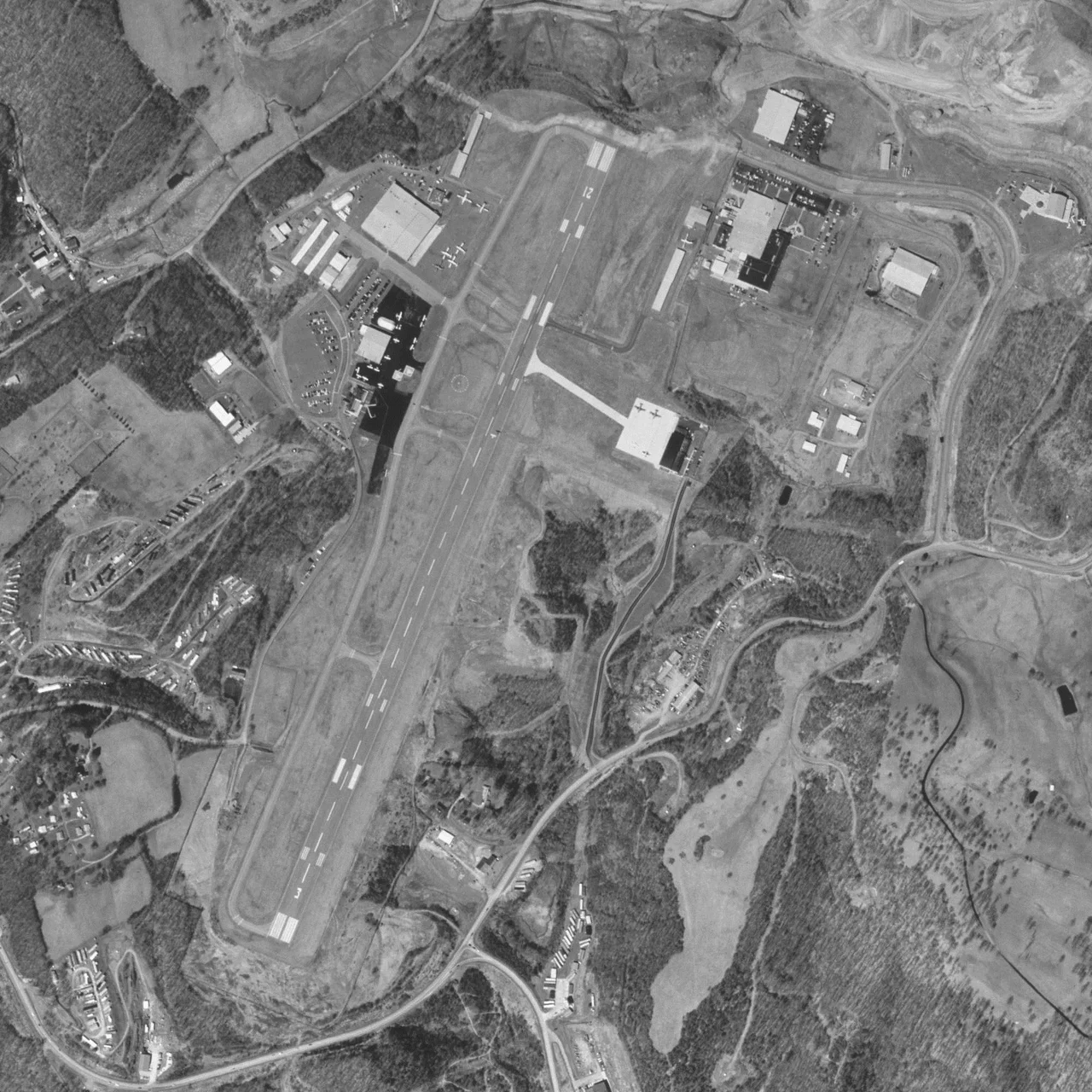
Clarksburg is at 39.28 N, 80.34 W in Harrison County, north-central West Virginia. Best viewed at 2,500-4,000 feet AGL; the West Fork River loops around downtown, and the dense concentration of historic commercial buildings is recognizable against the suburban Bridgeport development to the east. Nearest airport: North Central West Virginia Airport (KCKB) about 5 nm east at Bridgeport, with Allegiant and Silver Airways service. I-79 traces a clear north-south line east of the downtown; US-50 passes through the city west to east. Elk Creek joins the West Fork River near downtown.
Nearby Stories
- Buckhannon 9.3 km away
- North Bend Rail Trail 9.6 km away
- State of Kanawha 12 km away
- West Virginia Maneuver Area 13 km away
- Cathedral State Park 23 km away
- Battle of Fort Necessity 35 km away
- West Virginia Penitentiary 54 km away
- Gnadenhutten Massacre 102 km away