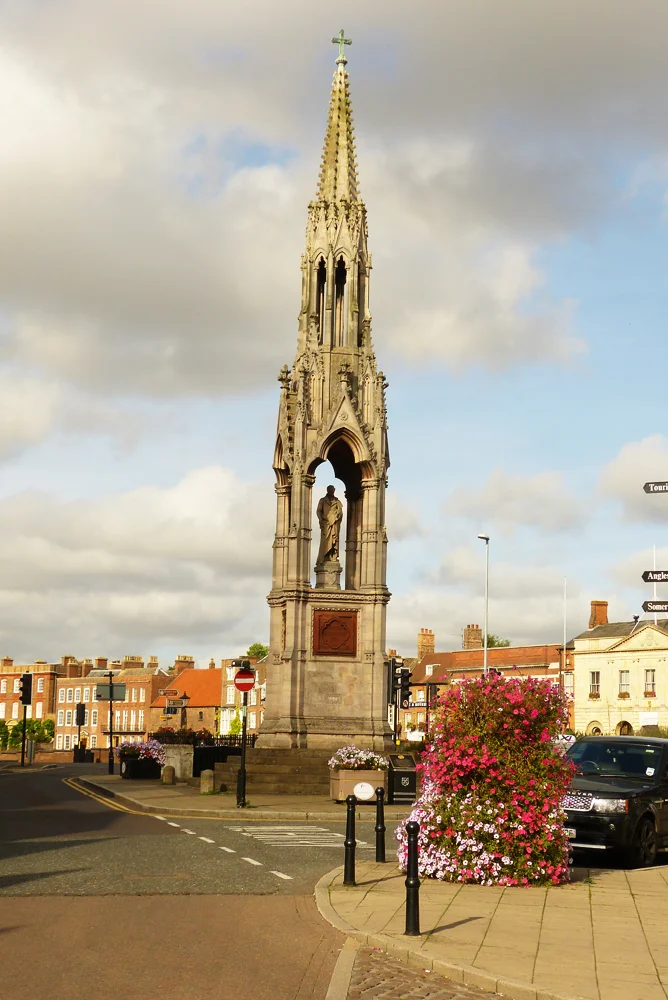

Clarkson Memorial
Thomas Clarkson was a student at St John's College, Cambridge in 1785 when he entered an essay competition on the question: "Is it right to make slaves of others against their will?" He won the prize. Then he could not stop thinking about what he had written. He spent the next two decades gathering evidence, interviewing sailors, collecting samples of African goods and textiles to argue that trade with Africa could flourish without enslaving its people — and he helped build the political movement that led, in 1807, to the Abolition of the Slave Trade Act. The town where he was born erected a monument to him in 1881. It stands on the South Brink of the River Nene, 68 feet tall, impossible to miss.
A Son of Wisbech
Thomas Clarkson was born in Wisbech in 1760, the son of the Reverend John Clarkson, headmaster of Wisbech Grammar School. He attended his father's school before going on to St Paul's School in London in 1775. The essay he wrote at Cambridge on the morality of enslaving others was not an abstract exercise — it became the pivot point of his life. He turned the abolition campaign into, in the words of contemporaries, "one of the major issues of the day," working alongside William Wilberforce and Granville Sharp, both of whom appear in carved bas-relief on the memorial. Clarkson lived until 1846, long enough to see his life's work extended — the Slavery Abolition Act abolishing enslavement throughout most of the British Empire passed in 1833. He died at 86, having outlasted the institution he had spent his life fighting.
The Structure
The Clarkson Memorial stands on the site of the old Customs House, which had been built in 1801 and was itself demolished in 1856 during bridge improvements. Work on the memorial began on 28 October 1880 and the statue was unveiled on 11 November 1881 by Sir Henry Brand, Speaker of the House of Commons and MP for Cambridgeshire. The total cost was £2,035, paid primarily through a substantial donation from the Peckover family — local Quaker philanthropists who were among Wisbech's most prominent citizens — with the remainder raised by public subscription. The design was adapted from one by Sir George Gilbert Scott, the architect responsible for the Martyrs' Memorial in Oxford and the Albert Memorial in Hyde Park, who had proposed it in 1875. Scott died before construction began; his son John Oldrid Scott oversaw the execution.
Three Faces of Justice
The memorial's four sides each tell part of the story. On three sides, carved bas-reliefs represent the principal figures of the abolition campaign: William Wilberforce, the parliamentarian who steered the bills through Westminster; Granville Sharp, the legal scholar whose earlier work had established that enslaved people brought to England could not legally remain enslaved; and a figure the memorial depicts as a manacled enslaved person in a beseeching attitude — a representation that captures how abolitionists of the era visualized their cause. The fourth side bears the inscription to Clarkson's memory. The Wisbech and Fenland Museum keeps Clarkson's chest — a physical collection he assembled of 18th-century African textiles, seeds, and leatherwork that he used to make his argument for direct trade with Africa as an alternative to the slave trade.
Town Memory
The memorial is not simply a historical artifact. Every year, the town's Remembrance Day parade uses it as the saluting point — a marker of civic dignity in a town that takes its connections to moral history seriously. Two schools in Wisbech carry Clarkson's name, as does a road. A four-year renovation project was completed in 2011, and a new panel was installed to mark the memorial's 130th anniversary. Near his former home on Bridge Street, the structure stands where the old Customs House stood, where before that the Buttermarket stood — a location that has always been the beating commercial and civic heart of the town along the river. The memorial's position is not incidental. This is where Wisbech faces itself.
From the Air
The Clarkson Memorial is located at approximately 52.66°N, 0.16°E on the South Brink of the River Nene in Wisbech, Cambridgeshire. The 68-foot Gothic spire would be visible from low-level passes over the town center. Wisbech sits at the intersection of the A47 and A1101 roads. Nearest airports: Peterborough/Conington (KNS) approximately 20 miles southwest, and Cambridge (CBG) approximately 35 miles south. The flat Fenland terrain makes the town's landmarks visible from a considerable distance.
Nearby Stories
- RAF North Pickenham 2.8 km away
- RAF Witchford 3.7 km away
- Burnham Market 4.3 km away
- RAF Honington 6.5 km away
- Burghley House 6.9 km away
- Sleaford 10 km away
- Boston Guildhall 15 km away
- Wellingborough 25 km away