
Coast Guard Air Station Elizabeth City
A Coast Guard pilot once described the call as the kind you remember for the rest of your career: a fishing boat going down in the Gulf Stream, two hundred miles offshore in heavy weather, the only platform that could reach them an HC-130J Hercules climbing out of Elizabeth City. The Hercules dropped a survival pump. The crew kept the boat afloat long enough for an MH-60T Jayhawk - also from Elizabeth City - to reach them and pull every person off the deck. That is the daily geometry of Coast Guard Air Station Elizabeth City: long-range Hercules and medium-range Jayhawks operating together across an ocean's worth of empty water, from Greenland to the Azores to the Caribbean.
Commissioned 1940
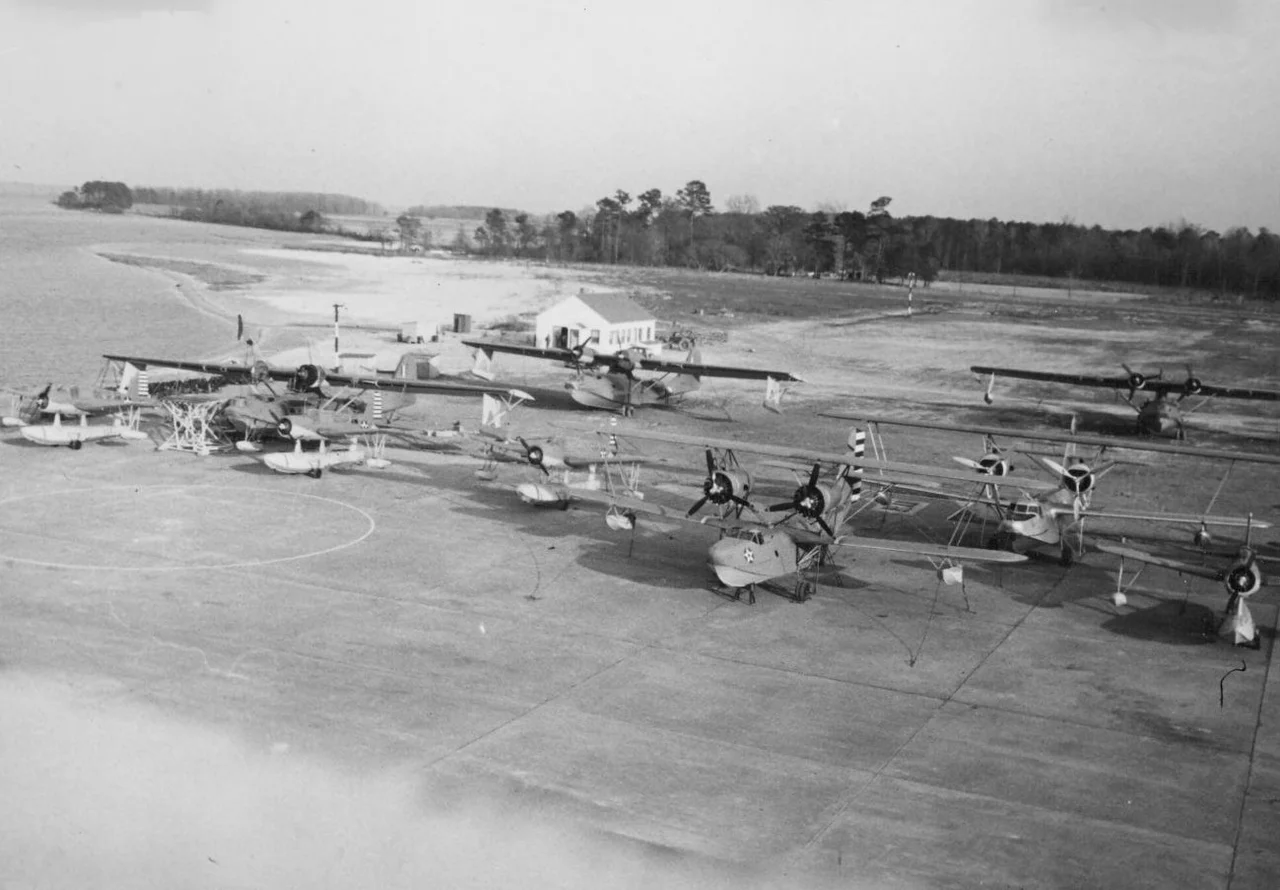
On August 15, 1940, Coast Guard Air Station Elizabeth City stood up with four officers, fifty-two enlisted men, and ten aircraft - three Hall PH-2 seaplanes, four Fairchild J2K landplanes, and three Grumman J2F Duck amphibians. The site had been picked in 1938 by Coast Guard planners looking at a map and seeing what aviators see: an ice-free river, the northernmost on the East Coast that does not freeze, sheltered water for seaplane operations, and a position sixty miles north of Cape Hatteras - close enough to the Gulf Stream traffic lanes that mattered, far enough from the open Atlantic that weather did not shut you down. The land they wanted was called Bayside Plantation. It was owned by the Hollowell family. The Coast Guard bought it. Within a year, the airfield was running anti-submarine patrols against German U-boats - the wolf packs that would sink dozens of merchant ships within sight of the North Carolina coast in 1942.
Sister Station at Weeksville
Two miles southeast, Naval Air Station Weeksville operated lighter-than-air airships from 1941 to 1957 - the great wartime blimps that lumbered out over the convoy lanes hunting submarines from above. During the war, Elizabeth City was under Navy control, flying search and rescue, anti-submarine patrols, and training missions alongside the Weeksville blimps. The steel blimp hangar at Weeksville still stands - one of the last surviving WWII airship hangars in the country; the wooden companion hangar, once among the largest clear-span wooden structures ever built, burned to the ground in 1995. The blimps are gone. After the war, the Coast Guard regained the station and aviation absorbed the missions that the airships had carried. In 1966 the air station expanded again, absorbing the Coast Guard air stations at Kindley AFB in Bermuda and NAS Argentia in Newfoundland - taking on long-range Atlantic patrols that had been split among other bases.
Hercules and Jayhawk
Today the airfield operates five HC-130J Hercules and four MH-60T Jayhawk helicopters. The Hercules is a four-engine turboprop with a 3,000-mile range and a search radar that can map a ship in a storm at fifty miles; the Jayhawk is a long-range twin-turbine helicopter with hoist and rescue swimmer capability. Together they cover an operating area that runs from the Greenland Sea to the Caribbean. International Ice Patrol - the mission that arose after the Titanic sank in 1912 - is one of the Elizabeth City taskings: HC-130 crews track icebergs in the North Atlantic to warn shipping. They also handle Maritime Law Enforcement intercepts, aids-to-navigation flights, marine environmental response (those calls about oil spills), and the bread-and-butter search and rescue that occupies most of the flight hours. The base is consistently rated one of the busiest in the Coast Guard.
On Screen, In Life
In 2006, the station stood in for Coast Guard Air Station Kodiak, Alaska, in the Ashton Kutcher and Kevin Costner film The Guardian. The crew that helped make that movie work was the same crew that, between takes, was launching real rescues into real ocean. In 2018 an Elizabeth City Jayhawk and four base personnel appeared in the pilot episode of Amazon's Jack Ryan reboot - the helicopter landing in the backyard of a dinner party, an Aviation Survival Technician and Aviation Maintenance Technician stepping out. Fiction borrowing the real thing, briefly. The bigger truth is the one the cameras do not catch: a hundred and one calendar years after Coast Guard aviation began, men and women fly out of Elizabeth City night after night into weather that other aviation does not fly in, looking for people other aviation cannot reach.
From the Air
Coordinates 36.26 N, 76.18 W. ICAO KECG, joint-use with Elizabeth City Regional Airport. Recommended viewing altitude 1,500-3,000 feet to read the long single runway and the Pasquotank River frontage with seaplane apron. Active military airfield - check NOTAMs and avoid the restricted airspace immediately around the station. Norfolk approach handles regional traffic. Nearest civilian fields: Dare County Regional (KMQI) 28 nm southeast on Roanoke Island, Currituck County Regional (KONX) 22 nm north, Edenton (KEDE) 25 nm southwest. Marine layer common in mornings; afternoon thunderstorms in summer.
Nearby Stories
- Chowan River 2.8 km away
- False Cape State Park 21 km away
- Bodie Island Lighthouse 24 km away
- Hertford County, North Carolina 31 km away
- Coastal Virginia Offshore Wind 38 km away
- Roanoke Colony 38 km away
- Nat Turner's Rebellion 52 km away
- Battle of the Chesapeake 75 km away