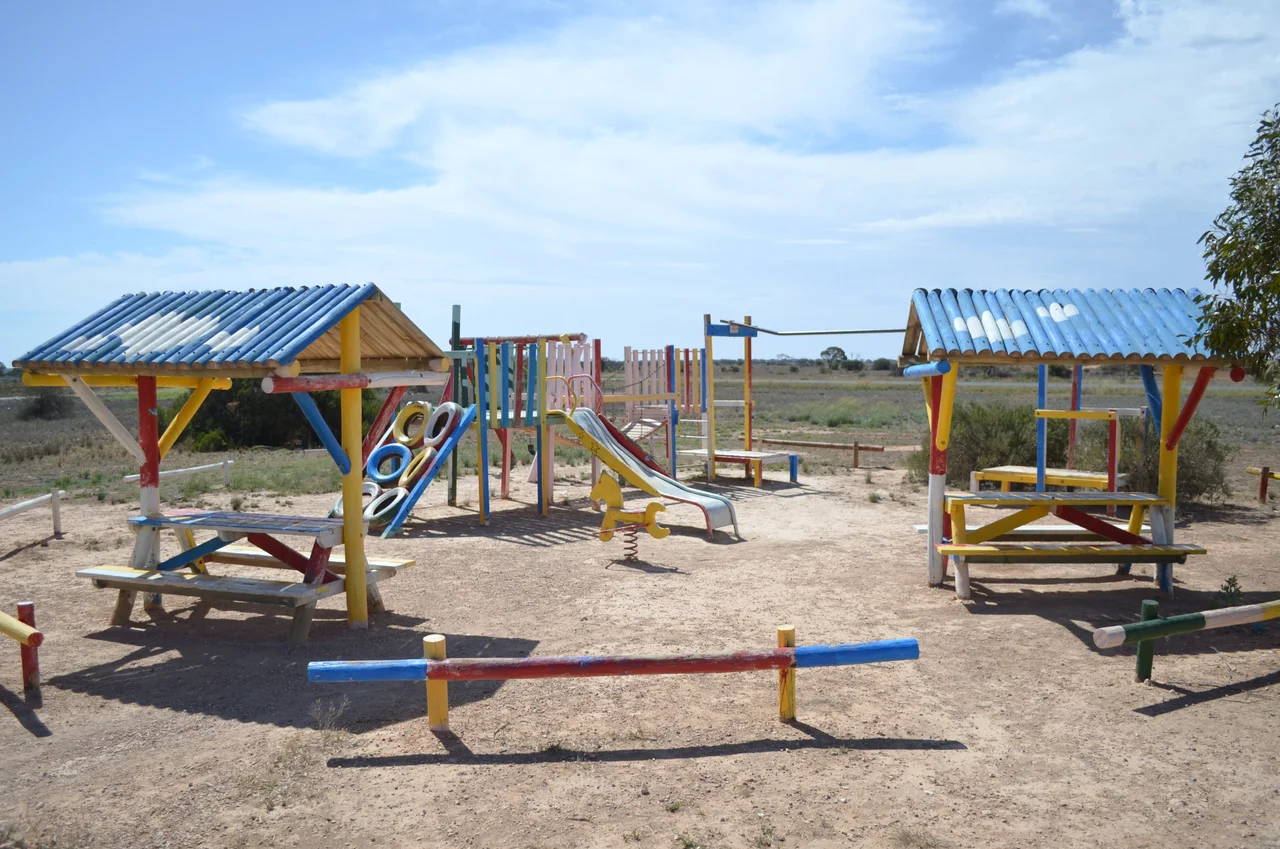

Cocklebiddy, Western Australia
From the Eyre Highway, Cocklebiddy looks like almost nothing: a fuel bowser, a roadside diner, a scatter of buildings shimmering in the heat 284 kilometres short of the South Australian border. Drive past in ten seconds and you would never guess that beneath the flat limestone you just crossed runs a flooded tunnel more than six kilometres long, dark and silent, where some of the boldest divers in the world once went looking for the edge of the possible. The third stop east of Norseman is the kind of place where the real story is underground.
The Tunnel Beneath the Plain
Cocklebiddy Cave is a single passage, mostly submerged, that bores away from a sinkhole entrance into blackness. Around ninety percent of it lies underwater, reachable only by cave divers willing to swim hundreds of metres from daylight with no easy way back. In September 1983 a French team laid line deep into the third flooded chamber and claimed the world record for the longest cave dive. Two months later an Australian expedition led by Ron Allum, with Hugh Morrison pushing the far line, swam past the French marker and extended the record to roughly 6.24 kilometres of penetration from the surface. South Australian diver Christopher Brown nudged it another twenty metres in 1995. Each advance was measured in metres, won at the limit of human endurance.
Divers Who Became Heroes
In late 2008 a team returned to map the cave's most distant reaches using rebreathers, which recycle a diver's breath to allow far longer dives, and radio-location "pingers" devised by Ken Smith to fix their position through solid rock. Two of those explorers were Craig Challen, a Western Australian, and Richard Harris, a South Australian. A decade later their names travelled the world. In 2018 the pair joined the rescue of a youth football team trapped deep inside Thailand's flooded Tham Luang cave, sedating and guiding the boys out one by one through water that had already killed a rescuer. They were jointly named Australians of the Year in 2019. The skills that saved those children were honed in places exactly like the dark water under Cocklebiddy.
Water That Lies
Water has always set the terms of life out here. Cocklebiddy began as an Aboriginal mission station, and today only stone foundations remain to mark it. During World War II, army engineers came hoping the local lakes might supply fresh water, but the ground played a cruel trick: a thin skin of fresh water floated atop a vast reservoir of brine, and the dream of a desert oasis dissolved into salt. The surrounding country is rich in its own quiet way. Twenty kilometres to the south-west, botanists found a plant new to science, the tussock-like Harperia eyreana, formally described in 2000. The Nullarbor only looks empty to people in a hurry.
A Clock of Its Own
Cocklebiddy keeps a time almost nobody else uses. Along this isolated strip of the Eyre Highway, communities set their watches to UTC+8:45, an unofficial "Central Western" zone wedged forty-five minutes ahead of the rest of Western Australia. There is no law behind it, only the practical logic of people living far from anywhere who decided the standard clock did not suit a sunrise this far east. The nearest coast, Twilight Cove, lies twenty-six kilometres south, where the limestone plain breaks off in cliffs above the Southern Ocean. In 2007 the Australian comedy duo Hamish and Andy rolled through, briefly putting this speck on the national map. Then the highway emptied again, the way it always does.
From the Air
Cocklebiddy sits at 32.04°S, 126.10°E on the Nullarbor Plain of Western Australia, hard against the Eyre Highway, which runs dead straight across the limestone for tens of kilometres in either direction and is your best visual reference from the air. The Southern Ocean coastline and Twilight Cove lie about 26 km south. There is no nearby airfield of consequence; the closest sealed runways are at Forrest (YFRT) on the Trans-Australian Railway line to the north and the airstrip at Caiguna to the west. Expect clear, dry conditions and exceptional visibility for most of the year; the flat, featureless terrain offers little to navigate by except the highway, the coastal cliffs, and the occasional roadhouse roof catching the sun.
Nearby Stories
- Arubiddy Station 10 km away
- Caiguna Airport 21 km away
- Roe Plains 24 km away
- Baxter Cliffs 82 km away
- Rawlinna Station 91 km away
- Trans-Australian Railway 94 km away
- Point Culver 141 km away
- Great Australian Bight 330 km away