
Faces in the Glass
When the Odd Fellows' Hall at Third and D Streets in Marysville was demolished in the 1970s, no one thought much about what was stored inside. Scattered among the debris were glass plate negatives -- hundreds of them -- recording the faces of Yuba-Sutter residents stretching back to the 1860s. Photographers had worked out of that building for nearly a century, from L.J. Stinson in the Civil War years to Earl Cilley in the 1930s, each leaving behind fragile plates that captured miners, merchants, families, and children in silver and glass. Some of the negatives were lost. Others found their way to a small museum on Butte House Road in Yuba City, where a photographer named Allan Lamb spent hundreds of hours scanning and printing them. The portraits he recovered -- sharp, luminous, startlingly intimate -- became an exhibition called "Portraits From Glass: Faces of Yuba-Sutter." The building that housed those negatives is gone. The faces survived.
A Gift on Butte House Road
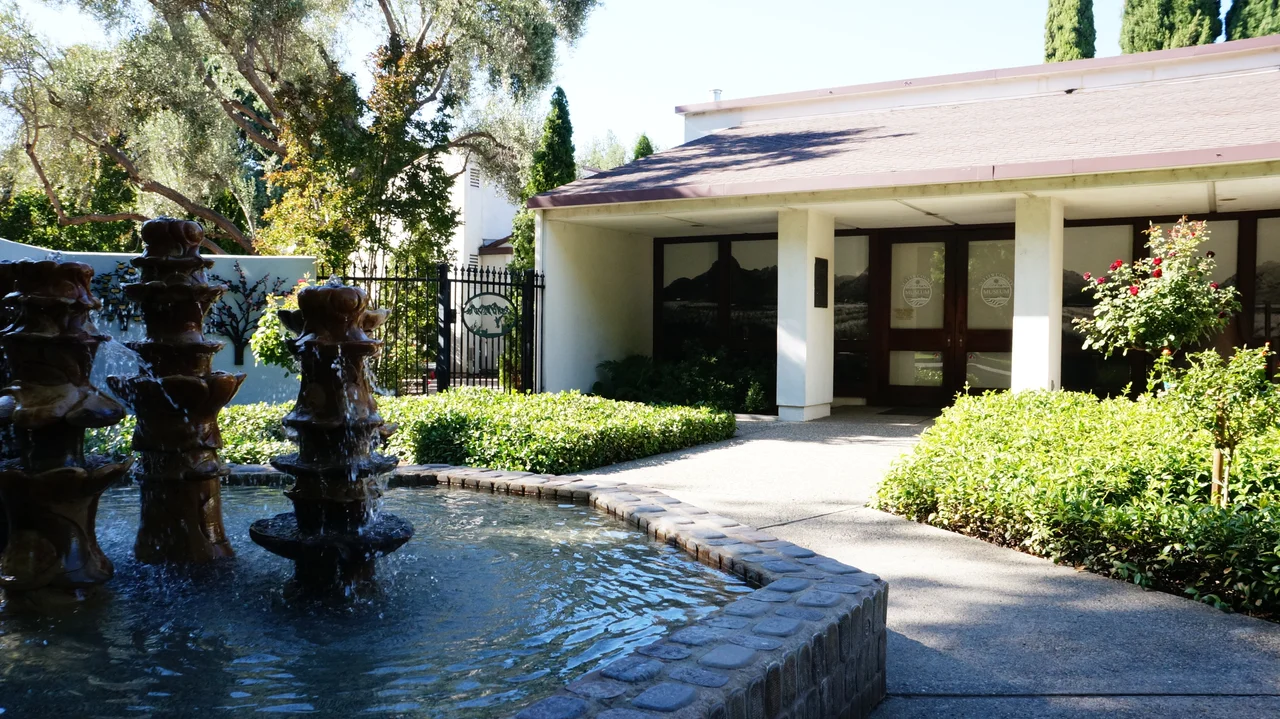
The Sutter County Museum exists because two people decided their community deserved a place to remember itself. Howard and Norma Harter, along with the Sutter County Historical Society and other private donors, funded the construction of a museum at 1333 Butte House Road in Yuba City. In 1975, they presented the finished building to the Sutter County Board of Supervisors as a gift -- no strings, no naming rights controversy, just a museum for the public. The county accepted and has operated it as a government department ever since, offering free admission. The building has been expanded multiple times over the decades, always through private generosity, growing from a modest storehouse of local artifacts into a facility with permanent galleries, rotating exhibitions, and educational programming. It remains one of the few county-run museums in California that charges nothing to walk through its doors.
The People Who Were Here First
The museum's most significant permanent exhibit tells a story that predates the Gold Rush by thousands of years. "The Nisenan: A History of the Sacramento Valley" was created in partnership with tribal members and includes artifacts specifically made for display -- not relics extracted from a vanished culture, but objects crafted by living people to represent a continuing one. Nisenan means "from among us" in the Nisenan language, a name that carries quiet insistence: we are still here. The Nisenan people lived throughout the Sacramento Valley and into the Sierra foothills long before John Sutter arrived in 1839 to establish his colony. When Sutter's workers discovered gold at Coloma in 1848, the resulting stampede -- a hundred thousand newcomers within a year -- devastated Nisenan communities. Disease, displacement, and violence reduced their population catastrophically. That the museum tells this story with tribal voices, not just archaeological labels, reflects a decision about whose history matters.
From Sutter's Ambition to Sutter County's Harvest
The county takes its name from John Sutter, the Swiss-born entrepreneur whose sprawling land grant, Rancho New Helvetia, anchored European settlement in the Sacramento Valley. Sutter's story is one of ambition undone by the very discovery that made his name famous: the Gold Rush destroyed his agricultural empire as squatters overran his lands and his workers abandoned the fields for the diggings. The museum traces this irony through its permanent exhibits, following the valley's evolution from Sutter's failed utopia through the agricultural boom that eventually defined the region. Yuba City and the surrounding area became one of California's most productive farming districts, growing peaches, walnuts, rice, and prunes. The multicultural wing of the museum explores the communities that powered this transformation -- Punjabi Sikh farmers, Japanese American families, Chinese laborers, and Mexican farmworkers whose stories braided together into the valley's modern identity.
Small Museum, Long Memory
County museums rarely make headlines, and the Sutter County Museum is no exception. It does not hold a Rembrandt or a dinosaur skeleton. What it holds is harder to replace: the specific, granular, unglamorous memory of a single place. The glass plate negatives rescued from the Odd Fellows' Hall capture people who left no other record -- no memoirs, no famous descendants, no Wikipedia entries. A woman in a high collar stares into the lens of a camera operated by Enno Nesemann sometime in the 1880s. A child sits stiffly in a photographer's chair in Clara Sheldon Smith's studio around 1905. These are not important people in any conventional sense. They are the people who lived here, and this museum is where their faces are kept. In a valley that has reinvented itself repeatedly -- from Nisenan homeland to Sutter's colony to Gold Rush boomtown to agricultural powerhouse -- the museum serves as the place where none of those layers gets discarded.
From the Air
Located at 39.147N, 121.636W in Yuba City, at 1333 Butte House Road, on the west bank of the Feather River across from Marysville. Yuba County Airport (KMYV) is approximately 5nm east-southeast. Sacramento International (KSMF) lies about 30nm south-southwest. The Feather River is the dominant visual landmark, dividing Yuba City from Marysville. From 2,000-3,000 feet AGL, the museum sits within the residential grid west of the river, near the distinctive curve of Butte House Road.
Nearby Stories
- Sutter's Mill 6.5 km away
- Where a Quarter Million Wings Converge 6.7 km away
- Feather River 15 km away
- Yocha Dehe Wintun Nation 17 km away
- Oroville Dam 18 km away
- Malakoff Diggins State Historic Park 28 km away
- Western Pacific Railroad Museum 62 km away
- August Complex Fire 73 km away