.jpg)
Where a Quarter Million Wings Converge
Every November, the sky above Colusa County darkens. Not with clouds, but with birds -- pintails, mallards, teal, snow geese -- descending by the hundreds of thousands onto a patchwork of managed wetlands seventy miles north of Sacramento. The sound reaches you before the sight does: a rolling, layered cacophony of honks and wing beats that seems to press the air itself into something heavier. This is Colusa National Wildlife Refuge, one of six refuges in the Sacramento National Wildlife Refuge Complex, and for a few months each winter it becomes one of the most densely populated stretches of waterfowl habitat in the western hemisphere.
An Engineered Eden
Nothing about Colusa's 4,507 acres is accidental. The wetland impoundments that sprawl across the refuge floor are intensively managed -- flooded, drained, and reflooded on schedules calibrated to mimic the seasonal rhythms that once governed the entire Sacramento Valley. Before agriculture transformed the Central Valley into one of the world's most productive farming regions, these wetlands extended for hundreds of thousands of acres, fed by seasonal flooding from the Sacramento River and its tributaries. What remains is a fraction of that original expanse, and the refuges of the Sacramento complex now carry the ecological burden that an entire landscape once shared. At Colusa, water control structures, levees, and carefully timed plantings create the shallow-water habitat that wintering waterfowl require -- flooded fields thick with smartweed, swamp timothy, and watergrass that provide both food and shelter.
The Winter Assembly
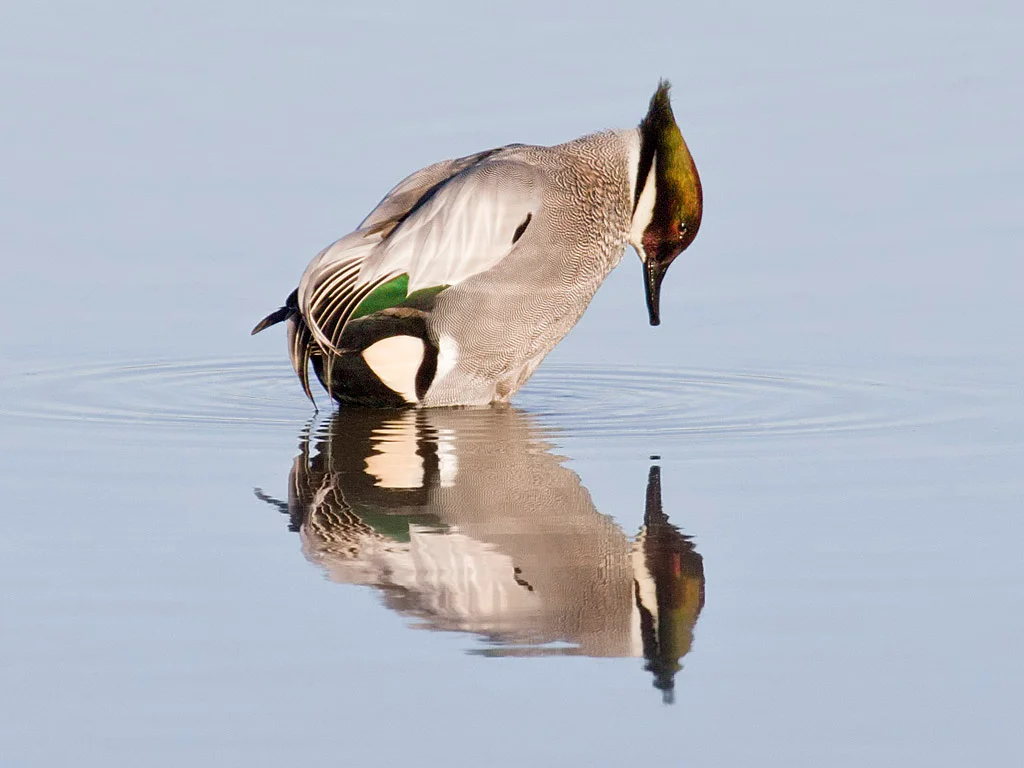
The numbers tell part of the story. More than 150,000 ducks and 60,000 geese crowd into the refuge each winter, concentrations so dense that individual flocks merge into shifting, undulating masses visible from miles away. But numbers flatten what is, in reality, a spectacle of choreography. At dawn, skeins of snow geese lift off the water in waves, the sound of their departure building like distant applause. Northern pintails, among the most elegant of North American ducks, thread through the air in tight formations. Green-winged teal rocket low across the impoundments in sudden, synchronized bursts of speed. For the roughly 35,000 visitors who come each year to watch, and the 4,000 hunters who come to participate in managed waterfowl seasons, the refuge offers something increasingly rare: a glimpse of what the Central Valley looked like before ninety-five percent of its wetlands disappeared.
Survivors on the Margins
The waterfowl get the attention, but Colusa's grasslands harbor species fighting quieter battles for survival. The palmate-bracted bird's beak, a small flowering plant listed as federally endangered, finds one of its last strongholds in the alkaline grasslands at the refuge's edges. Its survival depends on conditions so specific -- saline soils, particular moisture levels, open ground free from invasive grasses -- that only a handful of sites in California can support it. Below the surface, the giant garter snake, a threatened species endemic to the Central Valley's wetland-grassland interface, hunts for frogs and small fish in the refuge's ditches and marshes. Once common throughout the valley, this snake has lost most of its habitat to rice fields and urban development. At Colusa, the managed cycle of flooding and drying that serves the ducks also sustains the snake, an unintended beneficiary of waterfowl management.
A Refuge from the Refuge's Absence
The Sacramento Valley once held wetlands so vast that early explorers described an inland sea. Tule marshes stretched unbroken for dozens of miles, and the seasonal floods that fed them supported not just waterfowl but entire ecosystems of fish, amphibians, and riparian woodland. Over the past century, drainage, diversion, and conversion to agriculture eliminated ninety-five percent of those wetlands. What the Sacramento National Wildlife Refuge Complex preserves -- Colusa among its six units -- is not wilderness in any pristine sense. It is a managed reconstruction, an engineered approximation of what was lost, maintained through constant human intervention. The irony is not lost on the biologists who work here: the birds that once chose freely among millions of acres of habitat now depend on a few thousand acres of government-managed impoundments to survive the winter. That dependency makes places like Colusa not merely valuable but essential, the difference between a flyway that functions and one that collapses.
From the Air
Located at 39.16N, 122.04W in Colusa County, approximately 70 miles north of Sacramento. The refuge's wetland impoundments are clearly visible from 2,000-4,000 feet AGL as a grid of rectangular ponds and levees amid agricultural fields. Colusa County Airport (O08) is approximately 5nm east. Sacramento International (KSMF) lies roughly 55nm south-southeast. During winter months (November-February), massive flocks of waterfowl are visible from altitude, and pilots should be aware of dense bird activity below 3,000 feet AGL in the vicinity.
Nearby Stories
- Hoberg's Resort: Where Big Bands Played the Pines 2.6 km away
- Faces in the Glass 3.9 km away
- Feather River 7.2 km away
- Clear Lake: California's Ancient Inland Sea 13 km away
- Yocha Dehe Wintun Nation 13 km away
- Oroville Dam 23 km away
- Bidwell Mansion State Historic Park 49 km away
- The Asbill Massacre 64 km away