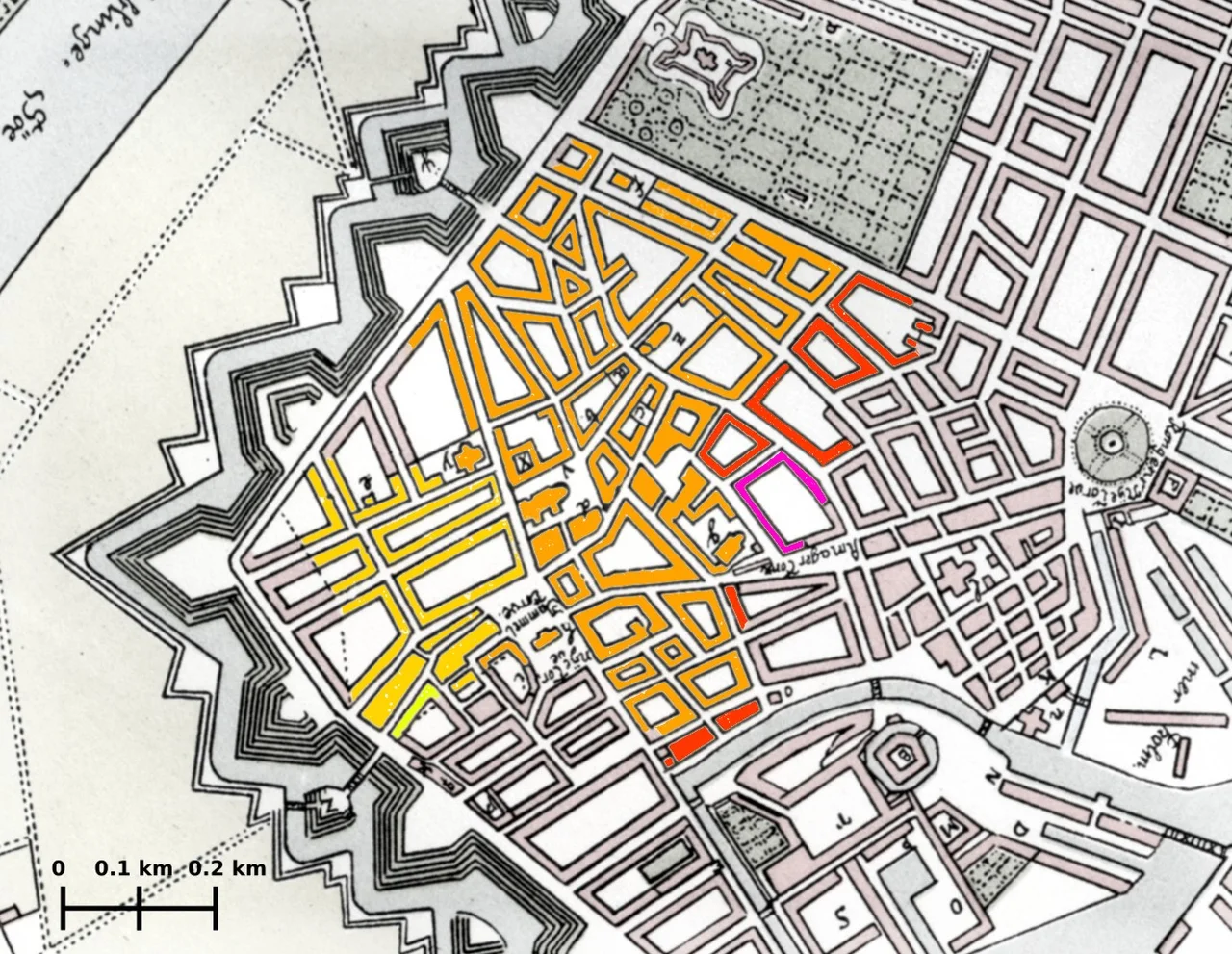

Copenhagen Fire of 1728
Around half past seven on the evening of 20 October 1728, on the second floor of a small house at the corner of Vester Kvarter, a candle fell over. The restaurant manager Peder Rasmussen and his wife Anne Iversdatter later told inquiries that their seven-year-old son had upset it — though the inquiry's officials, and most historians since, suspect the parents were casting candles themselves and blamed the boy to escape punishment. Whoever knocked the candle over, the flame caught quickly. The watchmen heard the alarm. The fire pumps would not fit down the narrow streets of Vester Kvarter. The wind was blowing southwest. By dawn the fire had crossed Vestergade and was spreading along five different streets. By the time it stopped four days later, almost half of medieval Copenhagen was gone.
Wednesday Night, Thursday Morning
The first night, the fire ran along Lille Sankt Clemens Stræde and Store Sankt Clemens Stræde and through Vombadstuestræde and Hellig-Kors Stræde. By 9 p.m. the main street of Vestergade was burning on both sides. The fire reached Sankt Peders Stræde, where it engulfed the Valkendorfs Kollegium dormitory and Professor Peder Horrebow lost most of his possessions. A second fire broke out at a brewery on Nørregade, possibly between ten and eleven that evening, while the original fire was still being fought at Gammeltorv. By midnight the wind shifted to the west and the situation on Nørregade turned critical. Early Thursday morning the city authorities tried to blow up buildings with black powder to create firebreaks. The first attempt failed catastrophically when the gunpowder ignited while men were still carrying in the charges; people were killed and the explosion spread the fire to nearby buildings, including the medieval Vor Frue Kirke — the Church of Our Lady. By 9:30 a.m. the church spire had fallen into the street, and inside the church the personal possessions townspeople had carried there for safekeeping were lost.
What the Fire Took
By Thursday afternoon the fire had reached Trinitatis Kirke, the church whose attic housed the University of Copenhagen library. When the ceiling collapsed around 10 p.m., the entire library went into the flames. Thirty-five thousand texts and a vast archive of historical documents were lost in a single hour. Original works by the Danish historians Hans Svaning, Anders Sørensen Vedel, Niels Krag, and Arild Huitfeldt; original notes and instruments by the scientists Ole Worm, Tycho Brahe and Ole Rømer; the Atlas Danicus by Peder Hansen Resen; the archive of the Diocese of Zealand, which had been moved to the library that very same day. The Round Tower above the library — the Rundetårn — survived structurally, but the observatory at its top burned out and Brahe's and Rømer's instruments were destroyed. A few hours later the Helligåndskirken was burning; at 8 p.m. its carillon bells rang the half-hour as they always did, playing Thomas Kingo's hymn Vreden din afvend, herre Gud, af Naade — Turn your anger, Lord, by mercy — just before they crashed into the fire below. Old Copenhagen city hall, then standing between Nytorv and Gammeltorv, burned around 10 a.m. Thursday.
The Wind Finally Turns
On Friday morning the wind shifted again, this time to the north, and the firefighting briefly began to look organised — until the fire took the soap factory on Magstræde at noon, after which it spread west toward Nybrogade and Gammel Strand and east into Klareboderne and Møntergade. Poul Fechtels Hospital on Møntergade burned with some of the residents still inside. Professor Ludvig Holberg — the great Norwegian-Danish playwright and historian — had to flee his home on Købmagergade. Saturday night the wind finally died. Thirty-six homes were marked for demolition to create a firebreak, and this time it worked, stopping the fire at the corner of Store Regnegade and Gothersgade. The total: 1,227 lots and about 1,600 buildings destroyed in three and a half days, roughly 28 per cent of the city by lots, and 47 per cent of the medieval section. About 15,000 people — perhaps a fifth of Copenhagen's population of 70,000 — were left homeless as winter approached. The number of people killed and wounded was never properly counted. King Christian VI declared 23 October a new annual day of thanksgiving in 1731, abolished forty years later in the holiday reform of 1770.
What Got Built Back
Reconstruction took until 1737. A commission proposed wider streets, and at first half-timbered houses were banned to prevent another fire of this scale. By 1731 the ban had been lifted, because brick was too expensive. But the medieval city had been altered permanently. Streets and alleys no longer followed their old paths; some had simply ceased to exist. What did emerge in large numbers were the ildebrandshuse — the fire houses — modelled on generic plans by Johan Cornelius Krieger and Christof Marselis. Two or three storeys high, five bays wide, with a prominent wall dormer, brick on the street façade and timber framing behind, painted in bright colours, they became one of the dominant typologies of post-fire Copenhagen. Well-preserved examples still stand at Gråbrødretorv and Gammel Mønt. The Copenhagen Fire of 1728, together with the Copenhagen Fire of 1795 and the British bombardment of 1807, is the reason that almost no medieval Copenhagen survives in the modern city. What you walk through in the old centre today is, mostly, what was built after this fire.
From the Air
The fire of 1728 destroyed a roughly square area in the western and northern parts of the medieval city, centred on present-day City Hall Square (Rådhuspladsen) at 55.677°N, 12.569°E. From altitude central Copenhagen sits on the eastern shore of Zealand at the entrance to the Øresund opposite Sweden. Copenhagen Airport (EKCH) is 8 km southeast on Amager island. The medieval city's footprint, smaller than the modern centre, lies between the harbour and the lakes (Sortedams Sø, Peblinge Sø, Sankt Jørgens Sø) that mark its old fortified boundary.
Nearby Stories
- Kullen Lighthouse 45 km away
- Lilleø 60 km away
- 2024 Baltic Sea Submarine Cable Disruptions 60 km away
- Rosenholm Castle 127 km away
- Historical Technical Museum, Peenemünde 146 km away
- Vaxjo Cathedral 156 km away
- Müritz National Park 216 km away
- Kalmar Castle 237 km away