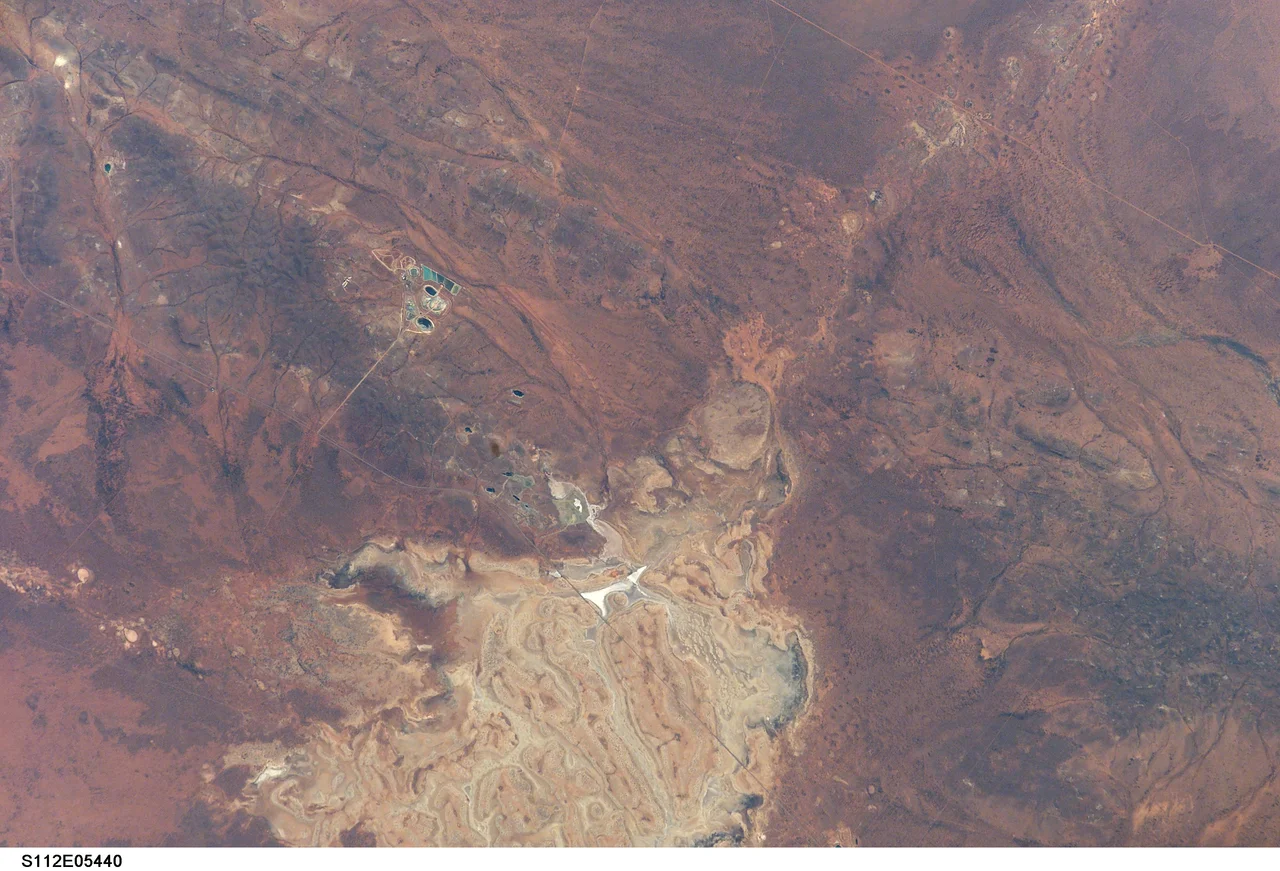

Cosmos Nickel Mine
Most nickel mines in Western Australia scrape a living from ore grading one to three percent metal. When Jubilee Gold Mines drilled into the Cosmos deposit in 1997, they pulled up rock running between five and twelve percent. In the unglamorous world of base metals, that is the equivalent of striking a vein of treasure. A company that had been hunting gold abruptly found itself sitting on one of the most concentrated nickel finds in the state, 38 kilometres north-northwest of Leinster. What followed over the next quarter-century was a saga of soaring fortunes, billion-dollar takeovers and repeated collapses, all playing out on country that the Tjiwarl people have called home for tens of thousands of years.
An Accidental Fortune
Jubilee Gold Mines had switched from gold to nickel exploration only the year before the discovery, a gamble that paid off spectacularly. The Cosmos ore was extraordinary, its grade several times richer than the West Australian norm, and the company moved fast. It planned to invest A$52 million, most of it in a concentrator to process the ore, and in 1998 forecast a short, sharp mine life of three years yielding 30,000 tonnes of nickel. Mining began in 2000. What was meant to be a brief, high-grade operation instead became the seed of something far larger, as the rising tide of global nickel demand turned a modest deposit into a coveted strategic asset that the world's mining giants would soon fight to own.
Billions, Then a Bust
In 2007, with nickel prices surging, the Swiss-based giant Xstrata bought Jubilee Gold, and the Cosmos mine with it, for A$3.1 billion. The timing was disastrous. Almost immediately the nickel price crashed, and by 2012 the mine was idled and placed in care and maintenance. The collapse of a workforce tells the story starkly: at its 2011 peak Cosmos employed more than three hundred people; by 2014, with the mine dormant, just four remained to mind it. Ownership kept shifting around the sleeping asset. Glencore had completed its takeover of Xstrata in 2013, and two years later sold Cosmos to Western Areas for A$24.5 million, a tiny fraction of what Xstrata had once paid. The mine that began as a fortune had become a bargain-bin orphan, waiting for nickel to rise again.
The Odysseus Gamble
The next act came when IGO acquired Western Areas in June 2022 for A$1.26 billion, a deal that also swept in Western Areas' Forrestania nickel operations alongside IGO's own Nova nickel-copper-cobalt mine. IGO bet big on reviving Cosmos around a new underground project named Odysseus, designed for a ten-year life producing over 10,000 tonnes of nickel a year. But the cost ballooned. Restarting the operation and enlarging the concentrator to one million tonnes a year would take an estimated A$825 million, roughly three times the previous owner's figure. The classic, cruel logic of nickel reasserted itself one more time. After pouring around half a billion dollars into the project, and with prices once again sliding, IGO transitioned Cosmos back into care and maintenance in 2024, the promised restart shelved before it could deliver.
Older Than the Ore
The geology that makes Cosmos valuable is ancient beyond easy comprehension, nickel sulphides locked into rock formed in the deep Archean past. But the human history of this ground runs deeper still in meaning, if not in years. The traditional owners are the Tjiwarl people, whose connection to this stretch of the Northern Goldfields long predates any company, lease or commodity cycle. The mine sits beside the Goldfields Highway in flat, sun-struck spinifex country where the horizon barely wavers. For now the pits are quiet and the concentrator idle, an A$3.1-billion asset reduced once more to a holding pattern. Cosmos waits, as nickel mines so often do, for a price that may or may not come, while the land around it keeps the slow, unhurried time it has always kept.
From the Air
Cosmos lies at 27.58°S, 120.57°E in the Northern Goldfields of Western Australia, about 38 km north-northwest of Leinster along the Goldfields Highway, in the Shire of Leonora and on Tjiwarl traditional country. From altitude the site shows as open pits, a concentrator and supporting infrastructure set in flat red spinifex plain, with the highway running past as a key navigation reference. The nearest airfield is Leinster Airport (ICAO YLST) to the south; Wiluna Airport (YWLU) lies to the north and Leonora Airport (YLEO) further south. The nearest major airport is Kalgoorlie-Boulder (YPKG), roughly 400 km south. Terrain is gently undulating semi-arid plain offering excellent visibility, with summer heat producing thermals and haze. No controlled airspace is nearby, but expect mining light-aircraft and helicopter movements around Leinster and the surrounding operations.
Nearby Stories
- Nickel mining in Western Australia 14 km away
- Agnew Gold Mine 28 km away
- Sandstone, Western Australia 62 km away
- Banjawarn Station 70 km away
- Sandstone Gold Mine 90 km away
- Wiluna Railway Line 92 km away
- Western Australia 139 km away
- Cosmo Newbery 193 km away