
Nickel mining in Western Australia
In late 1969, a single nickel discovery sent ordinary Australians into a frenzy. Shares in a small explorer called Poseidon NL had been trading at eighty cents; within months they touched an intraday high of $280, dragging the whole stock market up behind them in a speculative mania that ended, as manias do, in ruin. The metal at the centre of it all - silvery, hard, corrosion-resistant nickel - sleeps beneath the red plains of the Western Australian outback, in some of the oldest and most mineral-rich rock on Earth. The industry that grew up to extract it has lurched between euphoria and collapse for more than half a century, and the empty pits and quiet smelters scattered across the Goldfields are the receipts.
Born in 1966, Near a Salt Lake
The modern industry begins at Kambalda, south of Kalgoorlie, where Western Mining Corporation found nickel sulphide in 1966 and began production in 1968. The timing was extraordinary. The Vietnam War had driven nickel demand to record highs, and a long strike against the dominant Canadian producer, Inco, had choked global supply. Prices spiked. Suddenly the unglamorous Goldfields, long synonymous with gold, were sitting on a metal the world urgently wanted. The ore here is mostly the komatiite-hosted sulphide type, formed 2,700 million years ago from volcanic flows so hot they have no modern equivalent. It made Western Australia one of the planet's premier nickel provinces almost overnight.
The Bubble That Burst
Into that fevered market stepped Poseidon NL, which in September 1969 reported promising nickel results at Mount Windarra, 22 kilometres northwest of Laverton. Word leaked, insiders bought, and the share price detonated. Investors who had never seen a drill core poured savings into anything with the word 'nickel' attached. The peak came in February 1970; the crash followed almost immediately. When Poseidon finally produced nickel, the price had fallen, the ore proved lower-grade and costlier than hoped, and the company slid into receivership by 1974. The Poseidon bubble entered the history books as a cautionary tale - and a permanent reminder that the metal giveth and taketh away.
The Human Cost Underground
Behind the share charts were people who did dangerous work in difficult places, and some did not come home. During the development of the Leinster mine in April 1977, five workers fell 35 metres in an ore bucket at the Perseverance shaft and died. A cave-in killed a man in 1981; in December 1985, two more died of asphyxiation underground, the second while trying to rescue the first. At the Kwinana refinery in June 1978, J. W. Bell collapsed in a converter vessel - a faulty seal on his mask is presumed the cause - and his colleague S. J. Haywood died trying to save him, both overcome by nitrogen gas. The list is short on names and long on the same quiet tragedy: someone who turned back to help.
The Debt the Land Keeps
Nickel leaves a long environmental tail. The Bulong mine near Kalgoorlie operated for just five years, from 1998 to 2003, yet by 2016 its cleanup was projected to cost as much as $6.8 million - against a rehabilitation bond of only $1.1 million from its former owners. Abandoned tailings dams and evaporation ponds threatened nearby Lake Yindarlgooda, and a state investigation eventually ran to 900 pages. A rehabilitation fund introduced in 2013 was, by one estimate, two decades away from holding enough to matter. The lesson of Bulong is that a mine can be gone in five years and leave a mess that outlasts the company that made it.
Battery Dreams, Then the Bust Again
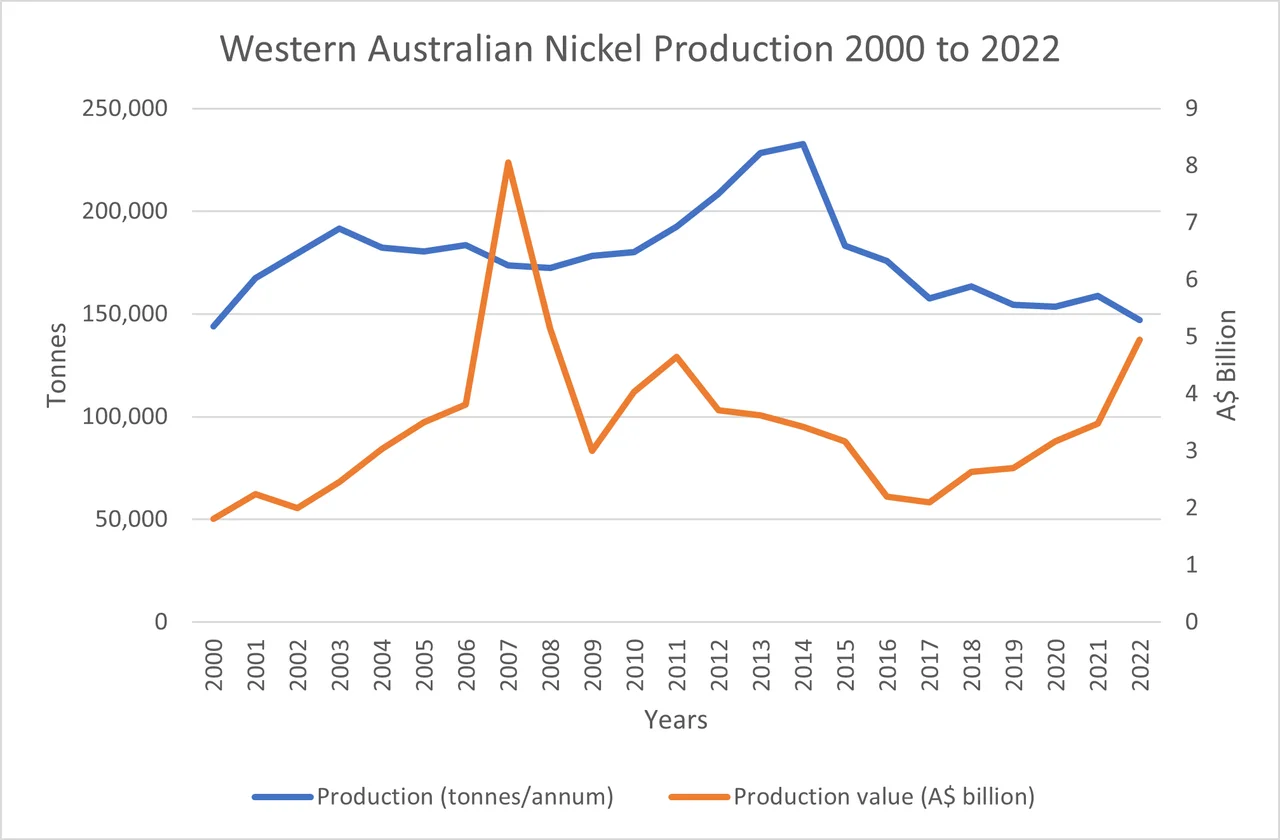
For a few years it looked different. Nickel is essential to the lithium-ion batteries powering electric vehicles, and a green-energy boom promised the Goldfields a clean second act. Then Indonesia flooded the market with vast quantities of cheaper nickel, and prices collapsed in 2024. One operation after another fell. Andrew Forrest's Wyloo moved to shutter the historic Kambalda mines; Panoramic's Savannah workers were made redundant; and on 11 July 2024, BHP suspended its entire Nickel West division, citing global oversupply. The cycle that began with a Vietnam-era spike and a stock-market mania had turned once more. The metal is still in the ground, exactly where the volcanoes left it. It always is. The only question that ever changes is the price.
From the Air
Western Australia's nickel belt traces the Norseman-Wiluna greenstone trend through the Eastern Goldfields; the article's nominal coordinates fall near Mount Keith at 27.21 degrees south, 120.55 degrees east. Flying the corridor between Kalgoorlie and Wiluna, the industry's footprint is visible as a string of open pits, headframes, tailings dams, and processing plants set against red, sparsely vegetated plain - Kambalda and Kalgoorlie in the south, Leinster and Mount Keith to the north. Best appreciated at 6,000 to 11,000 feet in the clear, dry conditions typical of the region. Principal airfields along the route include Kalgoorlie-Boulder Airport (ICAO YPKG) in the south, Leinster Airport (YLST), and Meekatharra Airport (YMEK) to the northwest. Visibility is routinely excellent; expect afternoon thermals and localised dust near active workings.
Nearby Stories
- Wiluna uranium mine 8.4 km away
- Cosmos Nickel Mine 24 km away
- Wiluna Railway Line 67 km away
- Banjawarn Station 74 km away
- Sandstone, Western Australia 85 km away
- Western Australia 100 km away
- Yarrabubba 109 km away
- Mulga Queen Community 118 km away