
Croft Castle
There is a name in the Domesday Book of 1086, near the start of the Herefordshire returns: Bernard de Croft. The family has owned the land at Croft, north-west of Leominster, ever since - with one interruption of about 124 years in the 18th and 19th centuries, when financial collapse forced them to sell. They bought it back in 1923. In 1957 they gave it to the National Trust. Almost a thousand years of single-family ownership, broken only by the South Sea Bubble. There are not many houses in England with a continuous story that long.
The Border Family
The Crofts settled in this corner of Herefordshire shortly after the Norman Conquest, and their early history is bound up with their neighbours the Mortimers - the great Marcher lords of Wigmore and Ludlow whose territories shaped English politics for centuries. The Battle of Mortimer's Cross, fought on 2 February 1461 during the Wars of the Roses, took place on Croft land less than a mile away. Edward, Earl of March - soon to be King Edward IV - defeated a Lancastrian army that day and saw three suns rising in the sky, a parhelion that became his personal badge. Sir John de Croft married Janet, one of Owain Glyndwr's daughters, weaving Welsh rebel blood into the family line. In the 15th century the Crofts adopted a Welsh wyvern as their crest - a wounded black dragon - in honour of that Glyndwr heritage. They were a border family. Their identity was Welsh and English at once.
Sir Richard and the King-Makers
The Crofts produced courtiers and soldiers in steady supply. Sir Richard Croft, born around 1430 and dead 1509, served four kings in succession - Edward IV, Edward V, Richard III, and Henry VII - which was a remarkable feat in the violent dynastic shuffle of the late 15th century. His tomb in the parish church of St Michael, next to the castle, shows him alongside his wife Eleanor, and the canopy is said to resemble that of Henry VII in Westminster Abbey. Thomas Croft, born around 1435, was a shipowner who helped finance early Atlantic voyages from Bristol, possibly sighting the New World before Columbus. Sir James Croft was Lord Deputy of Ireland under Edward VI and later one of the conspirators in Wyatt's Rebellion against Mary I - he was tortured but survived, and ended up Comptroller of the Household to Elizabeth I. Margaret Croft attended Elizabeth Stuart, the Winter Queen of Bohemia, in exile.
The Bishop, the South Sea, and the Architect
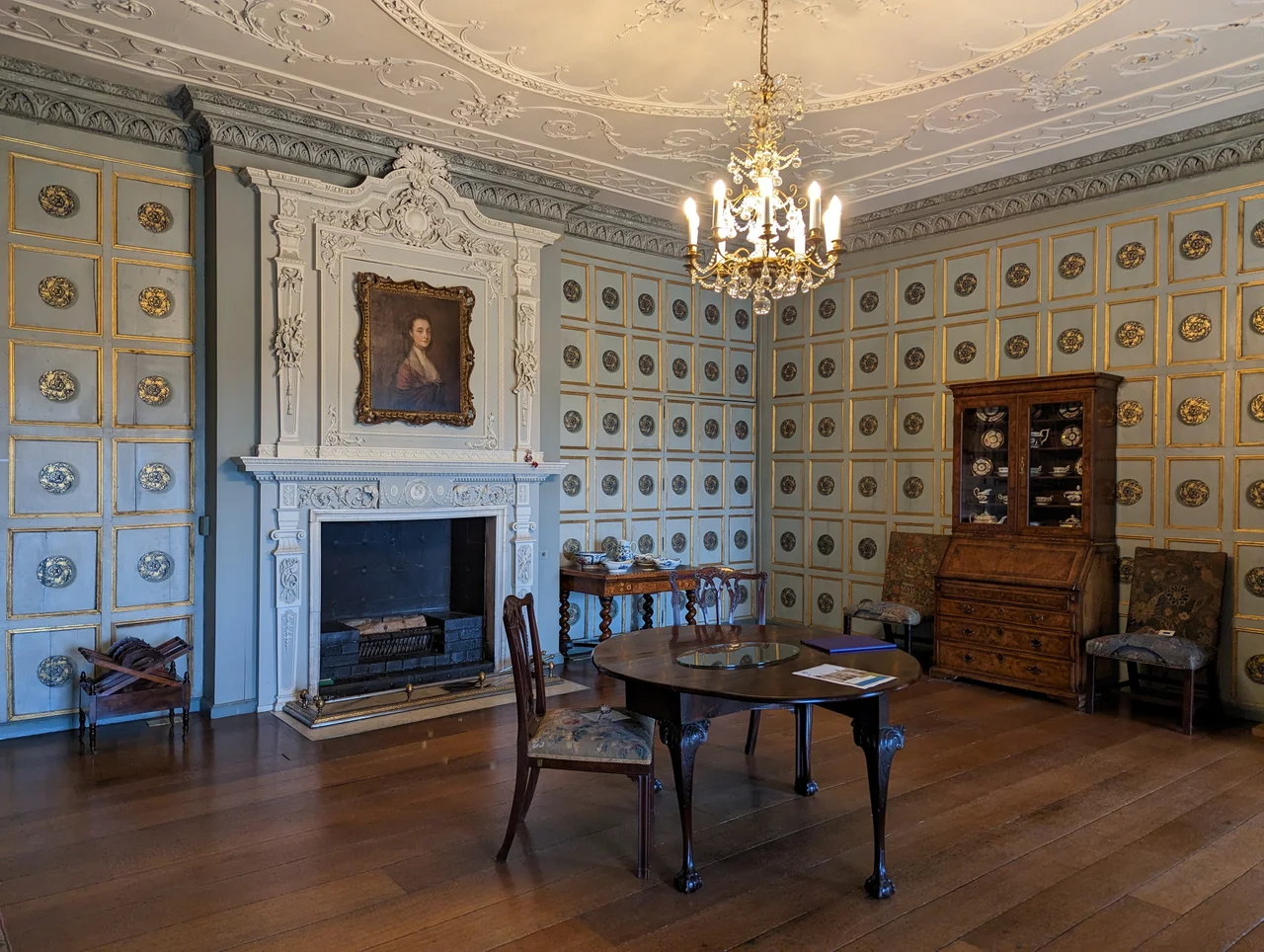
The present house dates from the 1660s, built during the time when Herbert Croft was Bishop of Hereford - chaplain to Charles I, Dean of the Chapels Royal to Charles II. It replaced an earlier house thirty yards to the west, which archaeologists excavated in 2002. The quadrangular stone structure with round corner towers is one of the first examples of medieval revival architecture in England, related to Lulworth Castle in Dorset and Ruperra Castle in Wales. Then came the South Sea Bubble of 1720, which wrecked many a country fortune. The Crofts hung on for forty years but eventually sold to Thomas Johnes, who in the 1760s remodelled the interiors in the fashionable Rococo-Gothic style. He hired Thomas Farnolls Pritchard - the Shrewsbury architect who would later design the world's first iron bridge over the Severn at Coalbrookdale - to create the gothic staircase, the plasterwork ceilings, and the chimneypieces.
Lost and Recovered
Johnes sold the castle in 1799. It passed to Somerset Davies, the MP for Ludlow, whose descendants the Kevill-Davies held it for over a century. Walter Sarel made further alterations in 1913 - removing the central section of Pritchard's gothic entrance and adding a battlemented porch with a mullioned bay window above. In 1923, Lady Croft - born Katherine - bought the castle back from the Kevill-Davies. The family had returned to its house. Then in 1957 came another crisis. Eighteen other great houses in Herefordshire had already been demolished after the war - part of the catastrophic destruction of country houses in 20th-century Britain that swallowed perhaps a thousand grand houses across the country. Diana Uhlman, born Croft, was determined that Croft would not join them. The family raised an endowment. The National Trust agreed to take the house and the remaining estate. The Crofts kept living there as tenants, and they still do.
What the Park Holds
The 1,500 acres of woodland, farmland, and parkland around the castle hold things older than the castle itself. Croft Ambrey, an Iron Age hillfort, sits on the high ground above the house - one of the most impressive prehistoric earthworks in the Welsh Marches. Beech and oak trees, some hundreds of years old, line the main drive. The Fishpool Valley, landscaped in the 18th century with descending ponds, a grotto, a Gothic pumphouse, an ice house and a lime kiln, has been carefully restored to its picturesque scheme. The Mortimer Trail, a long-distance footpath running from Ludlow to Kington, passes through the estate. The Church of St Michael, dating to around the 14th century, holds the Croft tombs and 17th-century box pews. The ceiling above the altar is painted with clouds and gilded stars. A small parish church, an Iron Age fort, a country house, a battlefield, and a continuous family - all within walking distance, all part of one estate's deep memory.
From the Air
Croft Castle sits at 52.285 N, 2.809 W in north Herefordshire, about 5 miles north-west of Leominster. The castellated stone house with round corner towers is visible from the air as a distinct quadrangular shape surrounded by wooded parkland; the long beech-and-oak drive curves in from the south. Croft Ambrey hillfort to the north-east shows as a contour-following enclosure on the high ground. Best viewed from 1,500-3,000 ft AGL. Nearest airports: Shawbury (EGOS) about 20 nm north-east, Wolverhampton/Halfpenny Green (EGBO) about 25 nm east, Gloucestershire (EGBJ) about 40 nm south-east. Titterstone Clee Hill (1,749 ft, flat top with radar domes) is 10 nm north-east and a useful landmark.
Nearby Stories
- Murder of Shawn Seesahai 2.3 km away
- Avoncroft Museum of Historic Buildings 3.3 km away
- Much Wenlock 6.8 km away
- Sudeley Castle 14 km away
- Battle of Maes Moydog 15 km away
- Fforest Fawr Geopark 15 km away
- Treago Castle 15 km away
- Cwmhir Abbey 16 km away