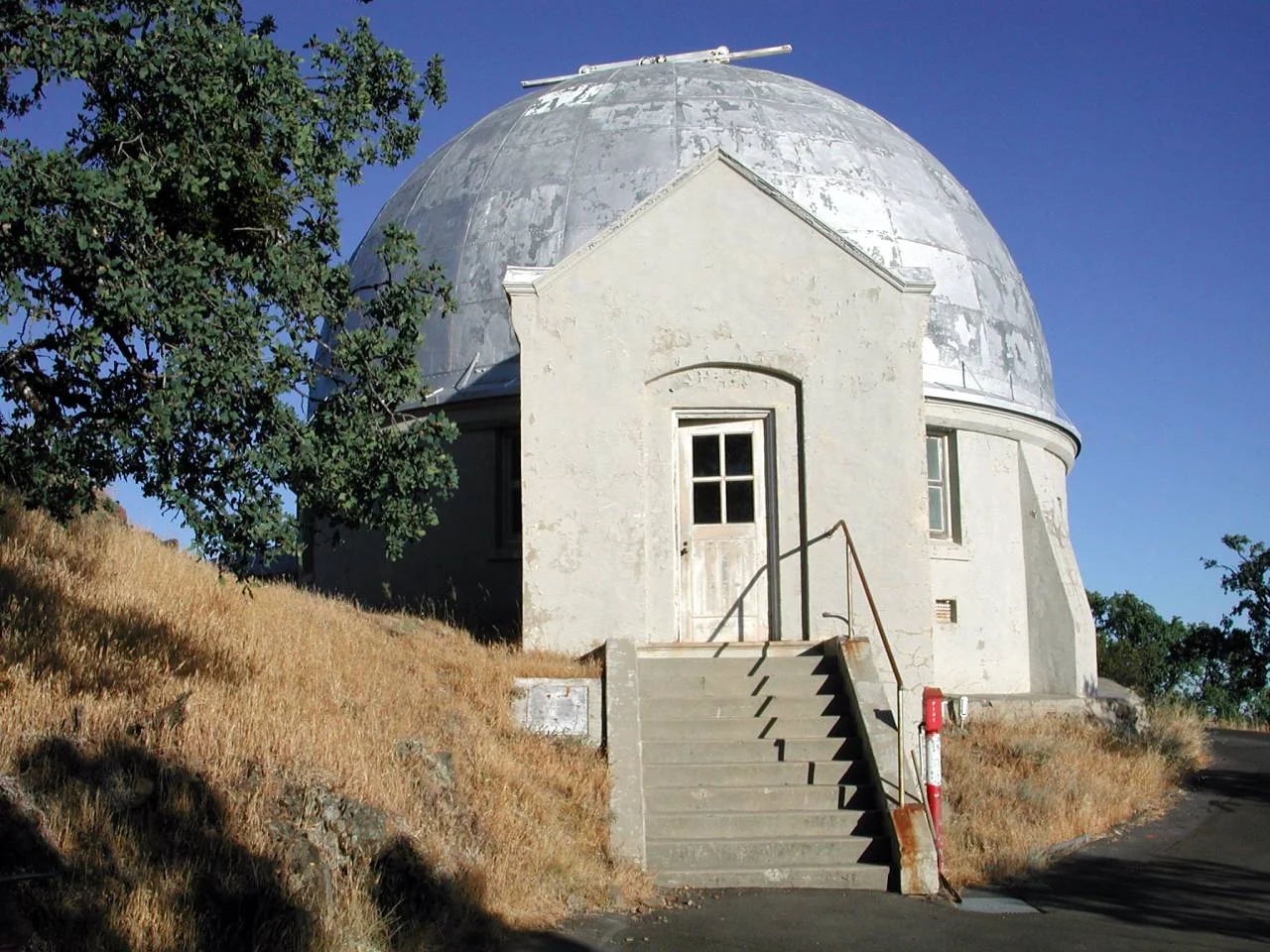

Crossley telescope
The Crossley telescope at Lick Observatory has lived two lives on two continents. Built in Halifax, England, by Andrew Ainslie Common and purchased by Edward Crossley, the 36-inch reflecting telescope crossed the Atlantic in 1895 as a donation to the mountaintop observatory above San Jose. In the hands of Lick astronomers, the Crossley became one of the most productive instruments in the history of observational astronomy, producing photographs of nebulae and galaxies that transformed understanding of the universe's structure.
An English Telescope in California
Edward Crossley was a wealthy English politician and amateur astronomer who had purchased the 36-inch reflector from its builder. Finding the English weather unsuitable for serious observational work, Crossley donated the telescope to Lick Observatory, where the clear skies above Mount Hamilton offered far better conditions. The telescope arrived in pieces and required significant modification to work effectively in its new dome. James Keeler, who became Lick's director, oversaw the modifications and then used the Crossley to conduct a systematic photographic survey that revealed thousands of previously unknown nebulae.
Keeler's Revelation
Keeler's photographs with the Crossley telescope, published around 1900, showed that spiral nebulae were far more common than anyone had suspected. At the time, astronomers debated whether these spirals were gas clouds within our own galaxy or separate galaxies entirely. The Crossley photographs did not settle the debate, but they provided the data that would eventually lead to its resolution decades later when Edwin Hubble proved that the spirals were indeed independent galaxies. The telescope thus played a pivotal role in one of astronomy's greatest discoveries, even though the full implications of its images were not understood for another quarter century.
Still Watching
The Crossley telescope remains in operation at Lick Observatory, though its role has evolved from frontier instrument to educational and research tool. Modern detectors have replaced the glass photographic plates that Keeler used, but the telescope's 36-inch mirror still gathers light from the same sky it has surveyed for more than 125 years. Perched on Mount Hamilton at 4,209 feet above sea level, the Crossley is part of an observatory complex that has been studying the heavens since 1888, making Lick one of the world's oldest permanently occupied mountaintop observatories.
From the Air
Located at 37.34°N, 121.64°W at Lick Observatory on Mount Hamilton, elevation 4,209 feet. Reid-Hillview Airport (KRHV) is approximately 15 miles west. The observatory complex is visible from altitude as a cluster of white domes on the summit of Mount Hamilton in the Diablo Range. Caution: mountainous terrain with rapidly changing weather conditions.
Nearby Stories
- Pan Am Flight 843 3.2 km away
- San Gregorio, California 4.8 km away
- The Mystery Spot: Where Gravity Takes a Vacation 18 km away
- Altamont Free Concert 26 km away
- From Aluminum to Ammunition to Aviation Fuel 35 km away
- Kesterson National Wildlife Refuge 37 km away
- Panoche Hills: California's Last Desert Refuge 70 km away
- ʻAkaka Falls State Park 3707 km away