
Crown Colony of Sarawak
On December 3, 1949, a seventeen-year-old named Rosli Dhoby approached the second Governor of Sarawak during a public ceremony in Sibu. He was disguised as a student. He shook the governor's hand, then drew a kris dagger and stabbed him repeatedly. Sir Duncan Stewart died two days later in Singapore. The assassination was the most violent expression of a wound that had been open since 1946, when the last White Rajah of Sarawak ceded his private kingdom to the British Crown. That decision, passed by the Council Negri in a vote of 19 to 16, split the territory along lines of ethnicity, loyalty, and self-determination that would not heal for years.
A Kingdom Signed Away
Sarawak had been ruled by the Brooke family since 1841, one of history's stranger political arrangements: a British dynasty governing a Borneo territory as personal sovereigns. After the devastation of Japanese occupation during World War II, the third and last Rajah, Charles Vyner Brooke, concluded that Sarawak lacked the resources to rebuild on its own and offered it to Britain as a Crown Colony. The Council Negri debated the bill for three days in May 1946. European officers voted in favor. Malay leaders opposed it fiercely. The final tally was 19 to 16, but the margin papered over deeper fractures. Between 300 and 400 Malay civil servants resigned in protest. Vyner Brooke's own nephew, Anthony Brooke, who stood to inherit the title, campaigned against cession for five years, arguing that his uncle had betrayed the people whose trust the Brooke family had held for over a century.
Governing from the Rajah's Chair
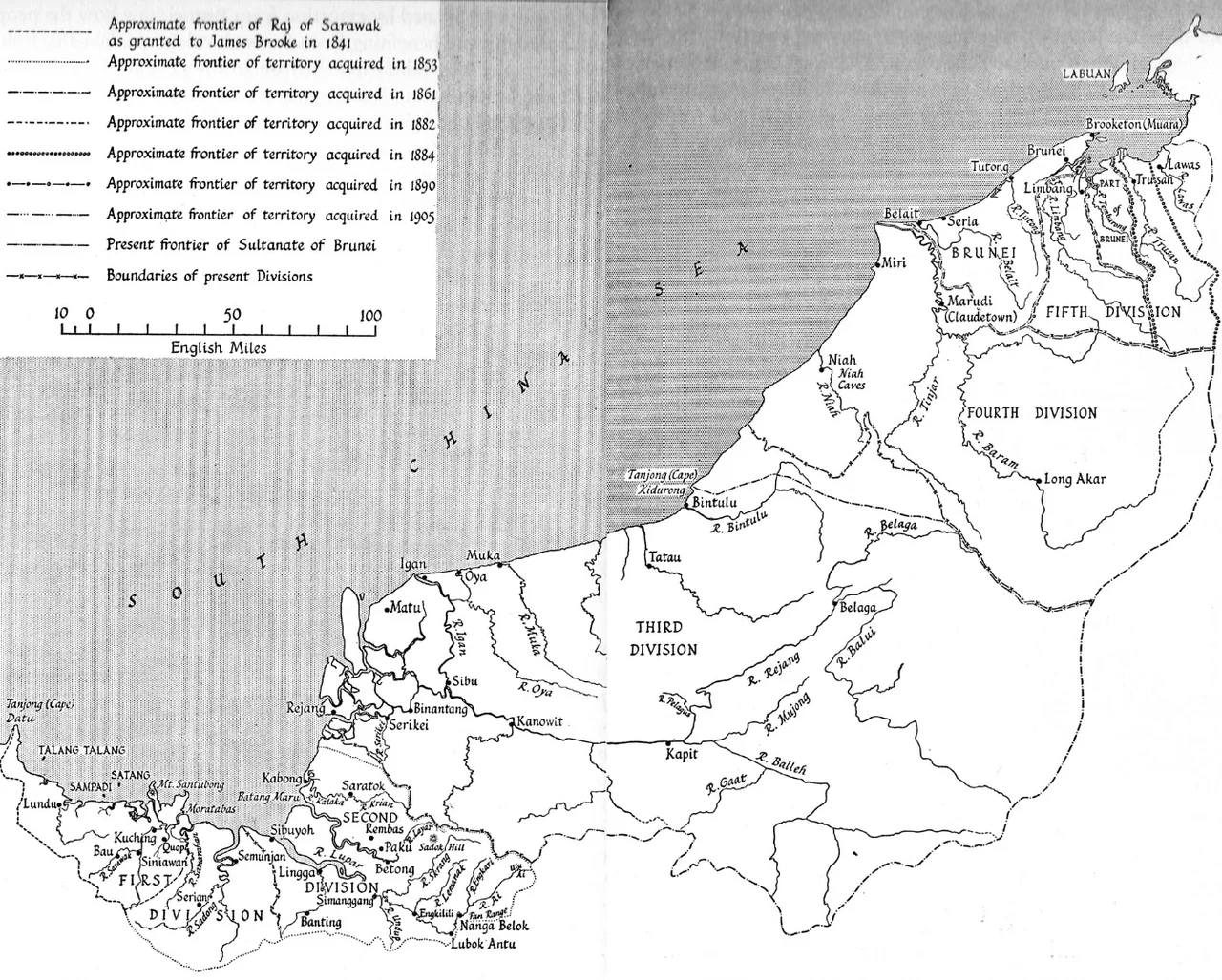
Sarawak was unusual among Crown Colonies because the institutions the Brookes had built remained largely intact. The Supreme Council and Council Negri, established under the Brookes' 1941 constitution, retained their authority, with a governor simply replacing the rajah. The territory was divided into five divisions, each overseen by a resident, subdivided into districts with their own officers and advisory councils. By 1954, the Council Negri had 25 members: 14 civil service officials and 11 non-officials representing the territory's ethnic and interest groups. It was governance by appointment rather than election, but it was governance that worked within local structures rather than replacing them wholesale. Some districts also had Chinese Advisory Boards, reflecting the Chinese community's significant role in Sarawak's commercial economy.
Hospitals, Radios, and Rural Dispensaries
Whatever the politics of cession, the Crown Colony period brought material changes that the Brooke regime had never managed. In 1947, Sarawak had two government hospitals and 21 rural dispensaries. By the late 1950s, new hospitals had opened in Miri, Kapit, and Limbang, along with a mental hospital in Kuching. Mobile dispensaries traveled the Rajang River to reach communities beyond the roads. Malaria, endemic throughout the interior, finally received its first systematic survey in 1952. Government revenue grew from 12 million dollars in 1947 to 78 million by 1962. Radio Sarawak launched on June 8, 1954, broadcasting in four languages: Malay, Iban, Chinese, and English. The Iban section aired nightly from seven to eight, covering news, farming advice, folklore, and epics. By the 1960s, 467 schools were participating in the School Broadcasting Service, using radio sets distributed under the Colombo Plan to teach English.
The Borneo Literature Bureau and the Question of Culture
The colonial government recognized that British education was reshaping a generation of Iban teachers, and that indigenous oral traditions risked being lost in the transition. On September 15, 1958, the Borneo Literature Bureau was inaugurated with a charter to nurture local literature in indigenous languages, English, Chinese, and Malay. It published technical manuals, instructional texts, and creative works for distribution across Sarawak and Sabah. Meanwhile, artists in Kuching turned to gentle themes after the war: scenery, nature, traditional dances, and cockfighting. It was a quiet cultural flowering in a territory still uncertain about its own identity, caught between the private kingdom it had been and the Malaysian state it would become when the colony dissolved in 1963.
From the Air
Coordinates: 2.63N, 113.54E, centered on the Sarawak interior. The Crown Colony encompassed all of modern Sarawak state, from the coastal cities of Kuching and Sibu to the remote interior along the Rajang River. Major airports in the region include Kuching International (WBGG), Sibu Airport (WBGS), and Miri Airport (WBGR). The Rajang River is clearly visible from altitude as it winds through dense jungle toward the South China Sea. Tropical weather prevails year-round with frequent cloud cover over the mountainous interior.
Nearby Stories
- East Malaysia 23 km away
- Fort Sylvia 57 km away
- Similajau National Park 70 km away
- Baram Dam 118 km away
- Fort Alice 193 km away
- Oil, Empire, and the Fight for Borneo 254 km away
- The White Rajahs of Sarawak 299 km away
- Luconia Shoals 345 km away