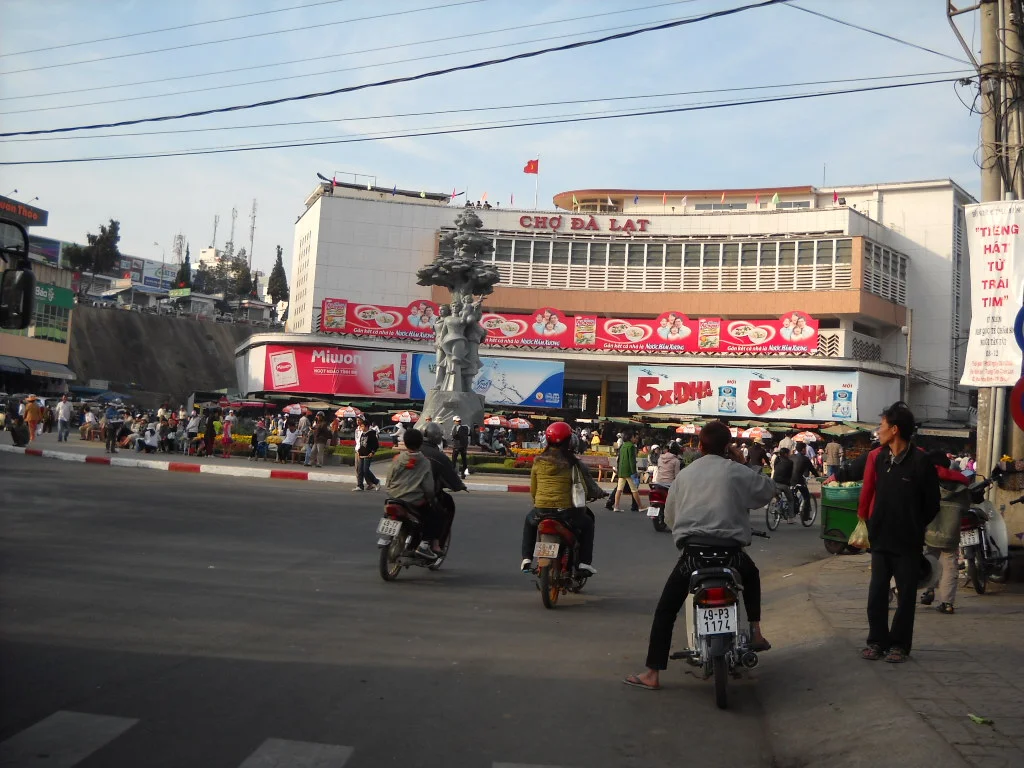

Da Lat Market
After dark, the roundabout at the center of Da Lat fills with people. The market — Chợ Đà Lạt — opens onto the square from its oldest building, and the stalls spill outward with a particular abundance: artichokes sold by the basketful, strawberries fragrant in the cool highland air, orchids bundled and ready to carry home, candied fruits in every color. Vietnamese families load up with produce that won't grow in the lowland heat. The smell of it all — flowers and roasting corn and coffee — is what Da Lat smells like at night.
From Chợ Cây to Chợ Đà Lạt
Markets have operated in this valley at the center of Da Lat since the early 20th century, when Vietnamese migration to the highland plateau was slowly gaining momentum from the Central region. The original structure, known as Chợ Cây, eventually gave way to the more permanent two-story building constructed in 1960, which still forms the oldest section of the complex today. That building faces the central roundabout, its facade a familiar reference point for anyone who has spent time in Da Lat. A third section, Block C, was added in 2010, expanding the complex by 5,000 square meters. Over decades, the market remained the most prominent structure in the city center — until the rapid rise of tourism began building high-rise hotels around it, and the market that once defined the skyline became a low anchor in a taller neighborhood.
What the Stalls Hold
The market is organized by use. The oldest building handles food — the produce that makes Da Lat famous throughout Vietnam: vegetables and fruits grown at altitude that can't survive in the heat of Ho Chi Minh City or the delta. Vendors here sell avocados, strawberries, artichokes, and coffee with a confidence born of geography. Their tags often read "Đà Lạt," a designation that carries real commercial weight in Vietnamese markets from Hanoi to Can Tho. The newer buildings behind handle clothing, housewares, and art. Among the most sought items are silk embroidered pictures, which can be found here at a fraction of the price charged by the galleries around the city. For travelers, this is the market's most practical asset: the same quality, without the markup.
Evening Ritual
Most of Da Lat's visitors are Vietnamese, and most arrive with shopping on the agenda. The market at night becomes a kind of organized wandering — families moving between stalls, couples stopping for roasted corn from a vendor near the entrance, tour groups being deposited at specific shops before being collected again. By 2017 there were concerns about management and safety in the night market sections, including scuffles and sanitation issues that made the experience less pleasant than it could be. The city began planning a Hoa Binh Center project that would reframe the entire area — repositioning the market as a cultural landmark within a larger urban renewal of the city center, as Da Lat sought to build its profile as an international destination. Whether those plans would preserve the market's organic character or smooth it into something more sanitized remained an open question.
The Roundabout at the Center
The geography of Da Lat bends toward this spot. The roads converge at the roundabout, and the market faces it directly, so that arriving and leaving the city center always involves passing the building. It has been the commercial heart of Da Lat since before the modern city fully existed — a point of continuity through French colonial architecture, the Vietnam War, reunification, and the tourism boom. The artichokes came from the surrounding farms. The strawberries came from the valleys just outside town. The flowers, grown in greenhouses in the hills, arrived by truck before dawn. The market assembled it all and put it within arm's reach of anyone who walked through the doors.
From the Air
Da Lat Market sits at 11.943°N, 108.437°E at the roundabout in the heart of Da Lat's city center. The market building is visible from the air as the focal point of the city's main circular intersection, surrounded by low commercial buildings on pine-covered hillsides. Da Lat occupies a plateau at 1,500 meters elevation in the Lam Dong highlands, making it visually distinct from coastal Vietnam — no delta rice paddies, instead terraced farms and conifer forests. The nearest airport is Lien Khuong (DLI), approximately 30 km to the south. Recommended viewing altitude is 4,000–6,000 feet to appreciate the city's hill-and-lake layout and the agricultural valleys surrounding it.
Nearby Stories
- Tà Đùng National Park 3.1 km away
- Phan Rang–Tháp Chàm 4.2 km away
- Cam Ranh 18 km away
- Bao Loc 18 km away
- Operation Byrd 23 km away
- Nha Trang Air Base 25 km away
- Bidoup Núi Bà National Park 34 km away
- Duc Lap Camp 43 km away