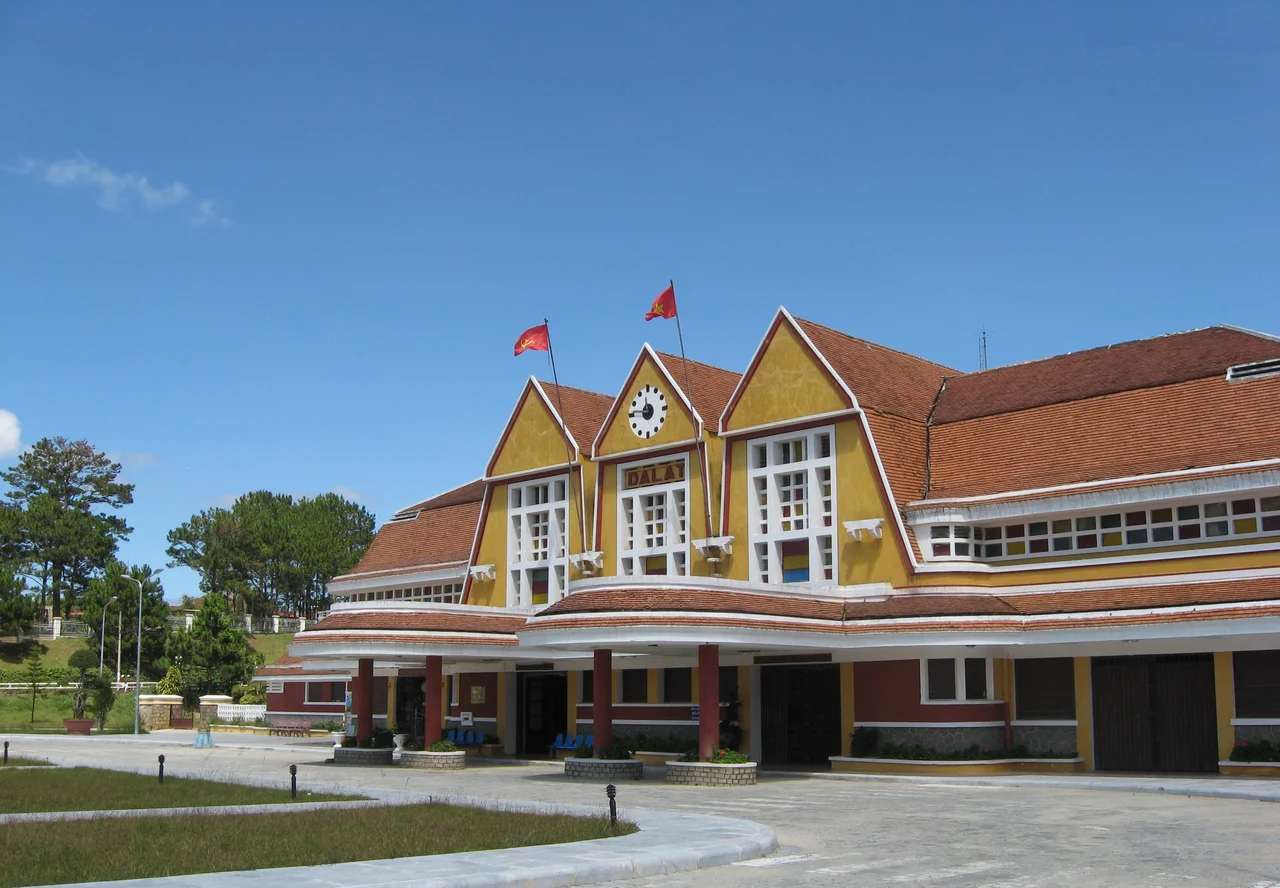

Da Lat Station
It took 24 years to build the railway to Da Lat. The tracks began climbing from the coastal plains in 1908, threading switchbacks through the mountains of the Central Highlands, and didn't reach the plateau until 1932. By then, the colonial administration wanted a proper station — not the utilitarian shed the SGAI company had been operating, but something that fit the aspirations of a highland city the French had decided would be their resort capital. They gave the commission to architects Moncet and Reveron. Reveron's design, submitted in 1932 and completed in 1938, is still standing.
Art Deco Meets the Central Highlands
The building Reveron designed doesn't look like anything else in Vietnam. It is Art Deco in its overall language — the geometric forms, the decorative precision, the ambition to make a utilitarian structure feel permanent and elegant. But the roofline breaks from European convention. The three steep, peaked roofs are drawn from the Cao Nguyen communal houses of Vietnam's Central Highlands, the traditional longhouses of the indigenous peoples who inhabited these mountains long before French surveyors arrived. Each roof shelters a multicolored glass window; under the central one hangs a large clock, recently restored. At the front, a porte-cochère — a coach gate — is supported by two rows of twelve columns each, making an entrance that was meant to impress. For a station at the end of a mountain railway, it succeeds.
War and Silence
The Da Lat–Thap Cham line was never a strategically neutral piece of infrastructure. Throughout the Vietnam War, it was bombed and mined repeatedly by the Viet Cong, as was the entire Vietnamese railway network. Regular operations on the mountain line came to an end in 1968, when the damage and danger made operation unsustainable. The station fell quiet. After the Fall of Saigon in April 1975, what remained of the line was dismantled — the rails pulled up and sent south to help repair the main coastal railway. The station building itself survived, standing empty while pine trees grew taller around it and the city changed around the structure that no longer served its original purpose.
Seven Kilometers Back to Life
In the 1990s, a seven-kilometer section of track leading from Da Lat station to the village of Trai Mat was reopened for tourist operations. It is not the original mountain railway — that route, with its switchbacks and rack sections, is gone. But the short tourist run gave the station back its reason to exist. In December 2009, four rail cars were restored to look like those used on the Da Lat–Thap Cham line in the 1930s and put into service carrying visitors through pine forests to Trai Mat, where a painted wooden temple sits at the end of the line. The cars carry signage reading "Dalat Plateau Rail Road." For most passengers today, the ride is a half-hour journey through highland scenery — but the station they leave from is one of the finest colonial-era buildings in Vietnam.
A Building That Outlasted Its Purpose
Railway stations are built for crowds — for arrival and departure, for the noise of steam and announcement boards and travelers with luggage. Da Lat station was designed for a mountain railway that no longer exists, connecting a plateau city to a coast it no longer needs trains to reach. What it has become instead is something a utilitarian structure rarely achieves: an architectural landmark that draws visitors who have no train to catch. The high peaked roofs catch the highland light differently in morning and afternoon. The columns of the porte-cochère cast shadows that shift through the day. The restored clock keeps time. Whatever the architects Moncet and Reveron intended when they combined Art Deco geometry with the steep lines of a Cao Nguyen longhouse, the building they created has proven more durable than the railway it was built to serve.
From the Air
Da Lat station is located at 11.942°N, 108.455°E in the city of Da Lat, Lam Dong Province, Vietnam. The station sits in the eastern part of the city, identifiable from the air by its distinctive three-peaked roofline — visually unusual among the surrounding buildings. Da Lat occupies a plateau at approximately 1,500 meters elevation; the city is ringed by pine-covered hills and sits above the cloud layer on many mornings, which can make low approaches spectacular. The nearest commercial airport is Lien Khuong (DLI), approximately 30 km to the south. Recommended viewing altitude is 4,000–6,000 feet to take in the station's context within the broader highland cityscape.
Nearby Stories
- Tà Đùng National Park 3.1 km away
- Phan Rang–Tháp Chàm 4.2 km away
- Cam Ranh 18 km away
- Bao Loc 18 km away
- Operation Byrd 23 km away
- Nha Trang Air Base 25 km away
- Bidoup Núi Bà National Park 34 km away
- Duc Lap Camp 43 km away