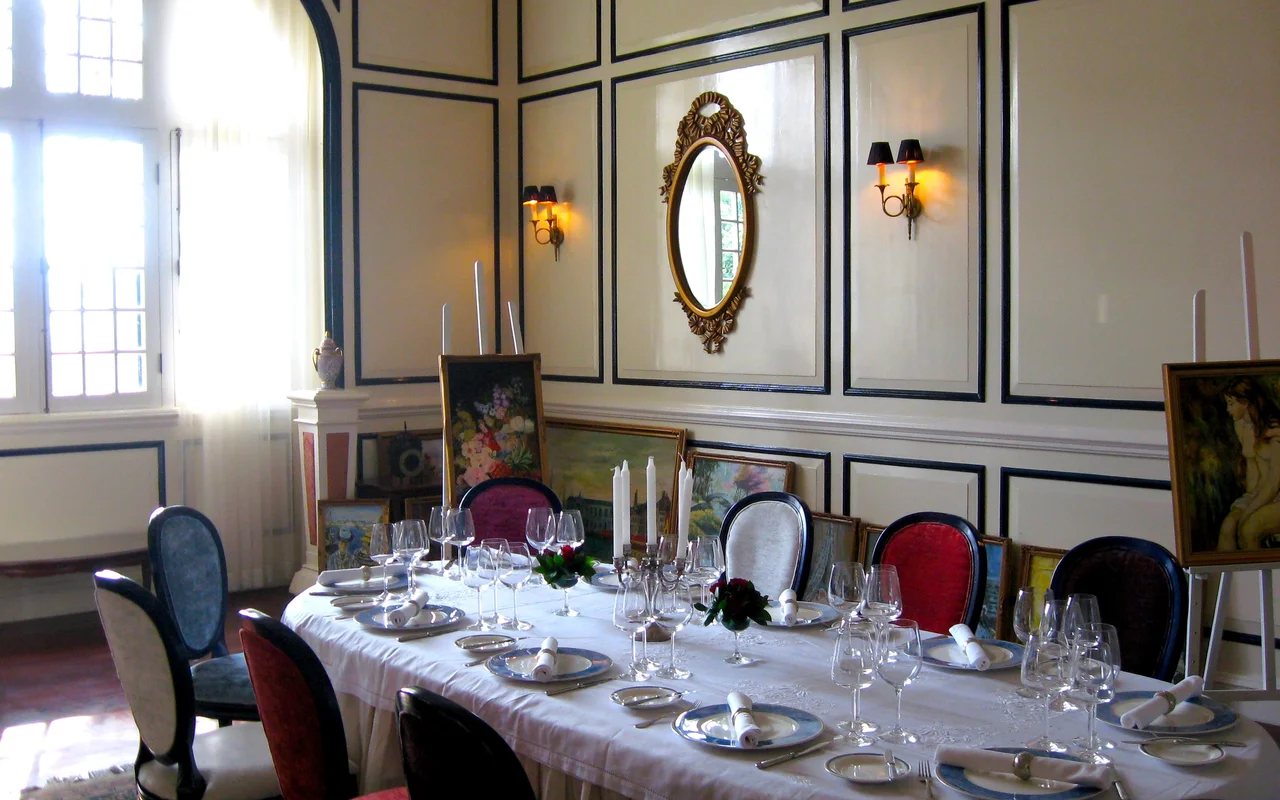

Dalat Palace Hotel
A 1925 city health inspection found the kitchens of the most glamorous hotel in the Indochinese highlands in, as the official report primly put it, "a condition of considerable filth." That gap between aspiration and reality captures something essential about the Lang-Bian Palace Hotel — opened in 1922 at 2 Tran Phu Street, draped over the shore of Xuân Hương Lake, designed to rival Raffles in Singapore and the Oriental in Bangkok, and yet never quite able to outrun the contradictions built into its foundations. Today, restored and renamed the Dalat Palace, it stands as a monument not just to French colonial ambition but to the messy, layered century that ambition set in motion.
A Palace Planted on a Hillside
When construction finished in 1922, the Lang-Bian Palace Hotel did not look like an accident of history. It looked like an intention. Architects had borrowed from the spa towns of metropolitan France — Vittel's mineral grandeur, the seaside facades of Cabourg and Cannes — and planted the result at the geographic and symbolic centre of the European quarter of Da Lat. On one side lay the shimmering lake; on the other, the subdued rooftops of what planners called the "native quarters." The placement was deliberate. Scholars have described the hotel as a "conspicuous symbol of French domination over the Indochinese central highlands," and the building performed that role architecturally as well as socially. Its thirty-eight luxury rooms, orchestra, cinema, dance hall, tennis courts, riding facilities, and private fruit gardens were aimed at colonial administrators and wealthy visitors who expected highland Vietnam to feel, as much as possible, like a resort somewhere between Nice and the Alps.
The Admiral's Makeover
In 1943, the Vichy governor general of Indochina, Admiral Jean Decoux, looked at the hotel's ornate fin-de-siècle facade and decided it was embarrassing. Rococo detailing was stripped away. The exterior was simplified into something starker — almost certainly influenced, scholars suggest, by architect Paul Vesseyre's two other Da Lat palaces: Bao Dai's residence and the governor general's villa, both built in the 1930s in a style leaning toward Art Deco or even Bauhaus. Decoux had form for this kind of cultural erasure. On his orders, caryatids were removed from the governor general's palace in Saigon, and the statues and bas-reliefs of the celebrated Saigon theatre were destroyed. For the Dalat Palace, the result was a building that lost its playful resort character and gained a more authoritarian sobriety. French novelist Morgan Sportès, writing about wartime Indochina, described the hotel — even in its altered form — as reminiscent of the Negresco in Nice. The likeness held the ghost of what had been stripped away.
The Long Silence and the Forty-Million-Dollar Return
After 1975 and the end of the Vietnam War, the hotel went quiet. Occupancy fell; upkeep faltered; the grand dining room became merely functional. The building spent roughly fifteen years in this diminished state before a reclusive American tycoon named Larry Hillblom arrived with unusual ambitions and a very large cheque. Hillblom — the "H" in the DHL courier empire — poured around forty million dollars into a lavish restoration in the early 1990s. The plain dining room was converted into a grand restaurant. Rooms were restored. The hotel was repositioned for high-end tourism and renamed, definitively, the Dalat Palace. Hillblom himself remained an elusive figure, better known for the litigation that followed his 1995 death in a plane crash than for his architectural philanthropy. But the hotel he resurrected outlasted his reputation, and it continues to receive guests on the same lakeside terrace that colonial planners staked out over a century ago.
What the Building Carries Now
Walk through the Dalat Palace today and the layers compress into a single experience. The pine-scented air off Xuân Hương Lake drifts through windows that have overlooked emperors' summers, wartime requisitions, postwar neglect, and tourist revivals. The building's monumental presence — by 1920s planning logic it was supposed to be surrounded by comparable government structures, most of which were never built — gives the hotel an outsized solitude on Tran Phu Street. It ended up as a centerpiece without a context, which is perhaps why it feels so peculiarly itself. The Dalat Palace is not quite a museum and not quite just a hotel. It is an original: the singular building that French colonial planners left standing when economic reality dismantled every other ambition they had brought to the highlands.
From the Air
The Dalat Palace Hotel sits at 11.9376°N, 108.4405°E on the northern shore of Xuân Hương Lake in Da Lat, at an elevation of approximately 1,500 meters. Approaching from the north at 3,000 meters, the lake presents as a gleaming ellipse in the valley floor and the hotel's roofline is visible on its western edge. The nearest airport is Lien Khuong Airport (VVDL), roughly 30 kilometers south of the city center. Da Lat sits in a bowl in the Langbiang Plateau of the Central Highlands; morning mist frequently fills the valley below 1,600 meters, clearing by mid-morning in the dry season (November–April). Nearby visual references include the Cathedral of Da Lat to the northwest and the forested slopes of the Langbiang massif to the north.
Nearby Stories
- Tà Đùng National Park 3.1 km away
- Phan Rang–Tháp Chàm 4.2 km away
- Cam Ranh 18 km away
- Bao Loc 18 km away
- Operation Byrd 23 km away
- Nha Trang Air Base 25 km away
- Bidoup Núi Bà National Park 34 km away
- Duc Lap Camp 43 km away