
Dalhousie Springs
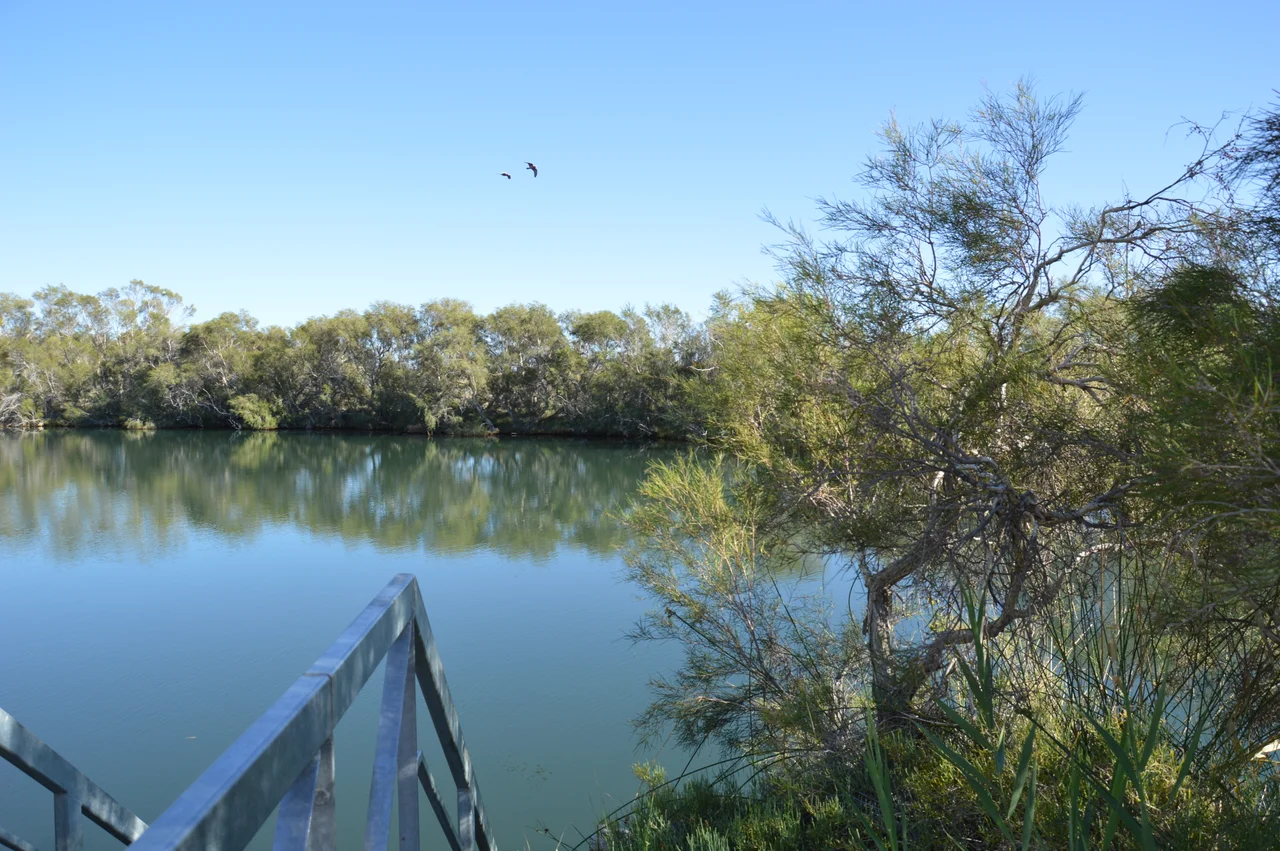
Picture the driest edge of one of the world's harshest deserts - red sand, gibber, a sky that withholds rain for years at a stretch. Now picture a pool of clear water in the middle of it, warm as a bath, ringed with reeds, steam rising in the cool of a desert morning. At Dalhousie, water that fell as rain thousands of years ago and has been travelling underground ever since finally reaches the surface, rising up through the desert floor at body temperature. There are more than sixty of these springs clustered here, the largest artesian springs in all of Australia - an oasis so improbable it seems invented.
Water From Deep Time
The springs are fed by the Great Artesian Basin, the vast underground reservoir beneath much of inland Australia. Rain falling on distant ranges seeps into the rock and creeps southward through the aquifer for thousands of years before it finds a fault and wells up here, on the western fringe of the Simpson Desert in Witjira National Park, about 180 kilometres north of Oodnadatta. The water emerges between 38 and 43 degrees Celsius - warm enough to soak in year-round - heavily mineralised yet just drinkable. The largest pool stretches for hundreds of metres. As a geological feature, Dalhousie is considered unique in Australia: a place where the deep plumbing of the continent breaks the surface in plain view.
Fish at the End of the World
Because the springs have flowed continuously for an immense span of time, while the country around them turned to desert, the creatures in them became marooned - evolving in isolation into forms found nowhere else on the planet. Dalhousie alone harbours around sixteen endemic species: fish, snails, a yabby and other crustaceans cut off from the rest of the world. Among the fish are the Dalhousie catfish, the Dalhousie hardyhead, and the Dalhousie goby - tiny survivors clinging to a few warm pools in the middle of nothing. Several are now listed as threatened species. They are living proof of what isolation can do, an evolutionary laboratory the size of a few ponds, sustained entirely by water rising from underground.
A Place of the Dreaming
Long before any of this was measured in litres per second, the springs were sacred. Dalhousie - Witjira - holds deep significance for the Lower Southern Arrernte and Wangkangurru peoples, sitting within an exceptional density of story and song lines. The endemic fish themselves are woven into Dreaming narratives tied to these very pools. When the springs were assessed for the National Heritage List, they were recognised not only for their biology but as an outstanding example of mound springs as a class of Aboriginal cultural place. In country where water means life or death, a permanent spring was never merely a resource. It was a presence - named, storied, and held in trust across uncountable generations.
Guarding the Oasis
Such a place is fragile. In 1915 the whole Dalhousie complex flowed at more than 23,000 litres per second; by 2000, decades of bore-drilling across the Great Artesian Basin had cut that to around 17,360 - a sobering measure of how easily ancient water can be drawn down faster than it returns. Recognition has followed. Dalhousie was added to the Australian National Heritage List in 2009, and in November 2021 the government moved to exclude mining from the Dalhousie Springs heritage area forever. Today the springs are a celebrated waypoint - the traditional launching point for the great desert crossing eastward to Birdsville, some 600 kilometres across the dunes - and a reminder that the most precious thing in a desert is, and always was, water.
From the Air
Dalhousie Springs lies at 26.46 degrees South, 135.48 degrees East, on the western fringe of the Simpson Desert in Witjira National Park. From the air the contrast is striking: the spring complex shows as darker, vegetated patches and reflective pools - a string of green and silver against the surrounding red sand and gibber, with the parallel dunes of the Simpson building to the east. The Finke River system and braided arid-zone channels run nearby. There is an airstrip near the springs at Dalhousie itself; Oodnadatta (YOOD) lies about 180 kilometres southwest, and Birdsville (YBDV) is across the desert to the east. Clear, stable cool-season air gives the best views; summer heat is extreme. Remote terrain with minimal services - plan fuel and water with care.
Nearby Stories
- Australian Overland Telegraph Line 30 km away
- Alberga River 43 km away
- Indigenous Australian Culture 76 km away
- Old Andado 90 km away
- Munga-Thirri–Simpson Desert Regional Reserve 140 km away
- Simpson Desert Bike Challenge 145 km away
- Oodnadatta Track 152 km away
- Mount Willoughby Indigenous Protected Area 240 km away