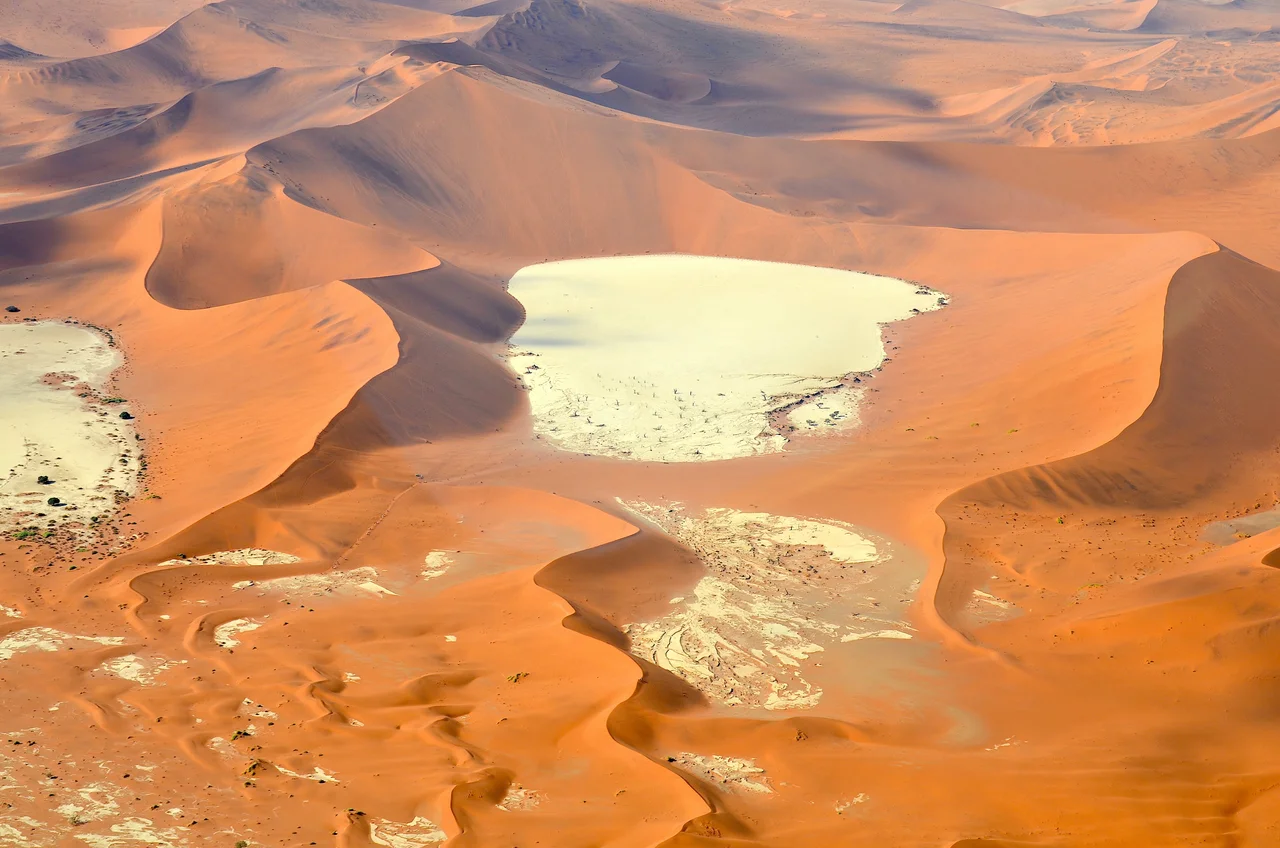

Deadvlei
The trees should not still be here. They died six or seven hundred years ago, sometime around the reign of Europe's late medieval kings, and yet they remain standing on the cracked white floor of Deadvlei, blackened and bare, their limbs clawing at a sky that has not given them rain in centuries. This is one of the strangest landscapes on Earth: a chalk-pale clay pan in the heart of the Namib Desert, encircled by towering dunes of rust-red sand, and studded with the skeletons of an ancient forest that the desert killed but could not destroy.
When the River Came
It was not always dead. Centuries ago the Tsauchab river, which usually peters out long before reaching here, flooded far enough to pool in this low basin. Water gathered, and life followed. Camel thorn trees, the hardy Vachellia erioloba of southern Africa, took root in the damp clay and grew into a small forest, an oasis of green in the desert's heart. The Afrikaans name vlei means a shallow lake or marsh, and for a time that is exactly what this was. Then the climate turned. Drought tightened its grip, and the restless dunes of the Namib crept forward, piling up barriers that finally choked off the river and sealed the basin away from any water at all.
Too Dry to Die Completely
Cut off from the river, the trees died, and here the desert performed its eeriest trick. In any wetter place, dead wood rots, softens, and returns to the soil within decades. But Deadvlei is so utterly arid that decay simply cannot get started. The camel thorns have stood for roughly six to seven centuries, dated to around 1340 to 1430, and the sun has scorched them black, yet the wood has not crumbled. These are not petrified trees turned to stone; they are the actual original timber, mummified by drought, dead but undecayed. They cast hard shadows across the white pan exactly where they fell silent, a forest frozen at the moment of its death and held there for six hundred years.
Walls of Red Sand
What makes the spectacle complete is the frame around it. Deadvlei sits in a bowl among some of the tallest sand dunes on the planet, mountains of sand whose iron-rich grains glow deep orange and red in the low sun. The colour comes from age: these are ancient sands, their quartz grains coated over millions of years in a film of oxidised iron, rust given form on a continental scale. The greatest dune looms over the pan and goes by the nicknames "Big Daddy" and "Crazy Dune," rising several hundred metres from base to crest on its sandstone terrace. Climbers ascend its knife-edge ridge at dawn, sinking shin-deep with every step, to look down on the white pan and its black trees far below, then run or roll back down the steep face in minutes. The colour contrast is almost unreal: bone-white clay, charcoal trunks, blazing red dunes, and overhead the hard blue of a desert sky, a palette so vivid it looks staged.
The Best Hour
Photographers and travellers come for one hour above all, the first light after dawn. Arrive early, before the heat builds and the crowds gather, and the rising sun catches only the upper faces of the dunes, leaving their lower flanks in deep shadow so the red seems to float above the pan. The white clay holds the cool light; the dead trees stand in sharp silhouette. Filmmakers have long understood the place's otherworldly power, using it as a backdrop in features from The Cell to The Fall. But no screen quite captures the silence of standing on that cracked white floor at sunrise, among trees that have been dead for six hundred years and somehow have not left.
From the Air
Deadvlei lies at 24.76°S, 15.29°E within the Namib-Naukluft Park in central Namibia, tucked just north of the better-known Sossusvlei pan among the great dunes of the southern Namib sand sea. From the air the pan is a striking pale-white patch set deep among towering orange-red linear and star dunes, with the dry Tsauchab watercourse threading in from the east near Sesriem. The surrounding dunes, including Big Daddy at several hundred metres, are among the tallest on Earth and unmistakable from altitude. Conditions are clear and dry most of the year; early morning offers the most dramatic light and dune shadowing. Nearest airfields are the Sossusvlei/Sesriem area airstrips (such as Sossusvlei Mountain Lodge and Geluk strips serving the park); the larger regional gateway is Windhoek's Hosea Kutako International (FYWH) well to the northeast. Recommended viewing altitude 2,000 to 6,000 ft AGL for the dune-and-pan contrast; keep clear of low-level wildlife and scenic-flight traffic in the park.
Nearby Stories
- Fairy Circles 30 km away
- Eduard Bohlen 58 km away
- Solitaire, Namibia 64 km away
- Duwisib Castle 80 km away
- Gobabeb Namib Research Institute 100 km away
- Sandwich Harbour 151 km away
- Ichaboe Island 152 km away
- Cospatrick 1364 km away