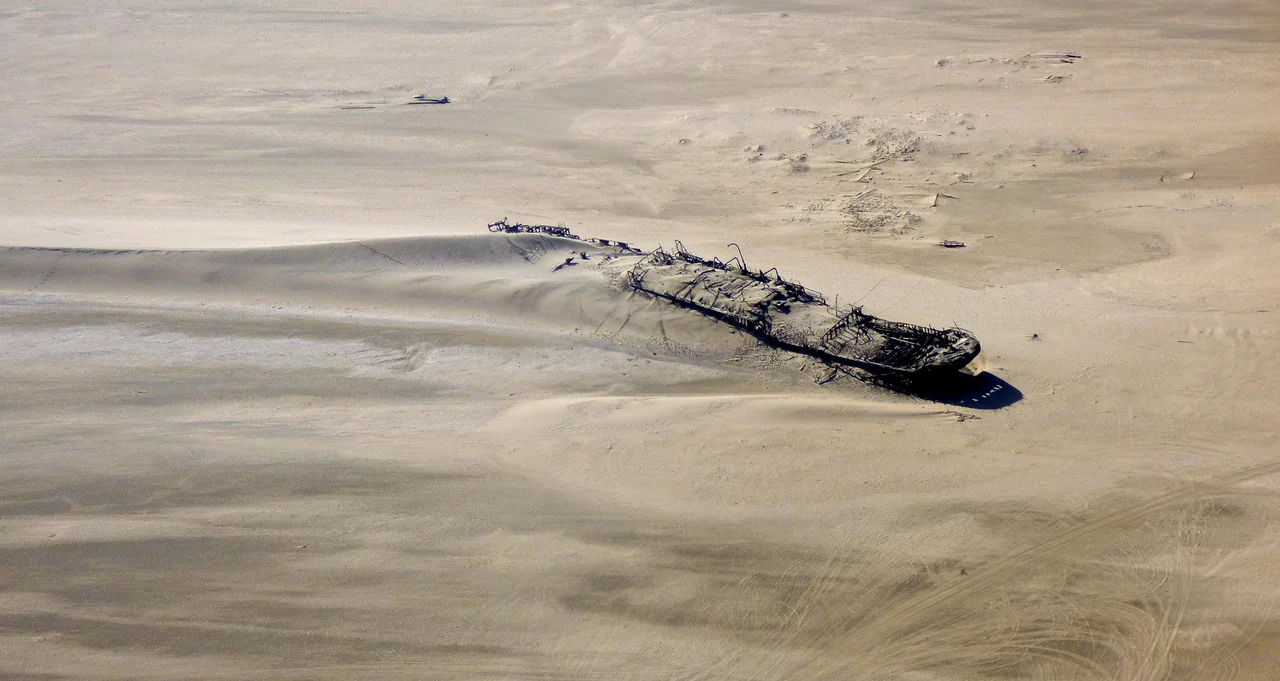

Eduard Bohlen
There is a ship in the desert, and it has been walking inland for more than a century. The Eduard Bohlen ran aground on Namibia's Skeleton Coast on 5 September 1909, blinded by the thick fog that rolls off the cold Atlantic and smothers this shore for much of the year. She did not sink. The sand came to her instead. Today the rusted hull lies some four hundred metres from the waterline, half-swallowed by the dunes of Conception Bay, a freighter stranded in an ocean of sand where there should be no ship at all.
A Coast Built to Drown Ships
The Portuguese sailors who first charted this coastline called it the Gates of Hell, and the name stuck for good reason. The Benguela Current carries frigid water up from the Antarctic, and where it meets the desert heat, fog blooms thick and persistent, swallowing the horizon. Add offshore reefs, unpredictable currents, and a near-total absence of safe harbours, and you have a graveyard. The shore is littered with the bones of vessels that misjudged the murk, their wrecks giving the Skeleton Coast its grim modern name. The Eduard Bohlen is the most famous of them, but she is far from alone.
The Last Voyage
Built in Hamburg in 1891 by Blohm and Voss, the Eduard Bohlen was a 2,272-ton steamship of the Woermann Line, ninety-five metres of iron designed for the run between Germany and its African colonies. On her final voyage she was steaming from Swakopmund toward Table Bay, her holds loaded with supplies for the diamond prospectors then swarming the desolate stretches near Lüderitz. Then the fog closed in. She struck the shallows off Conception Bay and held fast. Salvage crews tried to pull her free, but the sandbar would not release its grip, and by late 1909 her owners gave up. The miners she had been resupplying stripped what cargo they could reach and used the hull for shelter.
The Slow March Inland
What happened next is the reason people travel hours across trackless gravel to see her. The Namibian coastline does not hold still. Wind and current shovel sand against any obstacle, and the wreck became a seed around which the desert grew. Within ten days of the grounding, witnesses reported, enough sand had banked up that you could walk from ship to shore at low tide. The process never stopped. The waterline retreated, the dunes advanced, and over a century the Eduard Bohlen effectively migrated some four hundred metres from the sea. She is not a wreck the ocean abandoned. She is a wreck the desert claimed.
The Company She Keeps
The Eduard Bohlen is the most photographed wreck on this coast, but the desert is full of her companions. A few kilometres up the same beach lies the wreckage associated with the Dunedin Star, a British cargo liner that grounded in 1942 and triggered a desperate, drawn-out rescue across the dunes, an ordeal that cost lives among the would-be rescuers as much as the stranded. Up and down the Skeleton Coast, the sand hides ribs of timber and plates of iron from ships whose names are mostly forgotten. The Bohlen survives in memory partly through luck: she is large, intact enough to read as a ship, and reachable by those willing to make the journey. The rest of the coast's victims simply vanished into the dunes that are still, slowly, claiming her too.
An Icon of Decay
Stripped, rusted, and photogenic, the hull has become one of the most recognisable images of the Skeleton Coast. Film crews and television series have made the pilgrimage, framing the ship against the emptiness: a documentary on the nearby Dunedin Star disaster, the Amazon series The Grand Tour, even a scene in the 2024 adaptation of Fallout. The appeal is the same every time. There is something deeply strange about a seagoing vessel lying in a dune field, oxidising under a desert sun, with the nearest waves a long walk away. She is a monument to a coast that takes ships and keeps them, and to a landscape patient enough to bury the sea itself.
From the Air
The Eduard Bohlen lies at 23.996°S, 14.457°E on the central Namibian coast at Conception Bay, roughly 100 km south of Walvis Bay within the restricted Namib-Naukluft and former Sperrgebiet diamond zone. The wreck shows as a small dark gash against pale dune sand a few hundred metres inland of the surf line; best spotted from 1,500 to 3,000 ft AGL in the clear afternoon window before the coastal fog rebuilds. Frequent morning fog and low stratus off the Benguela Current can reduce visibility to near zero along this shore, so plan viewing for midday or later. Nearest controlled field is Walvis Bay International (FYWB) to the north; Swakopmund (FYSM) lies just beyond it. This is remote, sparsely served airspace with no nearby diversion options, so carry generous fuel reserves.
Nearby Stories
- Namib-Naukluft National Park 39 km away
- Sandwich Harbour 42 km away
- Sossusvlei 85 km away
- Deadvlei 91 km away
- Spreetshoogte Pass 109 km away
- Cape Cross 218 km away
- 1997 Namibia Mid-Air Collision 644 km away
- Cospatrick 1430 km away