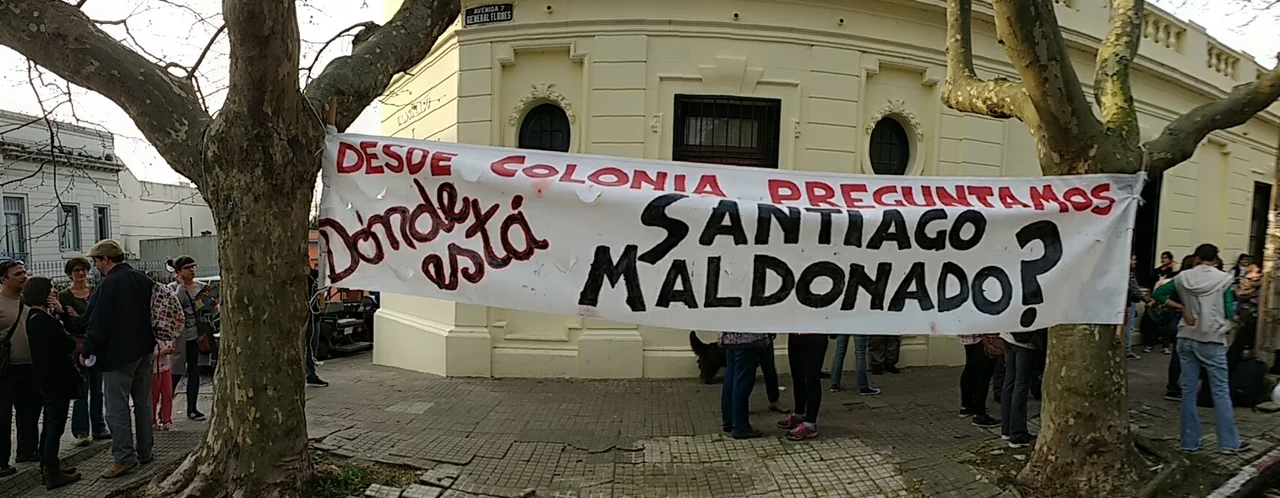

Death of Santiago Maldonado
For seventy-seven days in the winter and spring of 2017, two words appeared on walls and banners across Argentina, asked in marches from Patagonia to Buenos Aires: Donde esta? Where is he? The he was Santiago Maldonado, a 28-year-old tattoo artist and craftsman who had vanished on 1 August during a protest along a remote Patagonian highway. His disappearance touched a raw national nerve, summoning the ghosts of an earlier era when people simply disappeared. When his body was finally found in the cold Chubut River, the answer to the question only deepened the country's grief and division.
A Protest on Route 40
Santiago Andres Maldonado was born on 25 July 1989 in Veinticinco de Mayo, in Buenos Aires province. A craftsman and tattoo artist, he had recently moved south to El Bolson, drawn to the landscape and, his brother said, to the cause of the Mapuche communities pressing land claims against the Italian clothing company Benetton. On 1 August 2017, members of a Mapuche group occupying disputed land at the Pu Lof de Cushamen blocked National Route 40 to demand the release of a jailed leader. The National Gendarmerie was ordered to clear the road. In the confusion of the dispersal, witnesses said, Maldonado was among the protesters who fled toward the Chubut River. After that moment, no one could say for certain where he was.
A Nation Asks the Question
His disappearance became something far larger than one missing man. To many Argentines it evoked the darkest chapter in the country's recent history - the 1976 to 1983 dictatorship, when thousands were taken by the state and never seen again. Human rights organizations, including the Grandmothers and Mothers of the Plaza de Mayo, took up his case. Tens of thousands marched in Buenos Aires, Rosario, Cordoba, and dozens of other cities; solidarity rallies spread to Spain, Brazil, Uruguay, and beyond. The case landed weeks before national midterm elections, and it became fiercely political, woven into the bitter contest between the governing coalition and its opponents. Beneath the politics, a family simply wanted their son and brother back.
The River Gives Him Back
On 17 October 2017, after divers searched a stretch of the Chubut River choked with aquatic plants and strong current, a body was recovered roughly 300 meters upstream of where the protest had taken place. It was a man in light blue clothing, matching what witnesses recalled Maldonado wearing. The autopsy four days later, witnessed by 52 experts including those chosen by the family, found the cause of death to be drowning and hypothermia, with no signs of violence on the body. In November, a commission of 55 forensic specialists reached the same conclusion. The river, it appeared, had taken him on the day he disappeared - and the cold water had hidden him for nearly three months.
What the Verdict Could Not Settle
The forensic findings did not close the wound. In November 2018, a federal judge closed the case as an accidental drowning, and the gendarmes who had been under investigation were dismissed of wrongdoing. International bodies that had pressed Argentina to investigate found no evidence of foul play. Yet Maldonado's family rejected the conclusion, maintaining that he was the victim of a forced disappearance and that crucial questions about the Gendarmerie's conduct that day were never fully answered. The case remains contested in Argentina to this day - read by some as a tragedy of a man swept away by a river, by others as something the state has yet to fully account for. What is not in dispute is the human cost: a young life ended, and a family that has never stopped grieving.
From the Air
Santiago Maldonado disappeared in the remote Cushamen region of northwestern Chubut Province, near National Route 40 along the Chubut River, in Andean Patagonia roughly at 42 degrees S, 71 degrees W - far inland and west of the coastal cities; the broader article coordinates near 43 degrees S, 65 degrees W reflect Chubut Province generally. Recommended viewing altitude over the Cushamen area is 5,000-8,000 feet AGL, where the river valleys cut through arid pre-Andean terrain rising toward forested mountains to the west. The nearest significant airport is Esquel (ICAO: SAVE), about 70 km south; Bariloche's San Carlos (ICAO: SAZS) lies further north. Mountain weather here is changeable - expect wind, and reduced visibility near the Andes. This is a place tied to a human tragedy; travelers often pass through it with respect and reflection.
Nearby Stories
- Museum of Paleontology Egidio Feruglio 36 km away
- Valdés Peninsula 41 km away
- Islote Lobos National Park 144 km away
- Bahía Bustamante 229 km away
- Balneario El Cóndor 246 km away
- Potosi (barque) 262 km away
- Sol Líneas Aéreas Flight 5428 277 km away
- Disappearance of ARA San Juan 510 km away