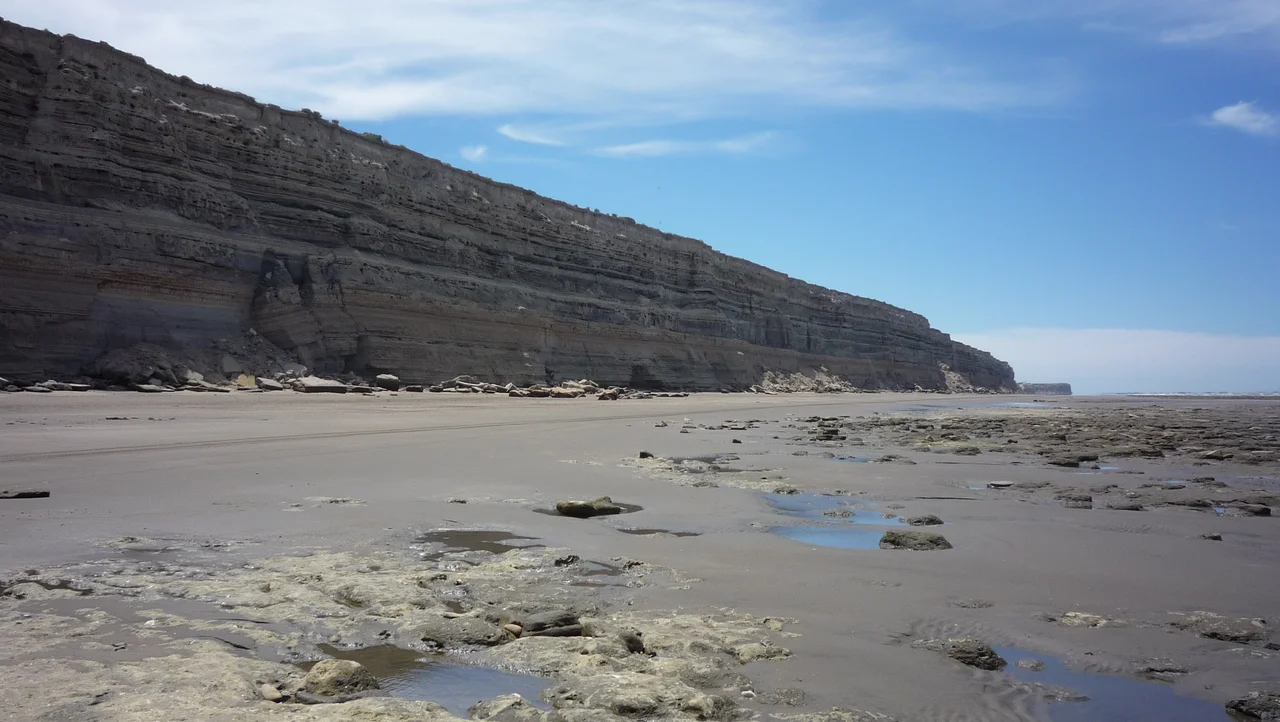

Balneario El Cóndor
At dawn the cliffs come alive. Tens of thousands of green parrots pour out of holes in the sandstone, a screeching emerald cloud that wheels over the beach and out toward the sea. This is the largest known colony of burrowing parrots in the world, and very possibly the largest colony of any parrot species anywhere. It clings to a few kilometers of crumbling cliff at the precise point where the Río Negro finishes its long journey across Patagonia and empties into the Atlantic. The locals call the resort below it El Cóndor. The parrots have no name for it. They simply own it.
A City in the Cliff
The numbers are staggering. When researchers surveyed the colony in 2001, they counted more than 51,000 burrows carved into the soft sandstone, of which roughly 37,000 were active nests. The colony stretches along several kilometers of cliff face that averages around 26 meters high, a vertical apartment block excavated entirely by beaks and claws. Burrowing parrots dig tunnels up to three meters deep, raising their young in the cool dark behind the rock. The species is intensely social, mating for life and returning to the same colony year after year, so the cliff is less a roost than a multigenerational town. So much of the world's population depends on this single stretch of coast that scientists consider it irreplaceable. Lose these cliffs, and you lose most of the parrots.
Studying the Unstudiable
A colony this enormous is almost impossible to count. Researchers have spent decades trying to pin down its size, hiking the cliff base, scanning the holes, and more recently turning artificial intelligence loose on aerial imagery to tally tens of thousands of nest entrances. The cliff fights back at every turn. It is forever crumbling, shedding chunks of sandstone in landslides that bury old burrows and expose fresh faces for new ones. That instability is exactly why the parrots flourish here, since soft, freshly fallen rock is easier to excavate than hard old stone. The colony is not a fixed monument but a shifting thing, migrating slowly westward along the coast over the years as the cliff erodes and the birds follow the diggable ground.
Where the River Ends
Arrive at kilometer 31 of Provincial Route 1, follow the access road to its end at the Playa Grande, and the geography lays itself out. To the left, the long coast runs toward the mouth of the Río Negro, where fresh water meets the Argentine Sea. To the right, where the cliffs begin, stands the oldest lighthouse in Patagonia, a weathered sentinel that has watched this estuary for generations. The parrot colony begins just past it, on the Playa del Faro, only a couple of kilometers west of the small town. The cliffs are unstable, and landslides are frequent, which is partly why the parrots thrive here. Fresh crumbling sandstone is easier to dig.
The Widest Beach in Patagonia
El Cóndor is built for open space. The beaches run extraordinarily wide and gently sloping, broadest near the river mouth where the sand seems to stretch forever toward the surf. Roughly 80,000 visitors come each year, making this the second most popular resort in Río Negro Province, yet the beach never feels crowded because there is simply so much of it. The town offers one of the widest ranges of activities on the Argentine coast: sailing across the broad sand, diving, fishing for the famous catches at the river mouth, and paragliding straight off the cliff that the parrots call home. Infrastructure stays sparse, growing only a little each year alongside the town itself.
From the Air
Balneario El Cóndor sits at 41.08°S, 62.80°W, on the Atlantic coast roughly 30 km southeast of Viedma at the mouth of the Río Negro. From the air, look for the dark estuary where the river meets the sea, the line of sandstone cliffs running west from the river mouth, and the old lighthouse marking where the cliffs begin. The nearest airport is Gobernador Edgardo Castello Airport at Viedma (ICAO SAVV), a short hop northwest. Comandante Espora at Bahía Blanca (SAZB) lies about 270 km northeast. Coastal visibility is generally excellent, though sea fog and strong onshore winds are common. Fly the coastline at low altitude to trace the cliffs and the wide pale beaches against the blue Argentine Sea.
Nearby Stories
- San Antonio Oeste 141 km away
- Valdés Peninsula 143 km away
- Desert Campaign (1833–1834) 147 km away
- Islote Lobos National Park 155 km away
- Port Belgrano Naval Base 211 km away
- Punta Alta 241 km away
- Puerto Madryn 249 km away
- Disappearance of ARA San Juan 626 km away