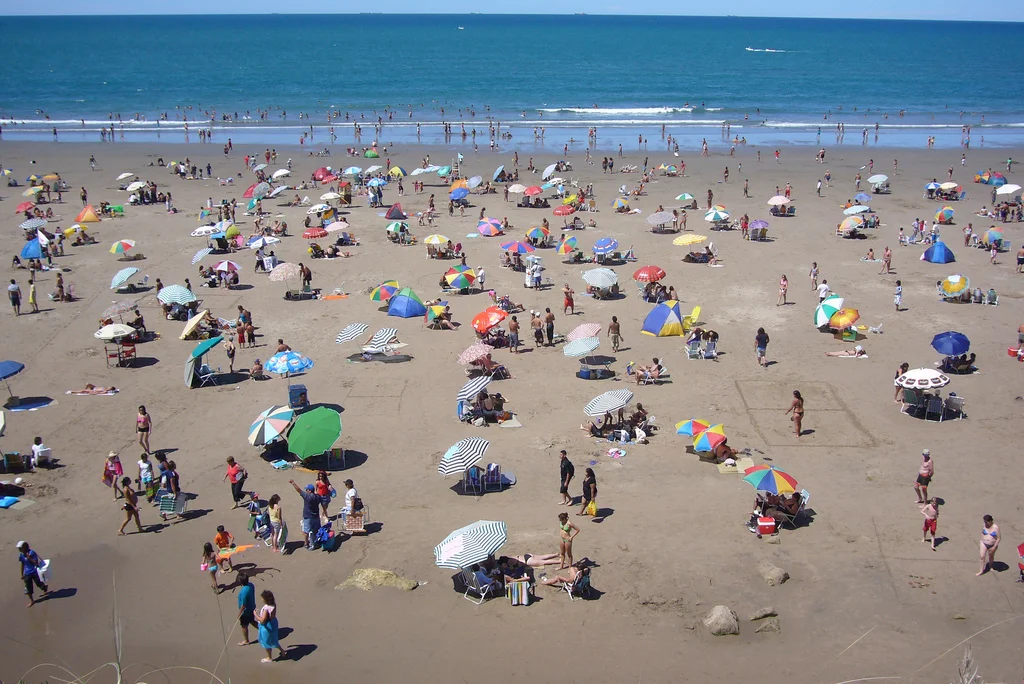

San Antonio Oeste
Wait for low tide at San Antonio Oeste and the bay simply leaves. Where there was a shallow sea, suddenly there is a vast wet plain, and locals walk out across what was the seafloor an hour earlier, picking their way over ground that the Atlantic will reclaim by evening. This is a town shaped entirely by the breathing of the tides, a fishing port at the head of a bay on the San Matías Gulf, in the dry Patagonian north of Río Negro province.
Three Towns, One Bay
San Antonio Oeste is really a trio of places strung around the water. The town proper, home to roughly 27,000 people, sits on the western shore, the busiest fishing port in northern Patagonia. Across the bay lies San Antonio Este, a working harbor that ships out the fruit and vegetables of the Río Negro valley. And fifteen kilometers southwest sprawls Las Grutas, the reason most visitors come at all. The center of the old town is largely modern and unremarkable, though it keeps a neo-classical municipal building and a neo-baroque church, and the harbor quarter still holds rows of picturesque, weathered wooden houses, many of them run down but full of character.
The Warmest Sea in Argentina
Las Grutas takes its name, The Caves, from the caverns hollowed into the cliffs that back its beaches. Its real claim is the water. Thanks to the enclosed shape of the San Matías Gulf, an enormous tidal range, sun, and almost no rain, the sea here is the warmest on the entire Argentine Atlantic coast, climbing into the low-to-mid twenties Celsius in late summer. That warmth transformed a quiet shore into an in destination from the 1990s onward. In January and February the resort overflows with families and young crowds; numbered stairways called bajadas drop down the rock face to the sand, which all but vanishes at high tide.
Quiet Beaches and Red Rock
Away from the packed central beach, the coast turns generous and empty. Four kilometers south of Las Grutas, Playa Piedras Coloradas curls beneath red rock; farther on, sandy Playa El Fuerte looks out toward a rocky hill on the shore. Across at San Antonio Este, the brilliant white Playa Las Conchillas owes its color to a mix of sand and milled clam shells, and a small sea lion colony hauls out nearby. North of there, the little peninsula of Punta Perdices and the bay of Caleta Falsa hold startlingly blue water and pale, near-empty beaches, beautiful and almost serviceless, for those willing to seek them out.
Gateway to the Northern Coast
The town makes a natural base for the wider coast. South lie Sierra Grande and the red desert hills above Playas Doradas, with their own sea lion and penguin colonies. East toward Viedma and Carmen de Patagones, the oldest settlements in Patagonia, the shoreline shelters parrot and sea lion colonies along Ruta Provincial 1. And down the gulf sits Islote Lobos National Park, where the world's northernmost Magellanic penguins nest. The airport here carries no scheduled flights at present, so most travelers arrive by long-distance bus or by the slow, twice-weekly train that still runs the line between Viedma and Bariloche, pausing at San Antonio on its way across the steppe.
From the Air
San Antonio Oeste sits at 40.73°S, 64.95°W at the head of the Bay of San Antonio, an inlet of the San Matías Gulf on the Atlantic coast of Río Negro province, Argentina. From altitude the bay is the landmark: an arm of water that drains to broad mudflats at low tide, with the town on its western shore and the Las Grutas cliffs about 10 km southwest. The local airport currently has no scheduled passenger service; the nearest served airports are at Viedma (Gobernador Edgardo Castello, ICAO SAVV) to the east and Puerto Madryn (El Tehuelche, ICAO SAVY) to the south. Expect a dry, sunny climate with strong, steady wind and excellent visibility.
Nearby Stories
- Islote Lobos National Park 55 km away
- Viedma 113 km away
- Balneario El Cóndor 130 km away
- Chimpay 155 km away
- Desert Campaign (1833–1834) 198 km away
- Sol Líneas Aéreas Flight 5428 215 km away
- Facundo Astudillo Castro 279 km away
- Neuquén 299 km away