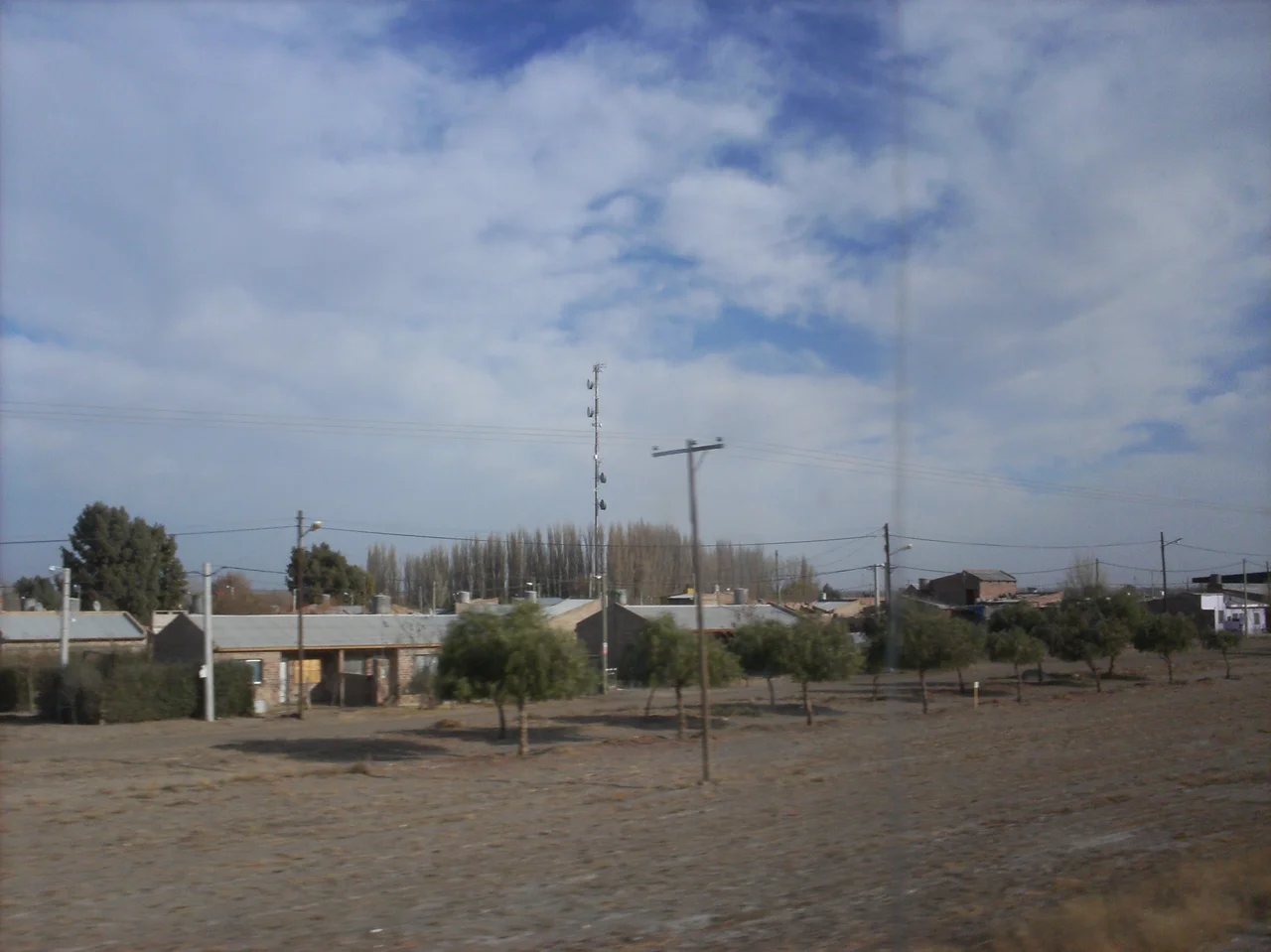

Chimpay
For most of the year, Chimpay is almost silent. A few hundred souls live along the left bank of the Río Negro, where steep clay slopes called bardas rise above the orchards and the highway runs straight toward the horizon. Then August arrives, and the population multiplies. Thousands of pilgrims pour into this small town in the Mid Valley to mark the birth of a boy who lived only eighteen years and never held office, never led an army, never grew famous in his lifetime. They come for Ceferino Namuncurá, born here in 1886, the son of a defeated Mapuche chief and a captured Chilean woman, and now the first person born on South American soil ever to be beatified by the Catholic Church.
When the Desert Was Conquered
Long before the orchards, the Tehuelche and the Mapuche lived across this land. In the 1870s, the Argentine army pushed south in the campaign history calls the Conquest of the Desert, and the people who had always ridden these plains were driven before it. The local lonco, or chief, was Manuel Namuncurá, and for years he fought the advance. In 1884 he surrendered. A Salesian priest, Domingo Milanesio, helped broker the terms. Namuncurá was granted land near present-day Chimpay and, in a gesture as much symbolic as practical, made a colonel in the army that had defeated him. It was here, on this granted ground, that his son was born two years later. The mother, Rosario Burgos, was a Chilean woman taken during a raid. Out of conquest and loss, a life began.
The Lily of Patagonia
Ceferino grew up between two worlds and chose to bridge them. Baptized at eight by Father Milanesio, he left for the Salesian college in Buenos Aires in 1897, determined to learn so he could return and serve his own people. "I want to study to be useful to my people," he is remembered as saying. Tuberculosis had other plans. The illness that haunted so many Indigenous communities after contact took hold of him, and the Salesians sent him to Italy for treatment and education. He met Pope Pius X in Rome. But the disease advanced, and on 11 May 1905, at a hospital in the city, he died. He was eighteen. Argentines came to call him the Lily of Patagonia, mourning a gentleness the world had barely glimpsed.
A Saint Comes Home
Devotion grew slowly, then everywhere. By the 1960s, people across Argentina prayed to Ceferino, and Chimpay became a place of pilgrimage. A statue rose in 1971. In 1999, after a woman in Córdoba Province recovered from advanced uterine cancer, the healing was attributed to him, and the path to beatification opened. On 11 November 2007, the ceremony was held not in Rome but here in Chimpay, on the boy's own land. An estimated 100,000 people filled the town. It was one of the first beatifications ever held outside the Vatican, and the first for anyone born in South America. The boy who left to be useful had, in a sense, finally come home.
Cherries and Pilgrims
Today two currents sustain Chimpay. The orchards came around 1900, after the railway arrived in 1889 on the Bahía Blanca line, and fruit companies expanded through the late 1990s. The town is now known for its cherries, celebrated each year at the Provincial Cherry Festival with fairs, music, and craftwork. The other current is faith. At the Ceferinian park, a chapel woven with Mapuche and Tehuelche symbols stands beside a lagoon and paths shaded by trees. A marble statue of the young man, five meters tall on a four-meter base, was unveiled in 2009. Most days the streets are calm. But the town holds, year-round, the memory of a boy who belongs to two peoples and now to a whole continent.
From the Air
Chimpay sits at 39.17 degrees south, 66.15 degrees west, on the left bank of the Río Negro in the province's Avellaneda Department, at roughly 149 meters elevation. From the air, look for the bright green ribbon of irrigated orchards threading along the river through otherwise dry, semi-arid steppe, bounded by the eroded clay bluffs known as bardas. National Route 22 runs parallel to the valley and makes a clear navigational line. The nearest major airport is Neuquén's Presidente Perón International (SAZN), roughly 130 km west up the valley; Santa Rosa (SAZR) lies to the northeast and Bahía Blanca's Comandante Espora (SAZB) far to the east. Skies here are often clear in the dry climate, offering long visibility across the valley floor.
Nearby Stories
- Lihué Calel National Park 100 km away
- Neuquén 111 km away
- San Antonio Oeste 165 km away
- Sol Líneas Aéreas Flight 5428 215 km away
- Islote Lobos National Park 251 km away
- Facundo Astudillo Castro 288 km away
- Vaca Muerta 295 km away
- Espacio Lejano Station 345 km away