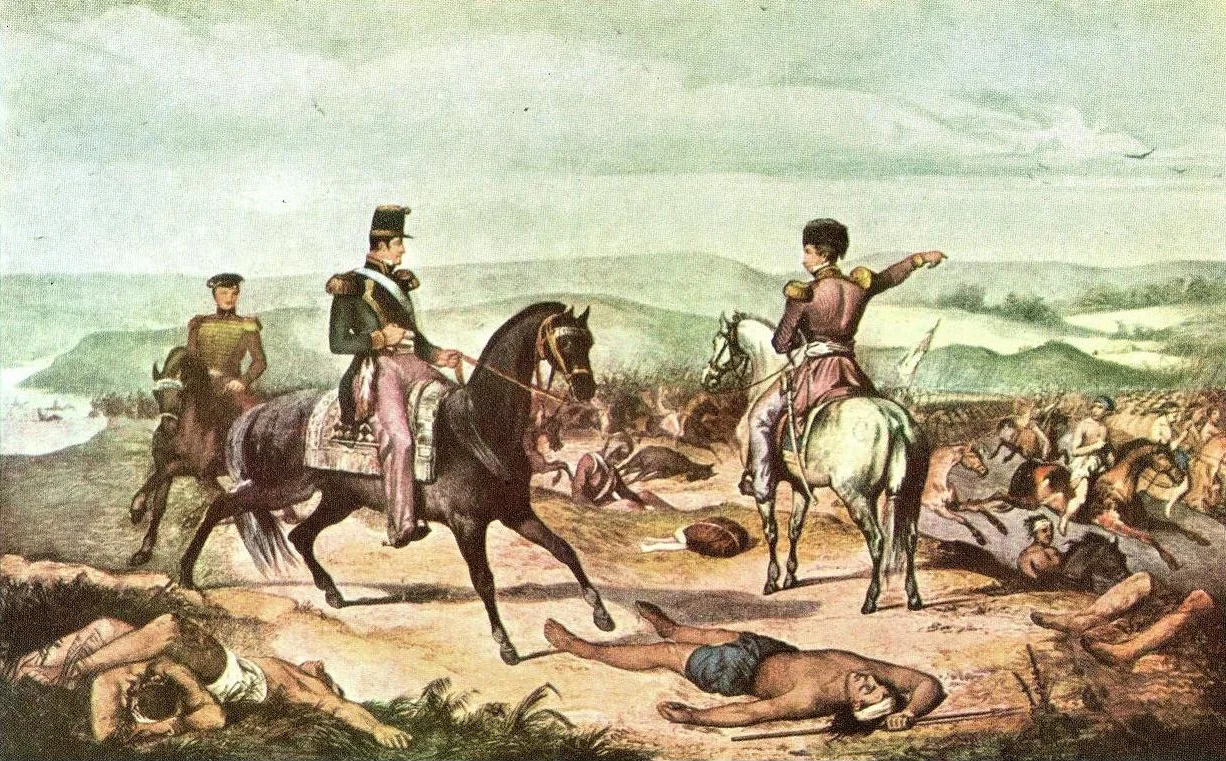

Desert Campaign (1833–1834)
They called it a desert. It was not. The grasslands rolling south from Buenos Aires toward the Andes and Patagonia were home to the Ranquel and Mapuche peoples, who had lived, hunted, traded, and raised families across these plains for generations. The word 'desert' was a useful fiction, a way of describing a populated homeland as empty space waiting to be claimed. In 1833, Juan Manuel de Rosas led an army into that homeland. The campaign that bears the name 'Desert' was, in plain terms, a war against the people who already lived there.
The Governor and the Frontier
Rosas had just finished his first term as governor of Buenos Aires when he turned his attention south. The civil wars that had consumed the young Argentine state were in a lull, and the frontier with the indigenous nations became his new project. His successor as governor, Juan Ramón Balcarce, gave him permission to march, brushing aside proposals to deny it. What followed was meant to finish what earlier leaders had only attempted. Rosas built on the failed frontier campaigns of Martín Rodríguez and Bernardino Rivadavia, but with greater force and deeper ambition. Where his predecessors had probed, he intended to conquer.
Friends, Allies, and the People He Named Enemies
Rosas sorted the indigenous peoples into three categories: friends, allies, and enemies. 'Friends' could settle within Buenos Aires province, some even on Rosas's own land, and received cattle and goods. 'Allies' kept their territories and independence. He learned the Puelche language himself and interviewed the caciques in person, later compiling a grammar and dictionary of the Pampa tongue, the gesture of a man who studied the people he intended to subdue. The third group, the 'enemies,' were mostly Ranquel and Mapuche who had refused to bend to either Spanish colonial rule or the Argentine state. These were the people the campaign came to destroy. Defending one's own land was, in Rosas's ledger, the crime of being an enemy.
Yanquetruz and the Long Resistance
The Ranquel did not wait passively for the columns to arrive. They were led by Yanquetruz, a renowned warrior who had come south from Chile and mastered the open plains. His fighters harassed the advancing troops with hit-and-run raids, cut their supply lines, and drove off the horses an army on the pampas could not live without. The Spanish-speaking columns scored battlefield victories: Ruiz Huidobro broke Yanquetruz at the Acollaradas lakes in March 1833, and Aldao beat him at Arroyo del Rosario that April. But victory on the plains proved hollow. Aldao's men were ambushed and mauled at Balsa Pass in May; Huidobro lost a supply convoy to the Ranquel and was forced to retreat. The harsh, roadless terrain, with no settlements and every provision hauled from distant Buenos Aires, fought as hard against the invaders as any warrior did.
What the 'Desert' Cost
Rosas pushed deeper than anyone before him, and where his army went, indigenous settlements were burned. He later claimed his forces had killed 3,200 indigenous people, taken 1,200 prisoners, and freed 1,000 captives held by the tribes. Behind that tally lie families destroyed, communities scattered, and a people pushed steadily off land that had always been theirs. They were not erased. They fought on for decades, even striking back during the Battle of Caseros years later. But the ground kept shrinking beneath them, and they retreated ever southward. The final blow came in the 1870s and 1880s, when Julio Argentino Roca's Conquest of the Desert completed what Rosas had begun. The grasslands were emptied at last, not because they had ever been empty, but because the people who filled them were driven out or killed.
From the Air
The 1833–1834 campaign ranged across the southern Pampas and into northern Patagonia, from the Atlantic to the Andes. The coordinates 39.50°S, 62.36°W mark a point near the Colorado River, the rough frontier line Rosas's forces pushed toward and beyond. From the air this is vast, flat grassland and dry steppe, sparsely settled even today, with the Colorado River winding eastward to the sea. The nearest major airport is Comandante Espora at Bahía Blanca (ICAO SAZB) to the northeast; Viedma's Gobernador Castello (SAVV) lies to the south near the Río Negro. Visibility over the open pampas is typically excellent, with the curve of rivers the main navigational features in an otherwise unbroken horizon.
Nearby Stories
- Port Belgrano Naval Base 44 km away
- Monte Hermoso 55 km away
- Carmen de Patagones 118 km away
- Carmen de Patagones School Shooting 129 km away
- Viedma 149 km away
- Tres Arroyos 185 km away
- Lihué Calel National Park 274 km away
- Disappearance of ARA San Juan 792 km away