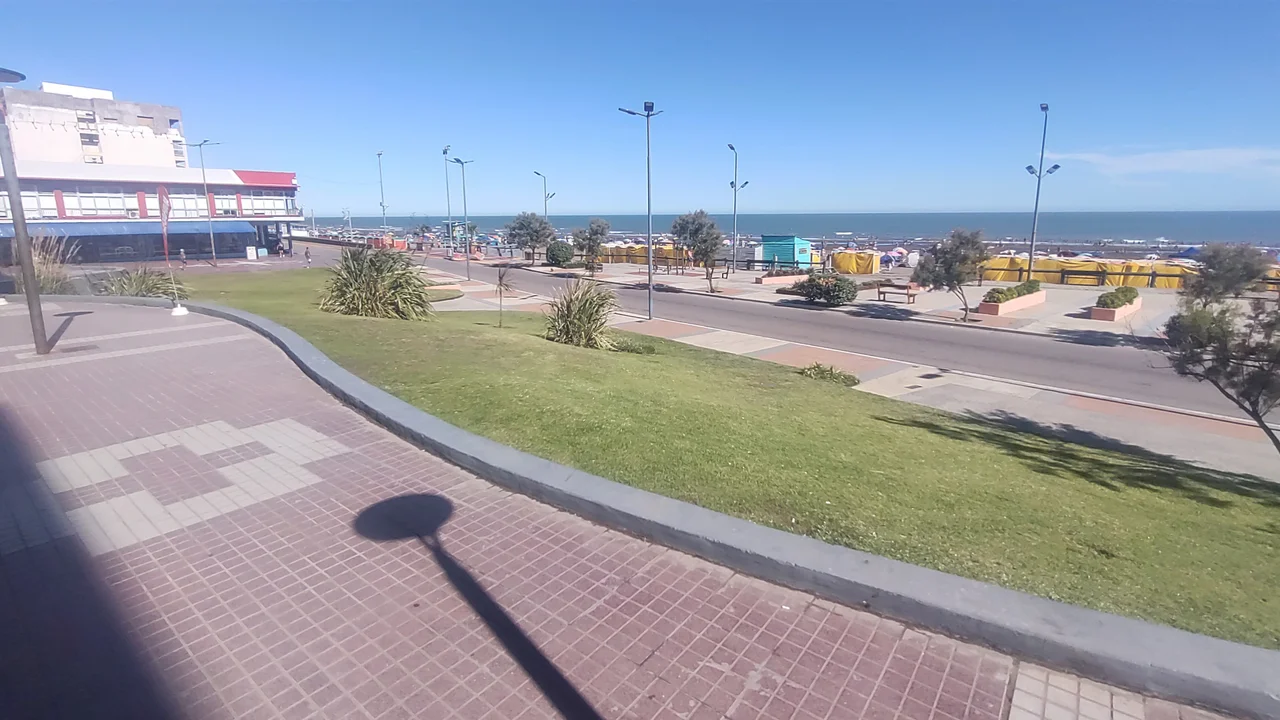

Monte Hermoso
At low tide on certain beaches near Monte Hermoso, the sand gives up something almost unbearably intimate: human footprints, pressed into ancient mud roughly seven thousand years ago and preserved through the millennia. Children, teenagers, men, women, walking the same shoreline that families walk today, their tracks laid down beside the prints of long-vanished animals. Few places collapse the distance between the deep past and the present so completely. You can stand on this coast in the same spot where someone stood before writing, before the wheel reached the Americas, and watch the same Atlantic roll in.
Footprints Across Seven Thousand Years
The coast around Monte Hermoso and neighboring Pehuén Co holds hundreds of fossilized human footprints, with some dated to around 7,800 years before present, alongside an extraordinary trove of animal tracks. Together these make the area one of the most important paleoichnological sites in the world, the kind of place where scientists read behavior rather than bones: where a person walked, how fast, in which direction, beside which beasts. The footprints are not the oldest in the Americas, an honor that belongs to far older tracks elsewhere, but they are among the most evocative, because they record not a skeleton but a moment of ordinary life. The reserve spanning Pehuén Co and Monte Hermoso has been proposed for UNESCO World Heritage status to protect this fragile record.
Darwin Walked Here Too
In October 1832, a young naturalist sailing aboard HMS Beagle came to this coast and started digging. Charles Darwin, then in his early twenties, collected fossils at Monte Hermoso on 19 October 1832, including the remains of a burrowing rodent, part of a haul of extinct South American mammals he gathered along the Bahía Blanca shoreline that season. Those fossils, the giant sloths and strange ungulates he pried from the cliffs nearby, would gnaw at him for years. Many scholars now argue that Darwin's encounter with the deep past on this stretch of Argentine coast pushed his thinking toward evolution as forcefully as the Galápagos finches that get all the fame. The plain-looking beach was, in its way, a cradle of an idea that changed the world.
A Tower from the Makers of the Eiffel
About seven kilometers east of town, on the road toward Sauce Grande, a slender red-and-white tower rises 73 meters from the dunes. The Faro Recalada is the tallest lighthouse in South America, and its pedigree is improbable: it was prefabricated in France by Barbier, Bénard et Turenne, a Parisian engineering firm that was the world leader in lighthouse construction in the late nineteenth century. Shipped across the Atlantic and bolted together on the Argentine shore, the octagonal cast-iron pyramid opened on 1 January 1906 to guide ships toward the port of Bahía Blanca. It still flashes white every nine seconds, and visitors can climb it on daily guided tours, trading the flat coastal view from the ground for a sweep of ocean and pampas from the gallery.
Where the Sun Rises and Sets on the Sea
Monte Hermoso owes its modern existence to one stubborn family. In 1879 Esteban Dufaur bought four thousand seaside hectares; his son Sulpicio founded the El Recreo estancia in 1910 and in 1918 opened the Hotel de Madera, built from lumber salvaged off a shipwreck washed up on the shore. From those beginnings grew a family beach resort with more than thirty-two kilometers of Atlantic sand and a quirk found nowhere else in Argentina: because of the way the coast curves, you can watch both the sunrise and the sunset over the open sea. Sea breezes keep the summers gentler than at rival resorts, and the water runs a touch warmer. It is an easygoing place built on an uneasy coast, where the same beach that fills with sunbathers each January still holds the footprints of people who walked it seventy centuries before.
From the Air
Monte Hermoso lies on the Argentine Atlantic coast at 38.98°S, 61.30°W, about 100 km east of Bahía Blanca in southern Buenos Aires Province. The standout aerial landmark is the 73-meter red-and-white Faro Recalada lighthouse, roughly 7 km east of town toward Sauce Grande, visible for a great distance along the otherwise low, flat coastline; the long arc of beach and the line where pampas meets ocean help orient navigation. Low-altitude passes (1,000-2,500 ft AGL) along the shore give the best views of the lighthouse and the fossil-bearing beaches near Pehuén Co. The nearest major airport is Comandante Espora at Bahía Blanca (ICAO: SAZB), about 100 km west; Buenos Aires Ezeiza (ICAO: SAEZ) lies far to the northeast. Coastal sea breezes and good visibility are typical, though marine haze can form.
Nearby Stories
- Punta Alta 18 km away
- Desert Campaign (1833–1834) 53 km away
- Sierra de la Ventana (mountains) 58 km away
- Tres Arroyos 59 km away
- Club Hotel de la Ventana 81 km away
- Carmen de Patagones 224 km away
- Yellow Fever in Buenos Aires 227 km away
- Disappearance of ARA San Juan 840 km away