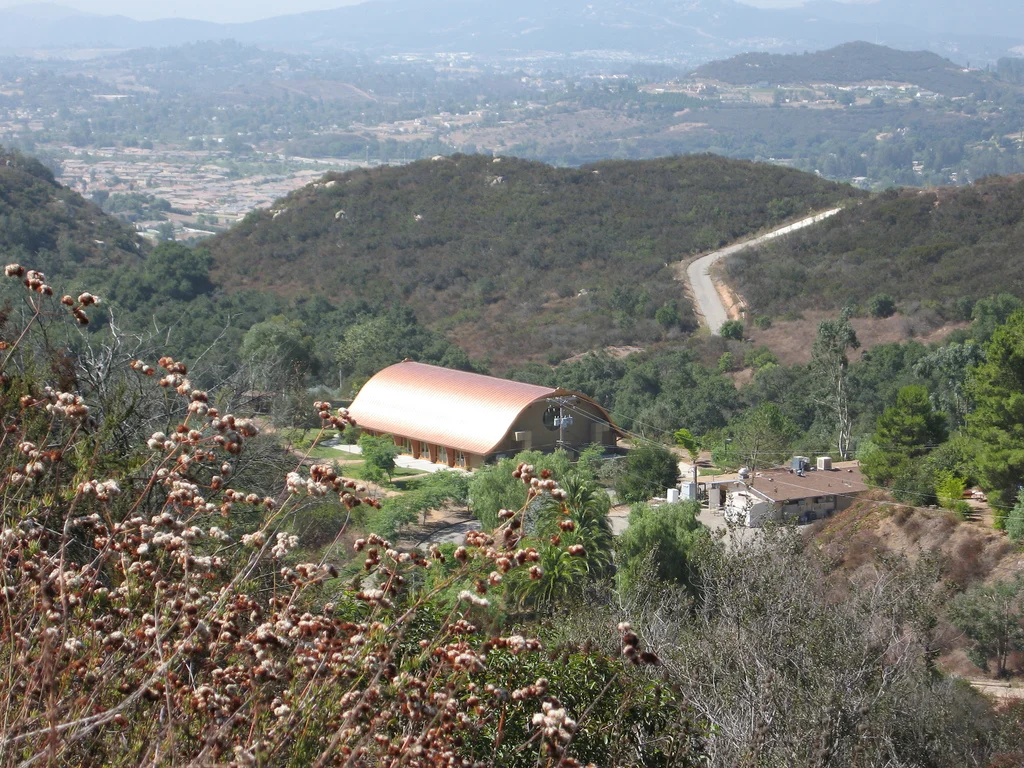

Deer Park Monastery
The Escondido hills are dry and steep, covered in chaparral, exposed to the sun for most of the day. It is not obvious terrain for a Buddhist monastery. But in July 2000, Thích Nhất Hạnh — the Vietnamese Thiền monk, poet, and peace activist who had spent decades teaching mindfulness in the West — established Deer Park Monastery on 400 acres of these hills, naming it after the deer park in Sarnath, India, where the historical Buddha gave his first teaching after his enlightenment. The location, with its heat and silence and distance from the coast, has its own logic: a place where the world's pace is hard to maintain.
Two Hamlets, One Practice
Deer Park is organized into two residential communities, following the structure of Plum Village, Thích Nhất Hạnh's original practice center in France. The Solidity Hamlet is home to monks and male lay practitioners; the Clarity Hamlet houses nuns and female lay practitioners. At the time of the monastery's establishment, approximately 27 monks and 35 nuns lived at Deer Park, carrying on a form of communal monastic practice rooted in the Vietnamese Thiền tradition — a school of Buddhism that emphasizes mindfulness as a continuous practice woven through daily activity rather than confined to formal meditation periods. The two-hamlet structure creates distinct residential spaces while maintaining the shared practice that defines the community.
Plum Village's American Branch
Deer Park is a sister monastery to Plum Village in France and to Blue Cliff Monastery in New York, forming a network of practice centers in the Western world where Thích Nhất Hạnh's approach to mindfulness can be transmitted in residential form. The relationship between the centers is not merely organizational — monastics move between them, teachings developed at one flow to the others, and the broader sangha of lay practitioners who connect with Plum Village communities in Europe can also access Deer Park's programs when they are in California or need a different setting for retreat. Weekly Days of Mindfulness at Deer Park are open to the public, offering day visitors a structured experience of the community's practice without requiring a longer residential commitment.
The Terrain and the Practice
Four hundred acres of Southern California chaparral is not a gentle landscape for walking meditation. The trails at Deer Park move through terrain that is rocky, sometimes steep, and genuinely hot in summer. The seasonal character of the landscape — brown and dry from June through November, briefly green after winter rains — is itself a teaching about impermanence that the monastery's location embodies more viscerally than a manicured garden would. Deer Park sits in the hills above Escondido at an elevation where the ocean is not visible but the sky is wide and the horizon is far. The surrounding chaparral, which has likely burned and recovered multiple times in the monastery's lifespan, grows back in a sequence that Thích Nhất Hạnh's tradition would recognize: not as interruption, but as continuation. The practice continues in the same way.
From the Air
Deer Park Monastery is located at approximately 33.1881°N, 117.074°W in the hills north of Escondido. The 400-acre property appears from altitude as an undeveloped block of chaparral amid the surrounding suburban and rural development. The monastery's buildings cluster in the valley areas of the property. Recommended viewing altitude 4,000–6,000 ft AGL. Nearby airports: KSEE (Gillespie Field, ~12 nm southwest), KOKB (Oceanside Municipal, ~14 nm northwest).
Nearby Stories
- Where Hollywood Came Home to Make Theater 0.5 km away
- Viejas Band of Kumeyaay Indians 3.4 km away
- Santa Ysabel Asistencia 3.8 km away
- Cahuilla Band of Indians 14 km away
- Tenaja Fire 15 km away
- Laguna Art Museum 16 km away
- Balboa Island Ferry 54 km away
- USS Agerholm 165 km away