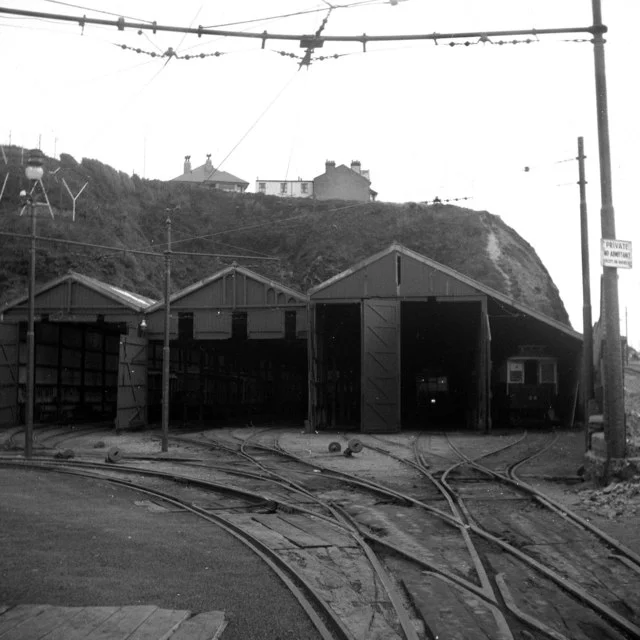

Derby Castle Depot
High on the cliffs above the running sheds at Derby Castle stands a small figure shaped like a tightrope walker. His name is Tommy Milner, and the legend at the depot is simple: while he stays in place, the railway is safe. In 1992 he was removed for repairs. A few weeks later a fire ripped through the bottom shed, almost destroying winter saloon No. 22. The car was rebuilt. Tommy was returned to his perch. He has not been moved since. This is the working heart of the Manx Electric Railway - a depot on reclaimed land at the northern end of Douglas promenade, where car sheds, paint shops and a Victorian power-station shell still keep one of the world's oldest electric tram lines running.
A Filled-In Creek
Where the depot stands now used to be open water. Port-E-Vada Creek was an inlet on the northern edge of Douglas Bay; it was filled in during 1892 to create the flat ground the railway needed. The first building on the new land was a power station, generating the electricity that the trams - which opened the following year - needed to run. The chimney has long since been demolished, but the stone shell of the original power station still survives at the far left of the yard, repurposed for maintenance. A footpath runs above the site, climbing the headland behind the depot. From the path you look down on the whole yard: the workshops at the bottom, the rebuilt sheds along the sides, and the cliff-face above them carrying the large illuminated sign that reads ELECTRIC RAILWAY in letters visible from across Douglas Bay.
The Sign That Came Back
The illuminated sign on the cliff was reinstated in 1993 as part of the celebrations marking the railway's centenary - the Year Of Railways festivities that ran across the island. The current sign is the latest in a series. Earlier versions read M.E.R. FOR SCENERY and, separately, advertised the long-vanished Derby Castle entertainment complex; one more sign in the same style had stood at the southern end of the White City amusement complex until 1985. The lights on the cliffs above the sheds were a deliberate piece of seaside theatre: a glowing sign visible from the promenade, telling visitors that this was the place where the trams to the north of the island departed from. The current incarnation marks the railway's continued life, after several decades when the older signs had simply rusted away.
Rebuilt and Rebuilt Again
The depot is a working facility, and working facilities get changed. In 1988 the layout was significantly altered: the old bonner siding, used for road-rail wagons, was removed, one road into the car shed was lifted, and a new oil and paint store along with a new works office was constructed between the two sets of car sheds. An ex-Aachen tramcar that had stood as a curiosity at the site was destroyed in the process. The shed to the right of the yard was completely replaced in 1998, the old wooden-doored building giving way to a steel-clad structure in a similar style. In 1999 the upper car sheds, built piecemeal between 1894 and 1924, were also demolished and rebuilt. The Manx Electric Railway Society opposed the demolition vocally, arguing for alternative accommodation. They were ignored. The new shed had teething problems - two roads ended up on lower levels than the others and could not be rail-connected - but it now functions as a vast improvement on what had decayed beyond economic repair.
Tommy Milner Keeps Watch
The little tightrope-walker figure on top of the lower sheds dates back to the railway's early years, and like a lot of railway traditions he is treated with a half-serious respect. The story is that if he is taken down, disaster follows. The 1992 fire is the evidence usually cited. There are other quiet customs in the yard too: the green corrugated hut at the mouth of the yard, which dates from the early days of the line, is still the signing-in area for crews. The site office at the entrance has survived every reorganisation. The ablutions block between the main sheds, with its toilets and showers, is the place where staff start and end their shifts. The site sits at multiple levels to accommodate rail access at different heights - the kind of working complexity that grew up over a century and now defines what the yard feels like to walk through.
From the Air
Located at 54.167 degrees north, 4.456 degrees west, geohash gcsu4, on the northern edge of Douglas promenade, Isle of Man. The nearest airport is Isle of Man (Ronaldsway) Airport (EGNS / IOM) about 11 km to the south-west. From cruising altitude, look for the curve of Douglas Bay along the eastern coast of the island, with the headland marking the depot's location at the northern end of the promenade. The illuminated ELECTRIC RAILWAY sign on the cliffs is visible from the air on clear evenings; the running sheds themselves form a distinctive multi-roofed complex below the headland path.
Nearby Stories
- St Bees Lighthouse 15 km away
- Celtic Array 22 km away
- Kirkmaiden 23 km away
- Isle of Whithorn 23 km away
- Seascale Lifeboat Station 31 km away
- German submarine U-1024 36 km away
- SS Georgetown Victory 40 km away
- Blackpool Illuminations 56 km away