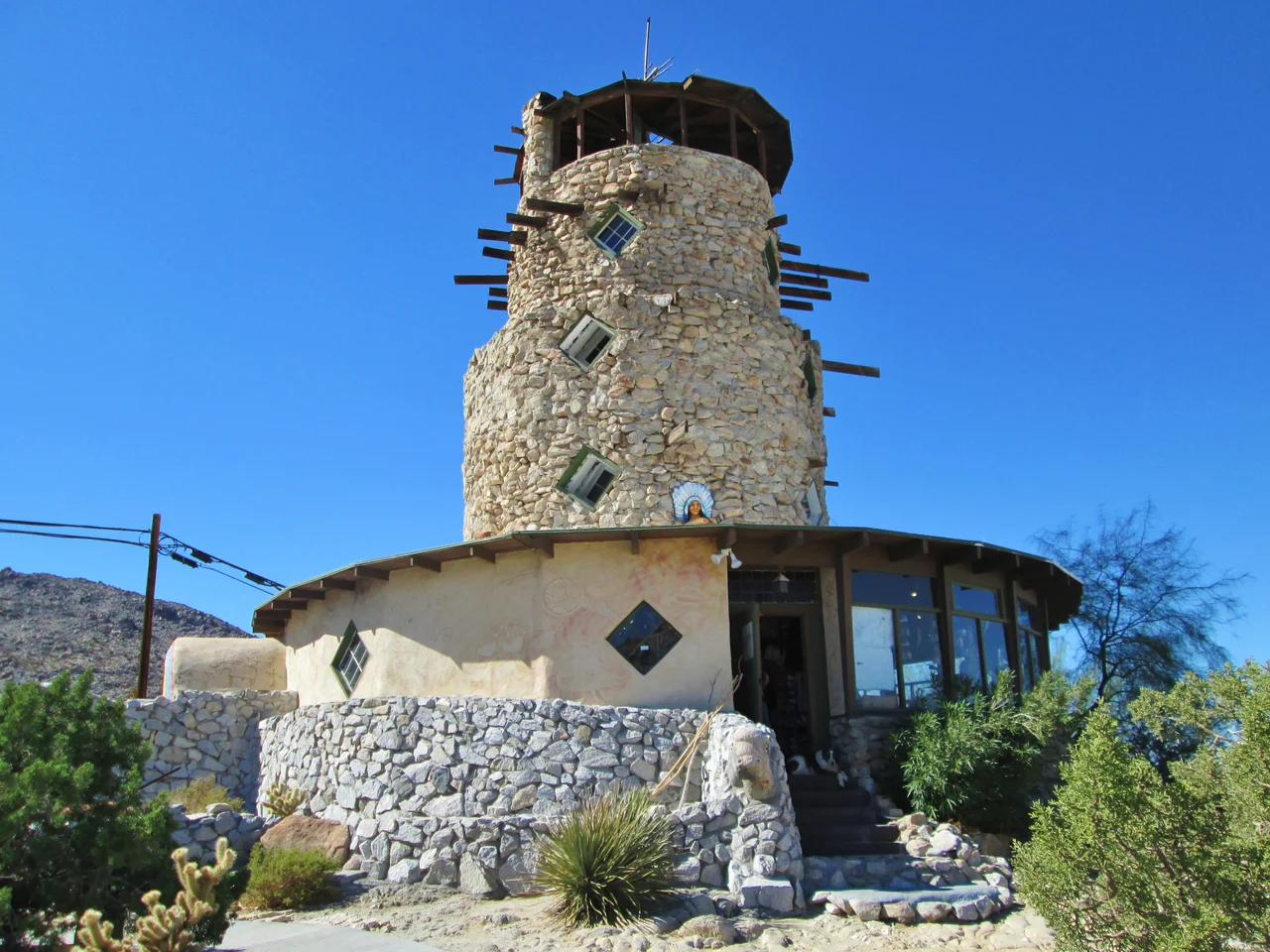

Desert View Tower
Standing at 3,000 feet in the In-Ko-Pah Mountains above the Imperial Valley, the Desert View Tower looks like something a person built because they needed to — not because they were commissioned to, or because a government asked them to, but because the view demanded a place to stand in it. Bert Vaughn, a San Diego real estate developer who owned the town of Jacumba a few miles west, began building the tower in 1922. He dedicated it to the pioneers and to the builders of the roads and railroads that made the crossing of these mountains possible.
The Crossing That Came First
Before the tower, before the railroad, before Interstate 8, there was the problem of getting across these mountains. Travelers between Yuma and San Diego had been making this passage for centuries; the mountains that separate the Imperial Valley from the coast presented a formidable barrier on every crossing. The first known wheeled vehicle crossing may have been Lieutenant E.B. Williston's 1856 journey from San Diego — briefly through Mexico, then up through Jacumba to Yuma.
A historical plaque next to the tower marks the site of the Mountain Springs Station, a stone building used from 1862 to 1870 as a store at a point where ox teams were needed to haul wagons up a 30 percent grade. Beginning in 1915, the Old Plank Road provided additional footing for motorcars crossing the desert approaches. By the time Vaughn started building his tower in 1922, motorized travel through here was established — though not yet easy. The tower also served a commercial function as a roadside advertisement for a restaurant and bar located on the old road across from it.
The Tower and Boulder Park
Vaughn's five-story stone tower houses a museum and has an observation deck on the upper level. From that deck, on a clear day, the view takes in the Imperial Valley floor below, the Salton Sea in the distance, and the mountains of Baja California to the south. The desert that the pioneers crossed is visible as a whole from this height in a way it cannot be from ground level.
Adjacent to the tower is Boulder Park, an ensemble of sculptural figures carved into the local stone by a man named Merle Ratcliff. He created them over two years during the Great Depression while he was unemployed — a WPA-adjacent exercise in making something from what was available, which in this case was time, skill, and the granite boulders already present in the landscape. Animals, faces, and other figures emerge from the rock throughout the park.
Both the tower and Boulder Park are classified as folk art — that is, work made outside the formal art establishment, driven by personal vision rather than institutional commission. The National Register of Historic Places listed them on August 29, 1980, and both were included in the Twentieth Century Folk Art Environments in California Multiple Property Submission.
What the Interstate Passes
Interstate 8 now runs through the same mountain crossing that once required ox teams. Tens of thousands of vehicles make the crossing daily — the trucks moving goods between the Imperial Valley and the coast, the cars traveling between San Diego and Phoenix, the RVs heading east from the Pacific. Almost all of them pass the exit for the Desert View Tower without stopping.
The tower stands at the edge of what was once US Route 80, the old transcontinental highway that Interstate 8 largely replaced. The section adjacent to the tower is one of the remaining portions of the old road. A gift shop operates at the base of the tower — a later addition to the original structure, as practical now as the restaurant and bar that Vaughn originally advertised.
The crossing of these mountains has never stopped being the crossing of these mountains. The grade has not changed. What has changed is the speed at which people manage it, and how little they look while doing so.
From the Air
Desert View Tower is located at approximately 32.659°N, 116.099°W at 3,000 feet elevation in the In-Ko-Pah Mountains, visible from Interstate 8. The tower is a recognizable landmark east of the Laguna Mountains grade. Nearest airports: KSAN (San Diego International, ~55 nm W), KIPL (Imperial, ~40 nm E), KSEE (Gillespie Field, ~40 nm NW).
Nearby Stories
- Mud Caves of Anza-Borrego 6 km away
- Capitan Grande Reservation 6.2 km away
- Mount Signal Solar 7.7 km away
- Brawley, California 17 km away
- Jamul Indian Village 18 km away
- Spanish Missions in Baja California 23 km away
- Off-roading in Baja 145 km away
- San Felipe 250 195 km away