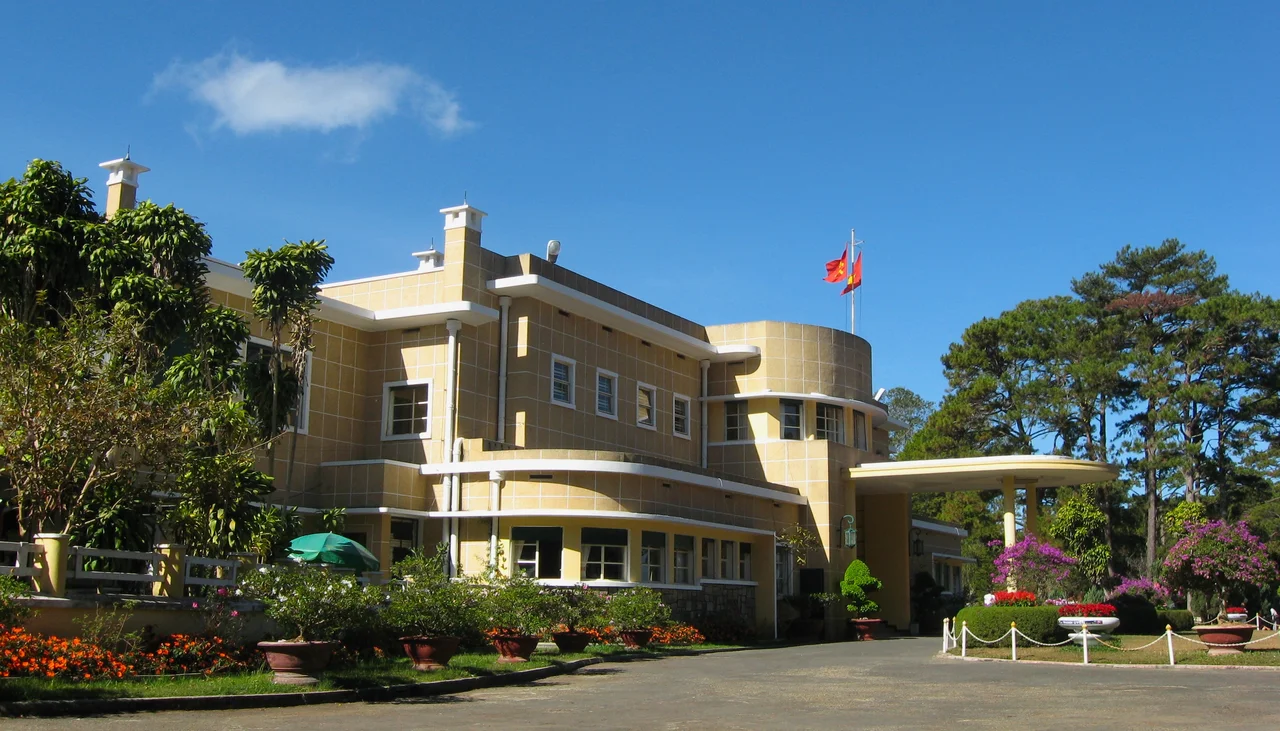

Dinh III
Bao Dai abdicated on August 25, 1945, and on August 30 handed his imperial seal and sword to a delegation of the new Viet Minh government at Ngo Mon Gate in Hue, declaring, famously, that he preferred to be a free citizen rather than the emperor of an enslaved nation. It was a moment of theatrical renunciation — but the house he left behind at Da Lat tells a quieter story. Dinh III, the mansion his French architects completed in 1938 on a hilltop in the Ái Ân forest, was not a seat of power in any conventional sense. It was a retreat: a summer home for a family — the emperor, his consort Nam Phuong, their children including Crown Prince Bao Long — in a highland city whose cool air and pine forests made it the preferred escape from the heat of the lowland court.
A Hilltop Built to Order
The commission for Dinh III grew out of French urban planner Ernest Hébrard's broader vision for Da Lat as a hill station that could serve both leisure and administration. French architects Paul Veysseyre and Arthur Kruze designed the mansion, positioning it at approximately 1,539 meters on a wooded rise that gave commanding views without ostentatious exposure. The design is symmetrical — flat roofs, expansive gardens, European lines softened by the surrounding pines — and it integrates with the highland landscape in a way the more ceremonial palaces of the lowlands do not. Construction ran from 1933 to 1938. By the standards of imperial residences, it is intimate: a family home rather than a throne room, its scale proportioned for the rhythms of highland summers rather than the pageantry of dynastic ceremony.
Family Seasons on the Mountain
For roughly seven years, Dinh III served the purpose it was built for. Bao Dai's family retreated here from the heat, from the obligations of court, from the increasingly complicated politics of a Vietnam caught between French colonial authority, Japanese wartime occupation, and the stirrings of independence. Nam Phuong, educated in France and deeply Catholic, brought a European sensibility to the household that aligned naturally with the highland setting. Bao Long, the crown prince, grew up spending summers here, learning something of the country his title claimed while that title was losing its foundations. The mansion's artifacts — furniture, personal objects, photographs — survived the subsequent decades and are preserved today as a record of a very specific kind of life: imperial but informal, colonial but Vietnamese, caught between two worlds that were moving fast toward a collision.
After the Emperor
Abdication did not end Dinh III's usefulness to the powerful. Under the Republic of Vietnam, presidents Ngo Dinh Diem and Nguyen Van Thieu both used the mansion as a high-end retreat for government officials — the same mountain air and pine-forest privacy that Bao Dai had valued were equally appealing to the republic's leadership. After reunification in 1975, the property passed to the Lâm Đồng provincial finance and administration department. It was managed as an administrative asset rather than a cultural site until 2000, when oversight transferred to the Xuân Hương Tourism Service Company and the mansion opened properly to visitors. The transition from imperial summer home to public museum took fifty-five years and passed through the hands of three successive political orders — each of which found its own use for the cool hilltop and the well-made rooms.
What Remains on the Hill
Visiting Dinh III today requires no particular historical imagination — the setting does the work. The pine forest presses close. The flat-roofed symmetry of the building stands against the hillside exactly as Veysseyre and Kruze positioned it. Inside, the preserved furnishings speak to the domestic reality of a family that was, simultaneously, the last bearers of a centuries-old dynasty and residents of a modernist French-designed house in the Central Highlands. In 2023, adjacent land near Dinh III was proposed for auction, a reminder that development pressures reach even the most storied sites. But the mansion itself endures, its hilltop intact, the Ái Ân forest still filtering the light that falls on a family's last, quietly ordinary summers.
From the Air
Dinh III sits at 11.9302°N, 108.4297°E in the southwestern residential quarter of Da Lat, at an elevation of approximately 1,539 meters on a forested rise. Approaching from the south at 3,000 meters, the hilltop compound is visible through the pine canopy southwest of Xuân Hương Lake. The nearest airport is Lien Khuong Airport (VVDL), approximately 28 kilometers south-southwest. The pine forests of the Langbiang Plateau surround the site; morning fog frequently clings to the treetops at this elevation. The Dalat Palace Hotel and Xuân Hương Lake are visible roughly 1 kilometer to the northeast as orientation landmarks.
Nearby Stories
- Tà Đùng National Park 3.1 km away
- Phan Rang–Tháp Chàm 4.2 km away
- Cam Ranh 18 km away
- Bao Loc 18 km away
- Operation Byrd 23 km away
- Nha Trang Air Base 25 km away
- Bidoup Núi Bà National Park 34 km away
- Duc Lap Camp 43 km away