_-_exterior_3_cropped.jpg)
Diocese of Charlotte
When James Gibbons arrived in North Carolina in 1868 as the first vicar apostolic, the entire state counted fewer than seven hundred Catholics. He spent his first four weeks in office riding nearly a thousand miles between mission stations, sleeping in farmhouses, and preaching in Protestant pulpits because they were the only pulpits available. He converted enough people to be made a bishop elsewhere in 1872, after which the Vatican left North Carolina without a vicar for eleven years. The diocese Gibbons started has grown into one of the fastest-expanding Catholic regions in the United States - over 530,000 Catholics in 2024, in a state where Catholics were once strangers.
The Irish, the Railroads, and St. Peter's
Catholicism arrived in North Carolina with Irish immigrants in the early nineteenth century - workers building railroads and construction projects in a state where the Protestant churches had been established for generations. St. Peter's Church, founded in Charlotte in 1851, was the first permanent Catholic church in the region. Much of its funding came from Protestants who were impressed by the preaching of its first priest, Jeremiah J. O'Connell. That kind of cross-denominational support was unusual then and would still be unusual now. The state had been part of the Diocese of Baltimore, then the Diocese of Charleston, before becoming its own Vicariate Apostolic in 1868. The Catholic story in North Carolina is a story of slow, late arrival in a place that had no particular intention of welcoming it.
Belmont Abbey and the German Monks
In 1876, the Benedictine monks of Saint Vincent Archabbey in Latrobe, Pennsylvania sent a party south. They bought land outside Charlotte and founded Belmont Priory. Pope Leo XIII elevated it to Belmont Abbey in 1884, and the monks elected Leo Haid as their first abbot. In 1910, Pope Pius X did something unusual: he designated Belmont Abbey as a territorial abbey, giving it ecclesiastical control of eight North Carolina counties - making Haid both abbot of his monastery and the equivalent of a bishop in his own right. Haid led two Catholic jurisdictions in North Carolina until his death in 1924. Territorial abbeys are rare in the American Catholic Church; Belmont was one of the few. Today the abbey remains, but only as a religious community within the larger Diocese of Charlotte.
Vincent Waters and the Word "Darkness"
When Pope Pius XII appointed Vincent Waters as bishop of Raleigh in 1944, he gave the diocese a Southerner who would say things from the pulpit that other Southern bishops were not saying. Waters described racial segregation as a product of "darkness" and declared in a 1953 pastoral letter that "the time has come for it to end." He said: "I am not unmindful, as a Southerner, of the force of this virus of prejudice among some persons in the South, as well as in the North. I know, however, that there is a cure for this virus, and that is our faith." He desegregated the diocesan parishes years before Brown v. Board of Education and against significant resistance from his own clergy. Twenty percent of his priests asked the Vatican to remove him over other administrative complaints. Waters stayed. The diocese stayed integrated.
Charlotte Becomes Its Own Diocese
Pope Paul VI erected the Diocese of Charlotte in 1971 by carving it out of Raleigh, covering 46 western counties and roughly 34,000 Catholics. Monsignor Michael Begley became the first bishop. Belmont Abbey's territorial status ended in 1977; it became one institution among many. The diocese grew, slowly at first, then quickly - 87,000 Catholics by 2002, 174,000 by 2010, 530,000 by 2024. St. Matthew Catholic Parish in Charlotte became, with over 35,000 members, the most populous Catholic parish in the United States as of 2017. Bishop William Curlin invited Mother Teresa to speak at the Charlotte Coliseum in 1995; she drew over 19,000 people. Bishop Peter Jugis opened a new seminary at Mount Holly in 2020 and announced plans in 2024 for a new cathedral, with construction set to begin in 2030 — though those plans were subsequently paused as the diocese shifted toward a broader capital campaign for parish needs.
The Other Reckoning
Like Catholic dioceses across the United States, Charlotte has faced credible accusations of clergy sexual abuse. Bishop Jugis released a list of fourteen accused priests in December 2019, adding two more names in March 2020 and publishing separate lists for accusations from before 1972 and from clergy who served elsewhere. The Yurgel case in 2009 ended with a $1 million civil settlement and a seven-year state prison sentence for the abuse of a 14-year-old altar boy in 1999. The Spangenberg, West, Kelleher, Farwell, Baker, and Gillespie cases followed. North Carolina has no statute of limitations on criminal sex abuse cases, though civil cases remain time-limited. The diocese maintains a public accountability page. The victims and families involved are the people at the center of these cases - and the institution they trusted, like many of its peers, did not protect them when it should have.
From the Air
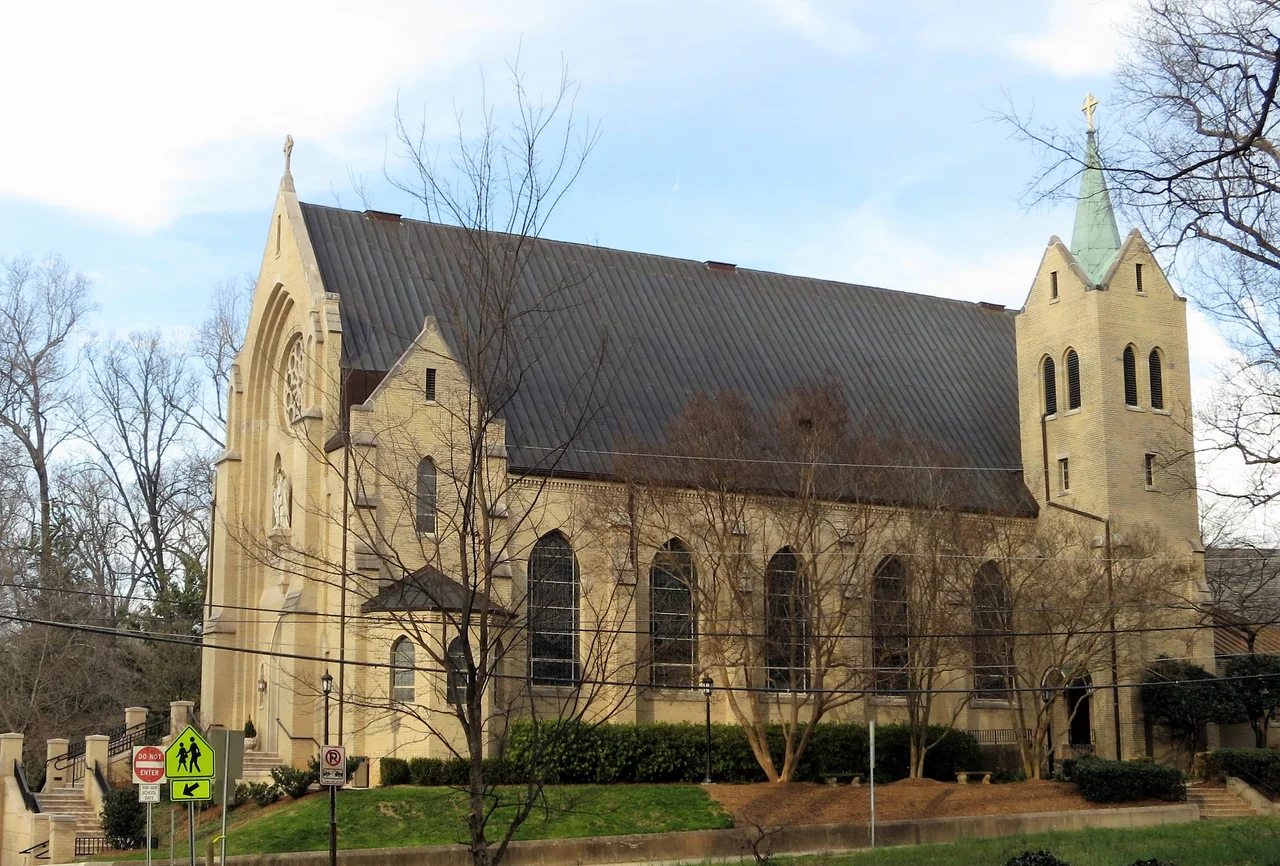
The Cathedral of Saint Patrick - mother church of the diocese - is located at 35.2206°N, 80.8542°W in the Dilworth neighborhood just south of Uptown Charlotte. From the air, look for the cluster of Uptown skyscrapers and follow South Tryon Street southwest. Nearest airport is Charlotte/Douglas International (KCLT) about 4 nautical miles west; Concord-Padgett Regional (KJQF) lies northeast. The diocese covers 20,700 square miles spanning 46 counties from the Atlantic Piedmont to the Smoky Mountains. Best viewing altitude 3,000-5,000 feet over Charlotte.
Nearby Stories
- Battle of Colson's Mill 12 km away
- Kings Mountain Mine 13 km away
- Thyatira Presbyterian Church, Cemetery, and Manse 16 km away
- Andrew Jackson State Park 19 km away
- Charleston Naval Hospital Historic District 22 km away
- Hickory Motor Speedway 22 km away
- North Carolina Aviation Museum 29 km away
- Battle of Fishdam Ford 47 km away