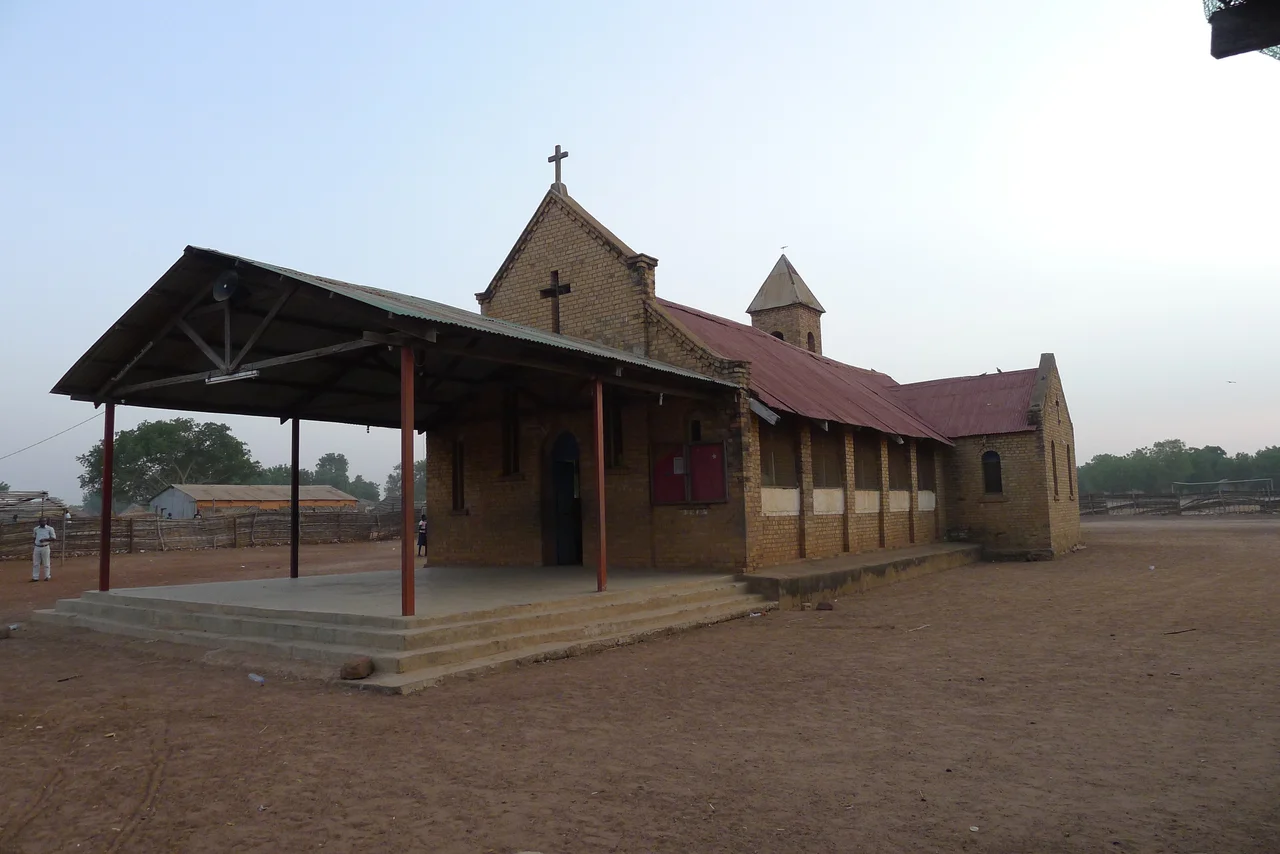

Diocese of Rumbek
From 1974 to 1981, the entire Catholic Diocese of Rumbek - a territory larger than Switzerland, serving a population estimated at 1.5 million - had exactly one priest. His name was Father Raphael Riel, and he covered ground that today is divided among eleven parishes and some 150 chapels and prayer stations. How a single man did this work, and why the work survived at all, is the story of one of the more remarkable Catholic jurisdictions in the world.
Comboni's Shadow
The Catholic mission to this part of Africa goes back to Saint Daniele Comboni, an Italian priest called the 'Apostle of Africa,' who lived at the Holy Cross mission in Shambe on the western bank of the Nile in 1857-58. From Shambe, Comboni dreamed of a mission to the Black peoples of eastern-central Africa. He died young, and his dream almost died with him. The Mahdi Revolution (1881-1899) expelled Christian missionaries from what is now Sudan and South Sudan. The British colonial administration that followed preferred Anglicans, allocating almost all of what is today the Diocese of Rumbek to the Church Missionary Society. Catholic missions in the area were small, latecomer affairs: Thiet in 1949, Rumbek in 1951, Tonj in 1953. The Apostolic Vicariate of Rumbek was not established until 3 July 1955, under Pope Pius XII.
One Priest, A Territory the Size of Switzerland
Less than a year after the Vicariate's establishment, power in Sudan shifted from the British to Arabic-speaking northern elites based in Khartoum. The Southern Sudanese resistance began - first the Anyanya rebels (1955-1972), then the SPLA from 1983 until the Comprehensive Peace Agreement of 2005. In March 1964, the Military Government of General Abboud expelled all foreign missionaries. They fled to Uganda, Zaire, and the Central African Republic. Persecution continued even after Abboud fell: in July 1965, the Vicar General, Father Archangelo Ali, was killed during a raid of Arab soldiers on Rumbek parish. After his death, the last priests left. The Church in Rumbek was abandoned for decades. When priests finally returned in the early 1970s, there was one. Father Raphael Riel held the Switzerland-sized diocese alone from 1974 to 1981.
Cardboard Cathedrals
Father Giuseppe Pellerino, who served as Apostolic Administrator from 1983 to 1990, was held in captivity for 112 days in 1986. Upon his release, he returned to Tonj to continue his work. In the same year, the two local clergy - there were only two - fled the civil war, taking many youths with them to Ethiopia. Cesare Mazzolari became Administrator in 1991 and was consecrated Bishop in 1999. Under Mazzolari, missions were built far from main roads, in the bush, where the people had fled from the atrocities of the war: Mapuordit in 1993, Marial Lou in 1994, Agangrial in 1995. When Rumbek township was retaken by the SPLA in May 1997, Mazzolari returned to find the whole of Rumbek razed to the ground. He began rebuilding - not just buildings, but the diocese itself. The Holy Family Cathedral in Rumbek, the sub-parish at Romic where Mass is still said under a tree, the church at Wulu, the mission at Mapuordit named for Josephine Bakhita, the Sudanese saint who had herself been enslaved.
Thirteen Days of Independence
Bishop Mazzolari led the Diocese until his death on July 16, 2011, exactly one week after the Republic of South Sudan obtained its independence on July 9, 2011. Whatever he had felt during those thirteen days - the ordination of a country he had served through two civil wars and the destruction of his own cathedral town - he took with him. Father Fernando Colombo administered the diocese until December 2013, when ill health forced him to resign; the diocese remained without a bishop for nearly a decade until March 2021, when the Italian missionary Christian Carlassare was named Bishop-elect. Carlassare's start was tumultuous: on the night of 25-26 April 2021, he was attacked in his home, shot in the legs, and hospitalized for a long period before returning to take charge. He did return. The violence, he said in subsequent interviews, would not determine his ministry.
A Diocese Lived, Not Drawn
Today the Diocese of Rumbek covers the whole of Lakes State and the southern part of Warrap State - around 65,000 square kilometers. Eleven missions serve a population of 1.5 million. The missions' names carry their own layered history: Daniel Comboni at Marial Lou and at Warrap, Don Bosco at Tonj, Mary Mother of God at Agangrial, Peter and Paul at Wulu, Josephine Bakhita at Mapuordit, Holy Cross at Yirol, Saint Anselm at Bunangok/Aliap, Holy Family at Rumbek. Each name represents a choice. Each choice represents a community that decided, often in the hardest possible circumstances, to stay. The cathedral was rebuilt. The schools reopened. Sunday Mass still gathers under trees where there is no roof. A diocese is not a drawing on a map. It is whatever its members do together, week after week, whether there is peace or not.
From the Air
The Diocese of Rumbek centers on Rumbek (approximately 6.80°N, 29.68°E) and covers Lakes State and southern Warrap State in central South Sudan - roughly 65,000 square kilometers. From cruise altitude, the land reads as savanna and floodplain, with the Bahr el Ghazal wetlands to the west and the Nile's wetland margins to the east. Rumbek itself is recognizable by its airstrip and the brick cathedral complex on the town's western edge. Nearest airport: Rumbek Airport (ICAO: HSMK). Regional hubs: Juba International (ICAO: HSSJ) to the south, Wau Airport (ICAO: HSWW) to the west. Best visibility November-April.
Nearby Stories
- Lakes State 33 km away
- 2018 South West Aviation Let L-410 crash 36 km away
- Tonj 62 km away
- Ramciel 78 km away
- Nyal, South Sudan 80 km away
- Leer, South Sudan 149 km away
- Juba–Terekeka–Rumbek Road 177 km away
- Ironstone Plateau 207 km away