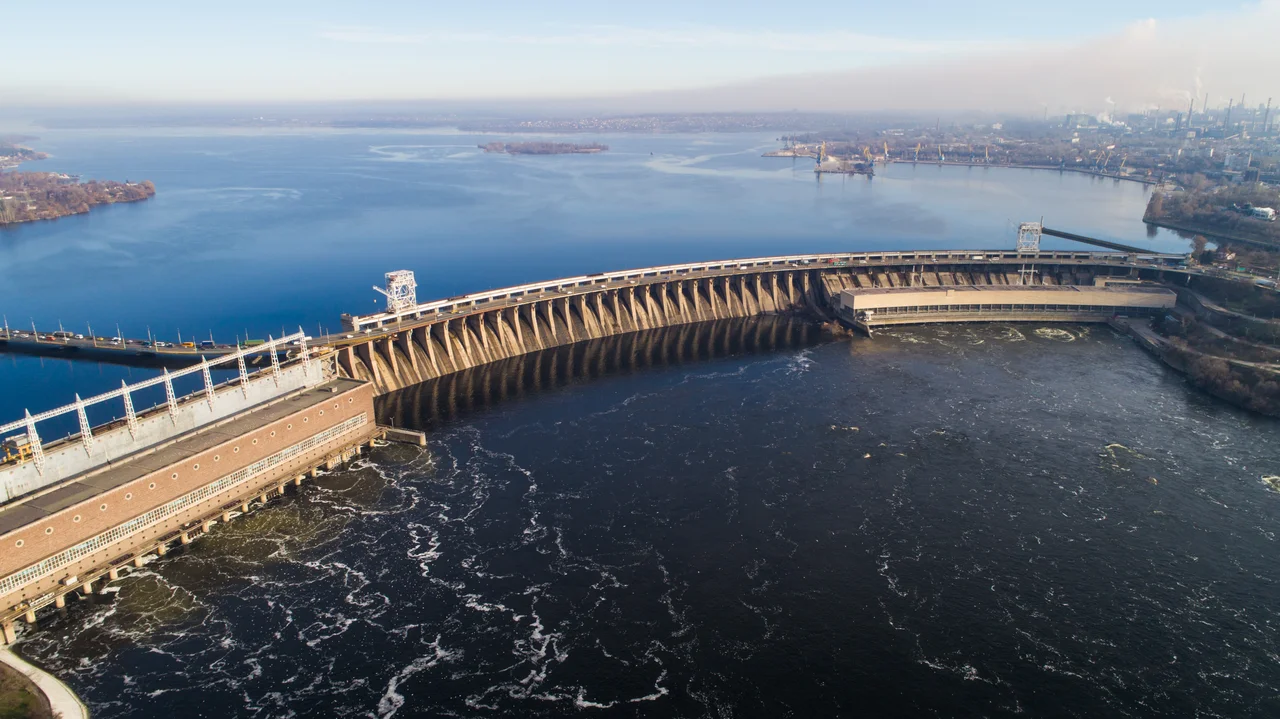

Dnieper Hydroelectric Station
"We shall compel it!" Leon Trotsky told a hall of Soviet youth in 1926, speaking of the Dnieper. For a hundred kilometers between what are now the cities of Dnipro and Zaporizhzhia, the great river had always run wild over the Dnieper Rapids, a stretch that had defied navigation since antiquity. The Soviet state resolved to end that. What rose from 1927 to 1932 was the Dneprostroi Dam, a sweeping concrete crescent 760 meters long and 60 meters high that lifted the river by more than thirty-seven meters, silenced the rapids beneath a new reservoir, and became a symbol of a nation determined to bend nature to its will.
Compelling the River
The dam was the flagship of GOELRO, the sweeping electrification plan the young Soviet Union adopted in the early 1920s, and it was built to power a whole industrial region: aluminum works, a high-grade steel plant, the factories that would define the Donets and Kryvyi Rih. A team of engineers under Professor Ivan Alexandrov designed it. The constructivist architects Viktor Vesnin and Nikolai Kolli gave the dam and its buildings their clean, monumental lines. And the Soviets did not build in isolation. They drew on hydroelectric experience from Niagara Falls and Quebec, and hired American consultants; in September 1932 the Soviet government decorated six American engineers, including Hugh Cooper of General Electric, with the Order of the Red Banner of Labour for their work on what everyone called DniproHES. It began generating power in October 1932.
A River Turned to Water
The dam reshaped the geography around it. Behind the wall spread the Dnieper Reservoir, 3.3 cubic kilometers of impounded water backing up 129 kilometers to the edge of Dnipro. Shipping locks at the eastern end let vessels climb past the dam and sail on upstream, as far as the Pripyat River, opening a waterway where the rapids had once forced boats to unload and portage. A highway ran across the top, and bridges spanned the canals, so the structure became a crossing as well as a power plant. It was, in every sense, a piece of engineering meant to be lived on and moved through, not merely admired from a distance. For the Soviet Union it was proof, cast in concrete, that the future could be manufactured.
The Dam as Battlefield
Twice the dam has been deliberately destroyed in war, and the first time carried a terrible cost. In 1941, as German forces advanced, retreating Red Army troops dynamited the dam to deny the enemy the crossing and cripple the regional power grid. The flood that followed swept downstream without warning. The death toll has been disputed ever since: contemporary accounts spoke of tens of thousands of civilians and soldiers drowned, while a Ukrainian historian has argued the true figure was closer to three thousand. Whatever the number, they died where the water reached them, and the tragedy went long unremembered. In 1943 retreating German troops rigged the dam to blow again, but Soviet scouts crept in and cut the detonation wire. Rebuilt between 1944 and 1950 with new General Electric generators, each weighing over a thousand tonnes, the station rose a second time.
The Long Recovery
In the decades that followed, the dam grew. An expansion from 1969 to 1980 built a second power station and roughly quadrupled the plant's output, and modernization continued after Ukrainian independence with support from the European Bank for Reconstruction and Development and the Swiss government. Today the station is operated by Ukrhydroenergo as the largest of the Dnieper cascade. It has not escaped the present war: struck repeatedly since 2022, it was badly damaged in strikes in 2024 that halted its generation and set part of the structure ablaze, though officials reported no danger of the dam itself breaching. Engineers have said restoration will take years. Nearly a century after it first tamed the rapids, the great crescent on the Dnieper endures, as it has through every rebuilding, a working monument to the river it was built to command.
From the Air
Located at 47.8694 N, 35.0861 W, spanning the Dnieper at the northern edge of Zaporizhzhia, just above Khortytsia Island. From the air the long concrete arc of the dam, the reservoir stretching north toward Dnipro, and the wooded island below are unmistakable. Best viewed at moderate altitude in clear conditions. Nearest airport is Zaporizhzhia International (UKDE).
Nearby Stories
- Dnieper Rapids 16 km away
- Aeroflot Flight 3630 69 km away
- Battle of Dibrivka 72 km away
- Kryvbas 78 km away
- Azov Upland 87 km away
- Meotyda National Nature Park 157 km away
- Lake Lemuria 164 km away
- Second Battle of Kharkov 168 km away