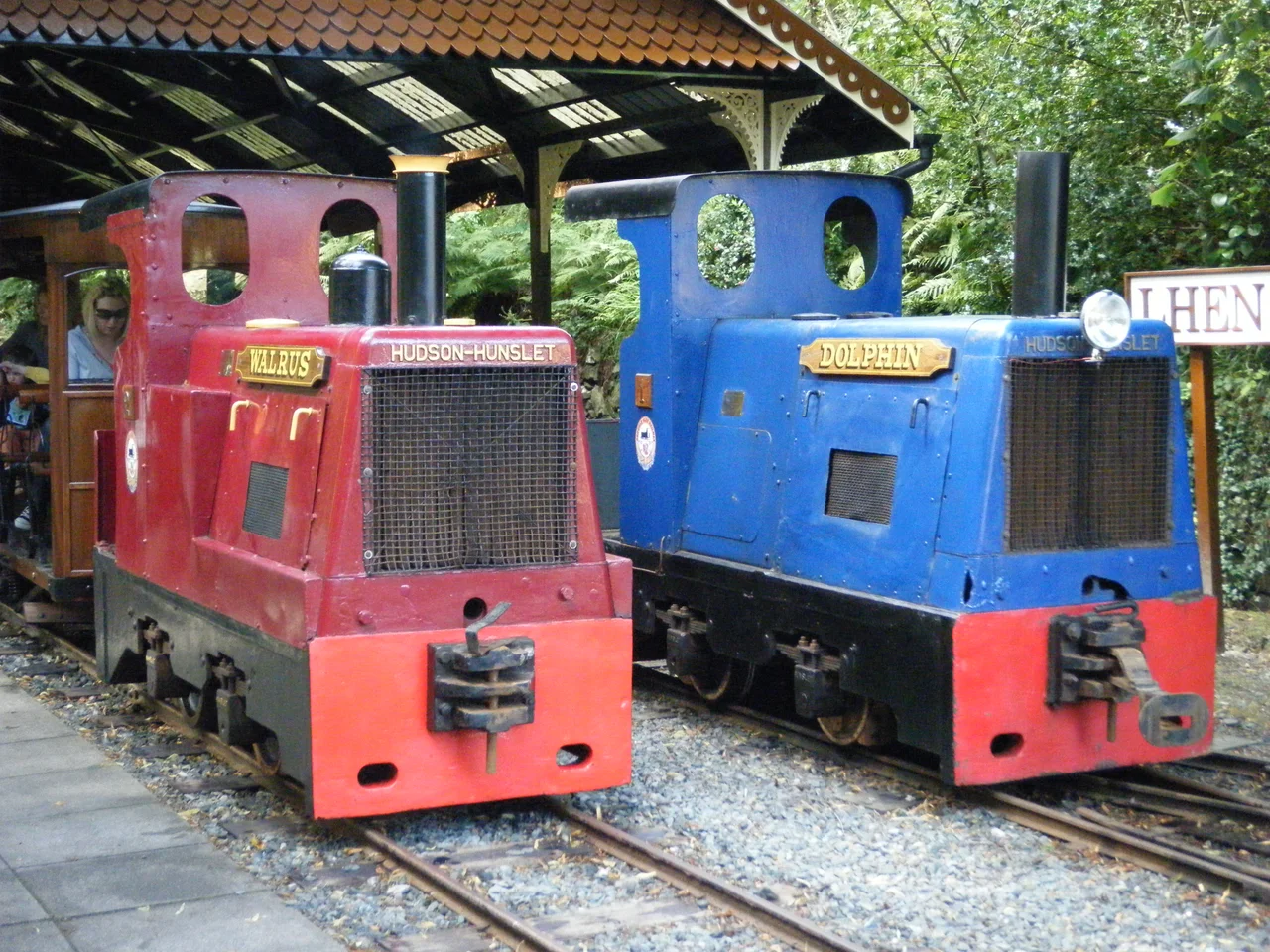

Dolphin and Walrus
There is a fake dome on Walrus that is, on closer inspection, half a gas cylinder welded to the cladding. There is a sheet-metal half-cab with oval windows, a false chimney, and dummy side tanks. The whole arrangement is designed to make a small 1952 diesel locomotive look like a Victorian steam engine, the exhaust redirected out of the false chimney so that the engine appears to be steaming along. None of it is original; all of it tells the story of how a working locomotive built for a Twickenham gravel pit became a pleasure-park attraction in Gloucestershire, and ended up as the workhorse that brought the Groudle Glen Railway back from the dead.
Built for a Sand Pit
In 1952 the Hunslet Engine Company built three small diesel locomotives for the firm Robert Hudson - which explains why the manufacturer's title cast prominently into each locomotive's radiator frontage is Robert Hudson rather than Hunslet. The three were sent to work a sand and gravel pit in Twickenham, west London, where they hauled spoil and aggregate until the pit closed. With the pit gone, the three were put up for sale. Two of them were bought by Doddington Park in Chipping Sodbury, where someone had set up a pleasure ground and needed locomotives to pull visitors around. The new owners fitted the false steam-outline cladding - half-cab, false dome, dummy chimney, the works - and one of the pair was given the name Doddington Dragon, with heraldic crests painted on its side panels. By 1980, the park was losing money. It closed, and everything went back on the market.
Rescued for the Glen
The Groudle Glen Railway on the Isle of Man had been built in 1896 to carry tourists down a narrow glen on the eastern coast to a small zoo at Sea Lion Rocks. It had run sporadically through the twentieth century and had fallen out of service entirely by the 1960s. In 1982 volunteers from the Isle of Man Steam Railway Supporters' Association began restoring the line. They needed locomotives, track, sleepers and pointwork. Doddington Park had all of it for sale. The two ex-Hudson locomotives were purchased along with everything else, and shipped to the island. The volunteers gave them new names in line with the railway's existing animal-themed naming - the original steam locomotives had been Sea Lion and Polar Bear, after the animals that had been kept at the zoo. The diesels became Dolphin, fleet number 1, and Walrus, fleet number 2. It was the first time fleet numbers had been used on the railway.
Workhorses, Then Stars
From 1982 until 1987, Dolphin and Walrus did everything. They hauled public trains, they ran works trains, they did all the permanent-way duties. They wore a green livery and wooden nameplates. When Sea Lion - the original 1896 steam locomotive - returned to service in 1987, the diesels could finally step back into supporting roles. Walrus was withdrawn in 1989, the wheels removed for reprofiling and major engine work. Because the line did not really need her, she sat in the back of the carriage shed on blocks for several years. When the Steam 125 event in 1998 brought visiting locomotives that needed shelter, Walrus had to be moved outside, so the wheels were put back, a coat of battleship grey paint was applied, and War Department transfers were added to the false tanks. In 2003, after the locomotives' 50th anniversary celebrations sparked fresh interest, Walrus was properly overhauled and repainted in a maroon scheme with yellow features. She has worked gala days and Santa Trains ever since.
A Liverist's Life
Dolphin has been many colours. She arrived in 1983 wearing a light green. In 1992 she was repainted in darker Brunswick green. In 1998 she got an unusual all-over grey livery - buffers, side frames, cab interior, everything - that didn't last long. By the summer of 2001 a fresh repaint had turned her royal blue. In 2012, for the 30th anniversary of the railway's restoration by volunteers, she was stripped down and repainted back into her original 1983 green, and in that livery she hauled the special anniversary trains in May. She used to be renamed Rudolph each Christmas between 1984 and 1997. Then she became Blitzen, with new nameplates installed. Since 2003 the Blitzen plates have been carried by Walrus instead. The two locomotives now alternate annual maintenance, share works-train duties, and turn out together for gala days. They are 74 years old this year, and they still run.
From the Air
The Groudle Glen Railway, where Dolphin and Walrus operate, is located at approximately 54.178 degrees north, 4.422 degrees west, geohash gcsu5, a few kilometres north of Douglas on the eastern coast of the Isle of Man. The nearest airport is Isle of Man (Ronaldsway) Airport (EGNS / IOM) about 14 km to the south-west. From cruising altitude, look for Groudle Glen as a steep, wooded valley running down to the coast just north of Douglas Bay and south of Onchan, with the small railway tracing the glen down toward the cliffs at Sea Lion Rocks.
Nearby Stories
- St Bees Lighthouse 15 km away
- Celtic Array 22 km away
- Kirkmaiden 23 km away
- Isle of Whithorn 23 km away
- Seascale Lifeboat Station 31 km away
- German submarine U-1024 36 km away
- SS Georgetown Victory 40 km away
- Blackpool Illuminations 56 km away