
Dolstad Church
The angel hangs from the ceiling of Dolstad Church, carved and painted, waiting. It has been there since 1782. At a baptism it is lowered on its rope until it hovers at the right height for the priest to take the bowl it carries, and a child born in Mosjøen this year is christened from a vessel held by the same wooden hands that held it for children born under Danish rule. Norway keeps a scattering of these dåpsengler in its older churches. This one has been doing its job for more than two hundred and forty years.
Eight Walls and a Steeple
Seen from the road the church reads as a red timber cross with a spire in the middle, which is roughly what it is - but the middle is not a crossing, it is an octagon. Four arms are fixed to a central eight-sided drum, with the steeple rising directly above it. The builder was Nils Pedersen Beck, a Trondheim man who almost certainly had Bakke Church in that city in his eye when he drew it. Work began in 1730 and took four years. The octagon was never the ordinary Norwegian solution, and it makes the interior behave differently from a standard long church: instead of a corridor pointing at an altar, you get a room that gathers around its own centre, with sightlines from every arm. The building seats several hundred - the figure usually quoted is about five hundred.
The Church Before the Church
There has been a church at Dolstad far longer than the present one has stood. The earliest surviving record dates from 1544, and it does not describe a new building; the foundation was probably twelfth-century, on a site some thirty metres north-east of where the octagon stands now. In the 1640s that older church was either heavily rebuilt or replaced outright by a cruciform log building with a porch at the west end, and its altarpiece carried the date 1644, which is the best clue anyone has to when the work was finished. The new church of 1730-34 went up thirty metres to the south-west, so that the parish never lost a place to worship. Only when the octagon was ready was the old building pulled down.
Consecrated by a Famous Man's Son
On 7 August 1735 the church was consecrated by the local provost, Anders Dass. The name carried weight in Nordland. His father was Petter Dass, priest at Alstahaug from 1689 until his death in 1707 and the finest Norwegian poet of his generation, whose verse survey of the north, Nordlands Trompet, is still the book people quote when they want to describe this coast. Fishing boats reportedly carried black cloth in their sails in his memory for a century afterwards. The son was no provincial: schooled in Bergen, a student in Copenhagen, then Oxford and Cambridge, before teaching at the cathedral school in Trondheim and coming home to the priesthood. He bought farms across Vefsn, Rana, Tjøtta and Alstahaug, and died in 1736 a wealthy landowner, a year after standing in this building to consecrate it. In 1750 the church was dedicated to Saint Michael. A sacristy was added at the east end of the choir around 1770.
The Day the Parish Voted
In 1814 Denmark ceded Norway to Sweden, Norway refused the arrangement, and an assembly was summoned to write a constitution. Dolstad Church became a polling station - one of more than three hundred parish churches across the country pressed into service as election churches. The mechanism was indirect and slow. Each parish chose electors; the electors of a county met and chose the men who would travel to Eidsvoll Manor. From Mosjøen that meant weeks of travel by boat and road to reach a room a very long way south. These were Norway's first national elections, held in churches because churches were the only buildings that every community had and everyone could find.
What Hangs Above the Pews
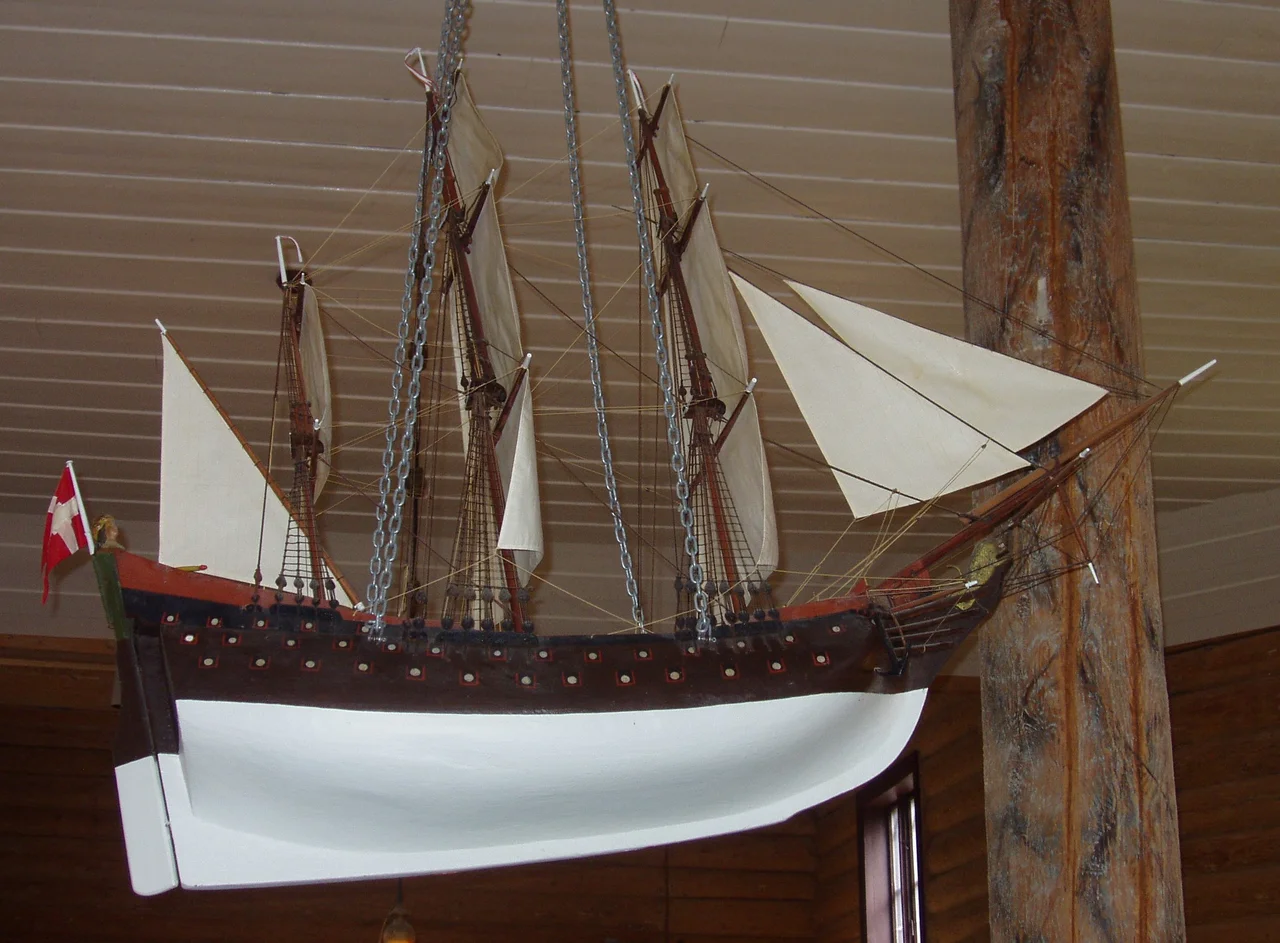
Look up. Besides the angel there is a votive ship, rigged and suspended, the standard offering of a coastal parish where the difference between a good year and a funeral was weather. The altarpiece in place today was painted in 1856 by Eilert Balle Lund. Objects from the medieval church dedicated to the Archangel Michael are still in use, which means the congregation handles things that predate the Reformation in this valley. A restoration in the 1970s stripped back later alterations and pushed the interior towards its eighteenth-century appearance; further work in 2007 kept the practical improvements a working parish church needs. It is still the parish church of Dolstad, in the Indre Helgeland deanery of the Diocese of Sør-Hålogaland - not a monument, but a building with a Sunday schedule.
From the Air
Dolstad Church stands at 65.8445 N, 13.204 E, on the eastern side of Mosjøen above the Vefsna river mouth, about 1 km from the head of the Vefsnfjorden. From the air the red-painted octagon with a central steeple and its surrounding churchyard is distinguishable against the town's grid; Øyfjellet, 814 m, rises immediately behind to the east and provides the terrain reference. Mosjøen Airport, Kjærstad (ENMS) is roughly 5 km south with a 1,019 m runway at 73 m elevation; diversion fields are Sandnessjøen Airport, Stokka (ENST) and Mo i Rana Airport, Røssvoll (ENRA). A slow pass at 1,500-2,500 ft AGL down the fjord and over the river mouth gives the best look, but keep terrain to the east in mind - the valley walls rise fast and low cloud sits on Øyfjellet regularly through autumn and winter.
Nearby Stories
- Bleikvasslia 9.7 km away
- 2024 Finneidfjord Train Derailment 10 km away
- Trofors 11 km away
- Tjotta International War Cemetery 12 km away
- Hattfjelldal Municipality 20 km away
- Wideroe Flight 710 33 km away
- Træna Lighthouse 49 km away
- Dunderland Valley Bus Crash 82 km away