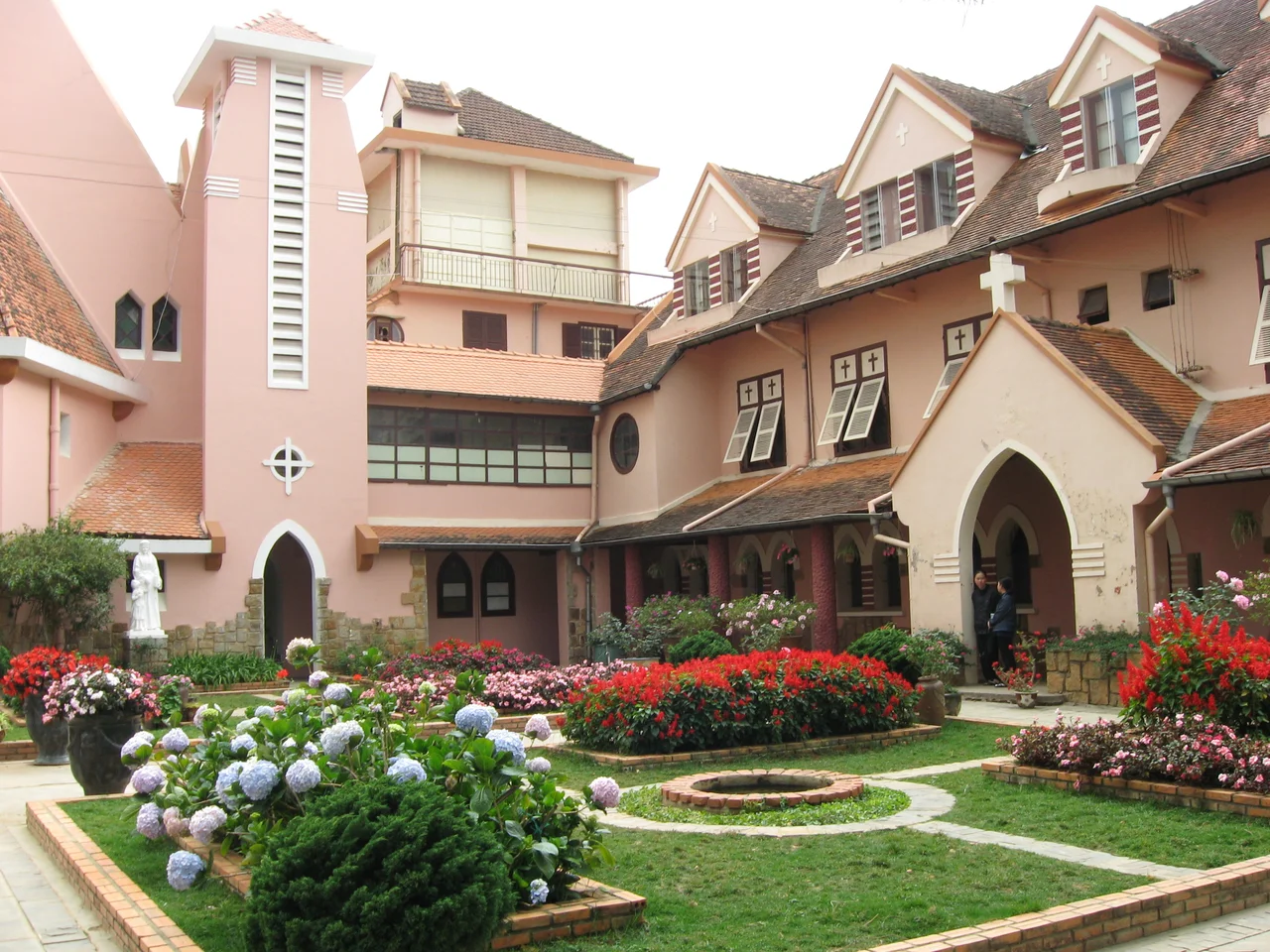

Domaine de Marie
In 1941, two nuns of the Daughters of Charity of Saint Vincent de Paul arrived in Da Lat with a single assignment: find a hill and determine if it could hold a convent. They found one, cleared the site, and by October 1941 thirty nuns had arrived from across the French Indochinese colonies to begin building a community. A year later, in November 1942, the church was inaugurated with sixty nuns and a priest. The speed of it — two scouts, one cleared hilltop, sixty religious women in residence within a year — says something about the certainty with which the Daughters approached their mission. The Domaine de Marie was not imported whole from France; it was built, quickly and purposefully, for the specific highland city at whose edge it stands.
The Hill and the Architecture
The church sits at the top of a rise in the northwestern part of Da Lat, its facade visible from the roads below. The style is reminiscent of seventeenth-century French religious architecture: the kind of sturdy, confident ecclesiastical building you find in provincial French towns where the church has occupied the high ground for centuries. On Da Lat's hilltop, the effect is amplified by the surrounding gardens — spacious, flower-filled — and by the highland light that clarifies every surface. Construction of the broader complex began in 1940, and the blend of French architectural vocabulary with the Vietnamese highland setting produces something that feels neither entirely foreign nor purely local. It is a colonial hybrid, but one that has been inhabited and adapted by Vietnamese religious life for more than eight decades.
A Living Community
The Daughters of Charity have maintained a presence in Vietnam since 1860, and the Da Lat community they built at the Domaine de Marie outlasted the colonial system that brought them there. Over the years, the convent accepted Vietnamese women who wished to join the order. The community expanded to include an orphanage; by 2007 that had evolved into a kindergarten serving 300 children, the revenue from which helps keep the Domaine functioning. As of 2007, twenty-three nuns of the order still lived in the convent alongside numerous young women and children who are hard-of-hearing, forming a community that crosses the boundary between religious house and social institution. The Daughters' mission in Da Lat was never merely devotional; it was always also practical, caring for people that other institutions did not reach.
Worship and Open Doors
The Domaine de Marie remains an active place of worship. As of 2015, weekday services were held at 17:00; on Sundays, masses ran at 5:45 and 16:30. The facility is open to tourists and to the general public, and the combination of working convent, hilltop garden, and French colonial church draws visitors who arrive for the architecture and stay for the quieter qualities of the place. Behind the church lobby, the tomb of a community member rests in the flower-filled grounds, a detail that grounds the site's history in the personal rather than the institutional. People came here, lived here, died here. That continuity — over eighty years of occupation, prayer, teaching, and care — gives the Domaine de Marie a character that purely historical monuments rarely achieve.
Part of the Diocese
The Domaine de Marie is part of the Roman Catholic Diocese of Da Lat, which gives it standing within a broader religious structure that has maintained a Vietnamese Catholic presence in the Central Highlands through dramatic political change. French colonial authority ended; the Republic of Vietnam rose and fell; reunification transformed the country's institutions. The Daughters of Charity stayed. Their persistence on the hilltop is not an act of defiance or exceptionalism — it is simply what happens when a community has planted itself in a place and found that the work, the care, and the devotion still make sense. The church that two scouts selected in 1941 is still the church where services are held today.
From the Air
The Domaine de Marie sits at 11.9495°N, 108.4303°E on a hilltop in northwestern Da Lat, at an elevation of approximately 1,500 meters. The church's hilltop position makes it one of the more visible structures from the air in this part of the city. Approaching from the north at 3,000 meters, Da Lat's forested hills cluster around the valley; the Domaine's grounds are visible on the northern edge of the urban area. The nearest airport is Lien Khuong Airport (VVDL), approximately 30 kilometers to the south. The Langbiang massif rises to the north, providing a distinctive visual reference. Morning fog is common in the valley below, while the hilltop often sits above the mist layer.
Nearby Stories
- Tà Đùng National Park 3.1 km away
- Phan Rang–Tháp Chàm 4.2 km away
- Cam Ranh 18 km away
- Bao Loc 18 km away
- Operation Byrd 23 km away
- Nha Trang Air Base 25 km away
- Bidoup Núi Bà National Park 34 km away
- Duc Lap Camp 43 km away