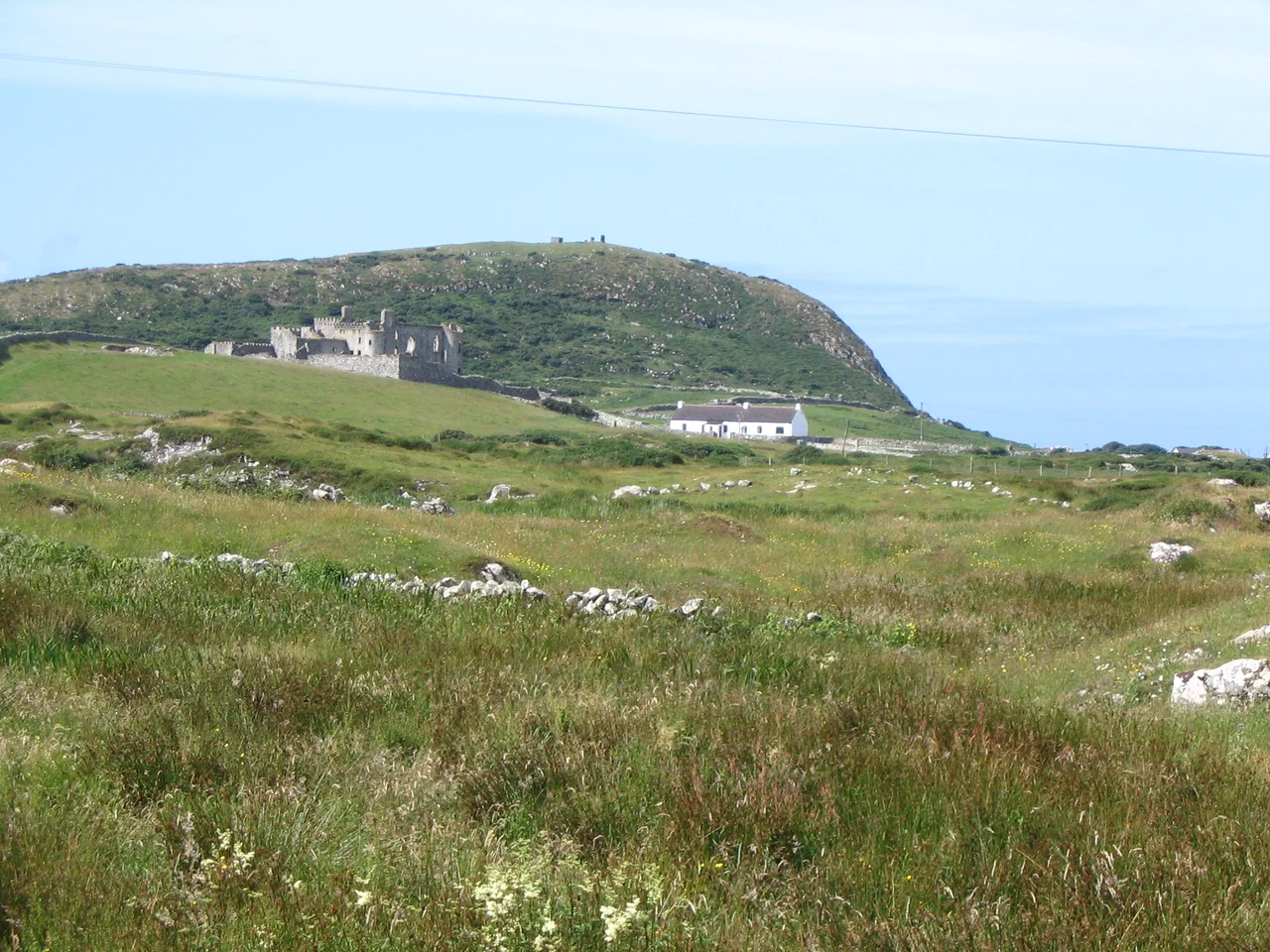

Doon Hill
Doon Hill is what is left after the rest of a volcano erodes away. The throat of the vent, where molten rock once cooled into a denser plug than the surrounding country, stood up to glaciers and centuries of Atlantic weather while the cone around it wore down to nothing. Sixty-seven metres is not tall by mountain standards, but on the flat western fingers of the Errismore peninsula it dominates everything. From its summit you can see the islands of Slyne Head trailing south into the Atlantic, the long white scallop of Bunowen Strand, and on a clear morning, the green smudges of Inishbofin and Inishshark on the horizon.
The Throat of an Old Fire
Volcanic plugs are the geological equivalent of leftovers. When a volcano falls silent, the conduit through which lava once travelled cools more slowly than the surrounding country rock. Over millions of years, weather strips away everything softer until only the resistant plug remains, standing alone above the eroded landscape. Doon Hill is one of these survivors. The volcano that fed it died so long ago that no human eye has ever seen its fire, and the hill that remains is now a habitat for skylarks and a stage for the wind. Walking up it, you climb through stratified time. Below your feet is rock that was once a passage for liquid earth.
Bunowen Castle and the O'Flahertys
At the foot of Doon Hill stand the ruins of Bunowen Castle, and the story of the castle is the story of how Irish land changed hands. The original castle on the site belonged to the O'Flaherty family - the same fierce western clan whose chiefs ruled most of the country north of Galway Bay. After the Cromwellian conquest of Ireland in the 1650s, English authorities 'transplanted' the lands at Bunowen to Art Geoghegan, a landowner from County Westmeath. The word transplanted is a polite cover for what actually happened: families dispossessed by force, told to take what they could carry and walk to assigned land elsewhere, often in Connacht's poorest western edges. The Geoghegans rebuilt and extended the O'Flaherty castle, and they remained until the mid-nineteenth century, when the Blake family purchased the property in 1852 to use as a summer home. The castle is now in ruin, owned by the McDonagh family. Near it stand the ruins of a medieval church, a cemetery, and the remains of a garden.
Standing on Old Volcanoes
The story of Doon Hill is partly the story of how much time a landscape can hold. The hill itself goes back to a volcano that has been dead longer than the human species has existed. The castle at its foot goes back to a clan whose name is older than any English-language map of Ireland. The garden behind the castle - small, walled, almost gone now - was someone's nineteenth-century idea of cultivation, of making the land yield roses or vegetables in a place where the wind off the Atlantic discourages both. Each layer ends. Each one left something that the next one built on, or beside, or against. The hill outlasts all of them.
From the Air
Located at 53.41 N, 10.12 W, on the Errismore peninsula in west Connemara, County Galway. Doon Hill at 67 metres is a distinctive isolated cone visible from a wide arc - the most prominent terrain feature on this part of the coast. Bunowen Castle ruins lie at its base. Nearest airport: Connemara Regional (EICA) at Inverin, about 50 km east; Galway (EICM) further east. Maintain safe altitude above the hill and be alert for sudden Atlantic squalls.
Nearby Stories
- County Galway 3.2 km away
- Uggool Beach 9.7 km away
- Doolin 11 km away
- Aughagower 17 km away
- RMS Carinthia (1925) 17 km away
- Inishmaan 29 km away
- Action of 7 May 1794 92 km away
- Inishtooskert 106 km away