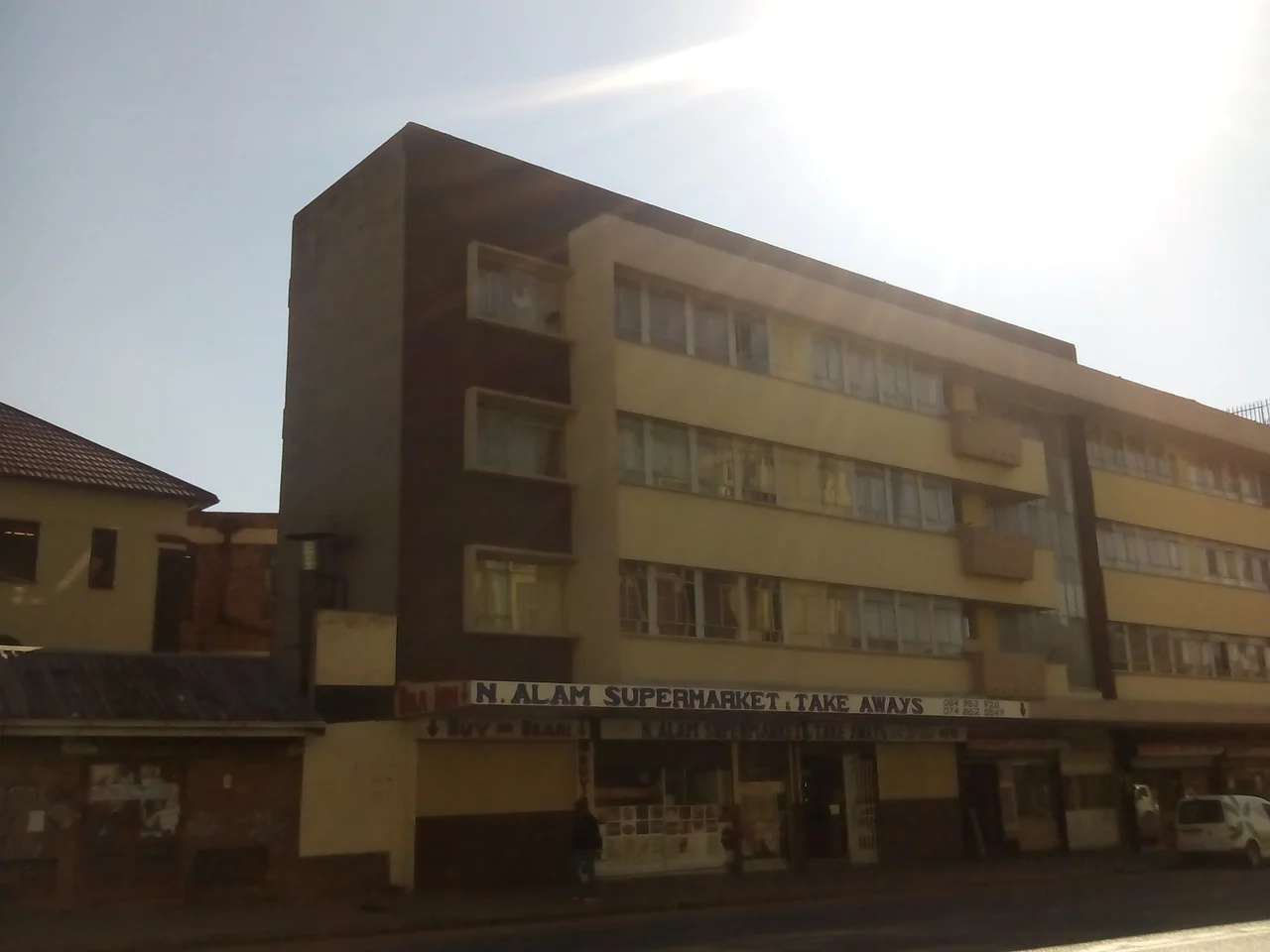

Dorkay House
It looks like nothing. A three-story slab of reinforced concrete with steel-framed windows at the unfashionable south end of Eloff Street, built in 1952 to sew cut-make-and-trim men's trousers. But for two decades, the floors of Dorkay House shook with sound. Step inside in 1959 and you might pass a young woman practicing scales in a stairwell, hear a saxophone working out a phrase behind one door and a piano answering behind another, and watch a generation of South African musicians turn a garment factory into the cradle of a national music.
The Priest and the Lease
When the clothing business folded, an Anglican priest saw what the building could become. Father Trevor Huddleston, the white English clergyman who had made himself the implacable conscience of apartheid Johannesburg, wanted a home where Black musicians could rehearse and perform free of the regime's suffocating restrictions. Money raised at a 1955 farewell concert in his honor, held next door at the Bantu Men's Social Centre, allowed the Union of South African Artists, founded in 1952 by Ian Bernhardt, to take a lease. By 1957 the building housed the African Music and Drama Association. Shops occupied the ground floor, a rehearsal stage sat on the first, and practice rooms and workshops filled the floors above. The open factory plan, meant for sewing machines, turned out to be perfect for making art.
King Kong
The building's defining triumph was conceived in its rooms. King Kong, billed as an all-African jazz opera, opened on 2 February 1959 at the University of the Witwatersrand's Great Hall and became an instant sensation. Composed by Todd Matshikiza, it told the story of the heavyweight boxer Ezekiel Dhlamini, who fought under the name King Kong, a township hero whose triumphs in the ring gave way to a violent and tragic end. The production was a rarity in apartheid South Africa: a Black cast and creative team making serious, ambitious art for audiences that crossed the color line to see it. The show launched careers that would soon belong to the world. King Kong went on to London's West End, and the singer who fronted it, Miriam Makeba, would carry South African song onto international stages while living in exile, becoming a global voice against the very system that had tried to confine her. The musical proved that work made in a Johannesburg garment factory by Black artists the state worked to silence could command the world's attention.
Who Walked Through the Door
On any given day you might have collided with greatness in the corridors. The pianist Abdullah Ibrahim, then known as Dollar Brand. The alto saxophonist Kippie Moeketsi, often called the father of South African jazz. The trumpeter Hugh Masekela and the trombonist Jonas Gwangwa, both barely out of their teens. Singers Dolly Rathebe, Thandi Klaasen, and Letta Mbulu. Saxophonist Ntemi Piliso and the African Jazz Pioneers. Theater lived here too: the African Music and Drama Association staged plays by Gibson Kente and, later, the searing anti-apartheid drama The Island by Athol Fugard, John Kani, and Winston Ntshona. Many of these artists would be driven into exile by the apartheid state, scattering South African jazz across the globe and carrying Dorkay House with them wherever they played.
What Remains
There is a quieter story folded into these walls. Nelson and Winnie Mandela are said to have met at Dorkay House, two figures who would help shape a nation crossing paths in a building dedicated to another kind of freedom. The place mattered because, in a city carved up by the pass laws and the rigid geography of apartheid, it was one of the few rooms where Black creativity could breathe and Black and white artists could work side by side. Time was not always kind to it. When parts of the building were converted to residential flats, the first-floor rehearsal stage where King Kong took shape was torn out, and the daily roar of jam sessions faded into memory. In 1989 the singer Queeneth Ndaba formed the Dorkay House Trust to fight for its survival. The building is now recognized as a heritage resource, not for its architecture, which is plain, but for what happened inside it. This was where a silenced music found its voice, and where a generation of artists learned that the regime could ban their movements but not their sound.
From the Air
Dorkay House stands at 5 to 7 Eloff Street in central Johannesburg, near 26.204°S, 28.042°E, at the southern edge of the city's downtown grid on the Highveld plateau, roughly 1,750 meters above sea level. From the air the surrounding central business district is a cluster of high-rise towers and mine-dump ridges that trace the old gold reef running east to west. O. R. Tambo International Airport (ICAO: FAOR) lies about 22 km to the east; Rand Airport (ICAO: FAGM), a historic general-aviation field in Germiston, is roughly 12 km to the southeast and offers the closest light-aircraft approach. Johannesburg's winter air is dry and clear; summer afternoons bring dramatic Highveld thunderstorms and reduced visibility.
Nearby Stories
- Kyalami Grand Prix Circuit 12 km away
- TauTona Mine 16 km away
- Boipatong Massacre 17 km away
- Battle of Bronkhorstspruit 33 km away
- Nan Hua Temple 57 km away
- Royal Bafokeng Nation 59 km away
- Secunda CTL 69 km away
- Vaal Reefs Mining Disaster 79 km away