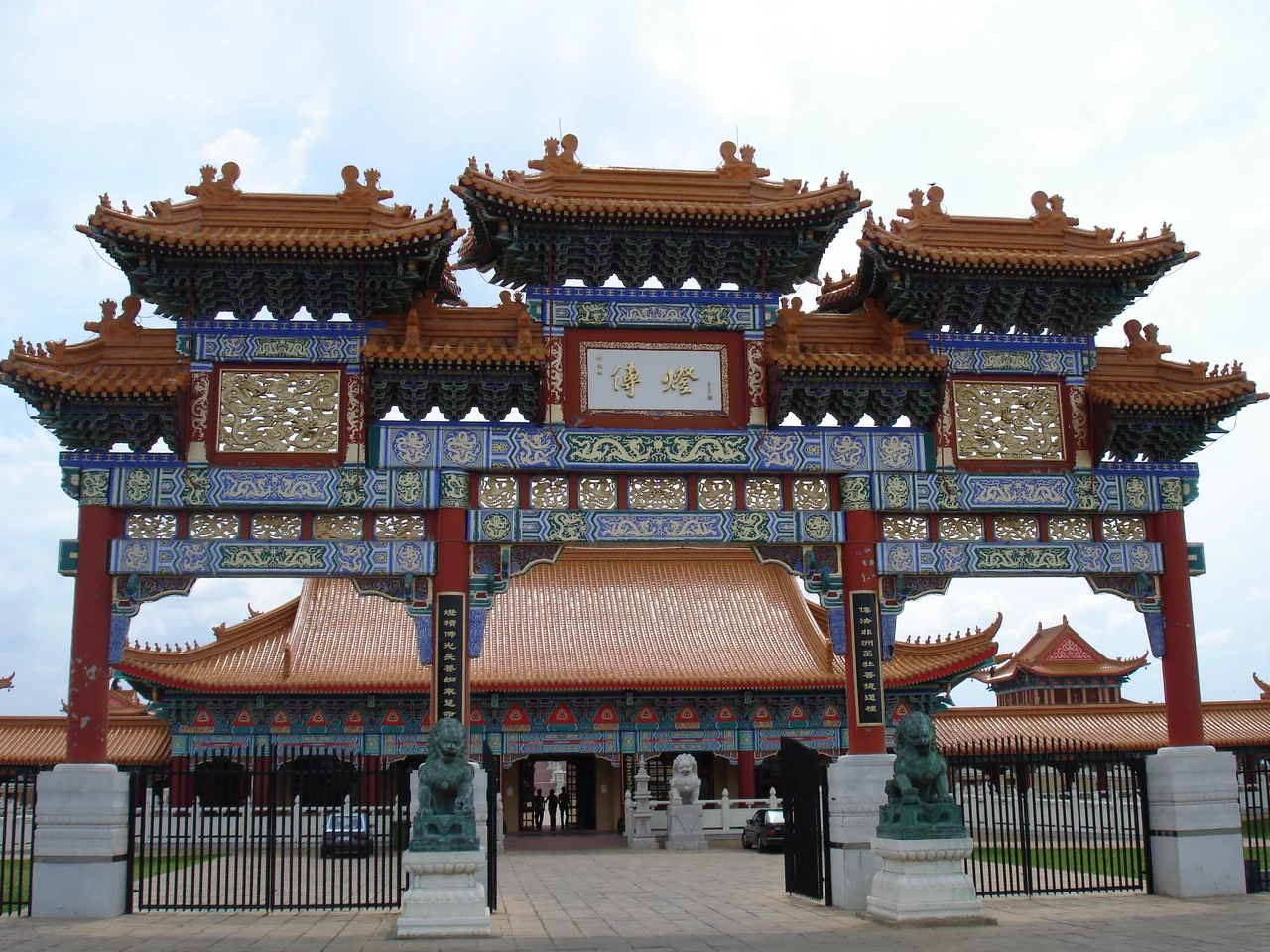

Nan Hua Temple
Drive an hour east of Pretoria, past maize fields and the rusting headgear of old coal workings, and the last thing you expect to see is a Chinese monastery rising from the highveld grass. Yet there it is: the curved, tiled roofs of Fo Guang Shan Nan Hua Temple, golden against the African sky. Spread across more than 600 acres in the Cultura Park suburb of Bronkhorstspruit, this is the largest Buddhist temple and seminary on the entire continent of Africa - the unlikely African headquarters of a monastic order founded on a mountain in Taiwan.
A Gift of Land
The story begins with a handshake and a patch of ground. On 8 March 1992, the Bronkhorstspruit City Council - led by Dr Hennie Senekal, its chief executive and a former church minister who had travelled to Taiwan to court investment - donated fourteen hectares of land to the Fo Guang Shan Buddhist Order. The order, whose name means Buddha's Light Mountain, had been founded in 1967 by the Venerable Master Hsing Yun and follows the Mahayana tradition of Chinese Buddhism, drawing on both the Linji Chan and Pure Land schools. The Religious Affairs Committee dispatched Venerable Hui Li to be the founding abbot, charged with nothing less than carrying Buddhism to Africa. Construction began that October. By the time the complex was finished, it had cost sixty million rand and grown far beyond those first six hectares.
A Monastery and a School
What rose from the veld was not a single building but a small religious city. Alongside the main temple stand a guesthouse, the African Buddhist Seminary, the Nan Hua Village, an assembly hall, and a Pure Land meditation retreat a kilometre and a half away. The seminary trains monks and nuns drawn from across Africa, making this a place where Buddhism is not merely practised but propagated and taught. The retreat centre keeps its doors open to everyone - monastic or lay, of any religion, nationality or background - and feeds its visitors an organic vegetarian diet between sessions of Chan and Pure Land meditation. The temple has since seeded branches in Johannesburg, Bloemfontein, Newcastle, Durban and Cape Town, and its monks run charity, cultural and prison outreach programmes. The grand main temple was formally opened in 2005 by Most Venerable Hsin Pei, then the order's worldwide head abbot.
The Bomb in the Basement
Not everyone welcomed a Chinese temple on Afrikaner soil. On 30 October 2002, members of the Boeremag, a militant right-wing organisation, planted a bomb in the temple's basement. Roughly 150 worshippers from South Africa, Australia, Taiwan, Malaysia and the United States were gathered in the main hall for ceremonies, with about thirty construction workers nearby. The attack could have been a massacre. It was not, only because the detonator misfired - it went off prematurely, lightly injuring two staff members but failing to set off the main charge. Police said afterward that dozens could have died. The attempt drew condemnation from across South Africa's political spectrum, and the temple endured. Today the only crowds it draws are pilgrims, tourists and the curious, many arriving for the Chinese New Year festival when lanterns fill the courtyards.
Where Two Worlds Meet
Walk the grounds and the dialogue between continents is everywhere. Statues of bodhisattvas look out over grassland that once knew only Boer farms and Bantu cattle herders. Inside the main shrine, thousands of small golden Buddha figures line the walls in glowing tiers, each one lit, each one a focus for a single devotion. The air carries incense and, on still mornings, the low rhythm of chanting. For South Africa's Chinese community - whose roots here stretch back more than a century - Nan Hua is a spiritual anchor. For everyone else it is something rarer: proof that a tradition can travel halfway around the world, take root in foreign soil, survive a bomb meant to destroy it, and flower into the largest temple of its kind on a continent that had never seen one before.
From the Air
Nan Hua Temple sits at approximately 25.82°S, 28.73°E in the Cultura Park area on the western edge of Bronkhorstspruit, about 55 km east of Pretoria on the highveld plateau (elevation around 1,500 m / 5,000 ft). From the air, look for the distinctive cluster of orange-tiled, upturned Chinese roofs and large rectangular courtyards standing out sharply against the surrounding grassland and the town's grid - an unmistakable shape unlike anything else in the region. The nearest large airport is OR Tambo International (FAOR) roughly 60 km to the south-west; Wonderboom Airport (FAWB) lies west near Pretoria. Clear, dry winter days (June through August) offer crisp visibility and the sharpest contrast between the gold roofs and the tawny veld.
Nearby Stories
- Liliesleaf Farm 7.8 km away
- Tswaing crater 9.8 km away
- Vlakplaas 12 km away
- Boksburg explosion 47 km away
- Bushveld Igneous Complex 79 km away
- Battle of Bergendal 92 km away
- Makapansgat 157 km away
- Battle of Majuba Hill 175 km away