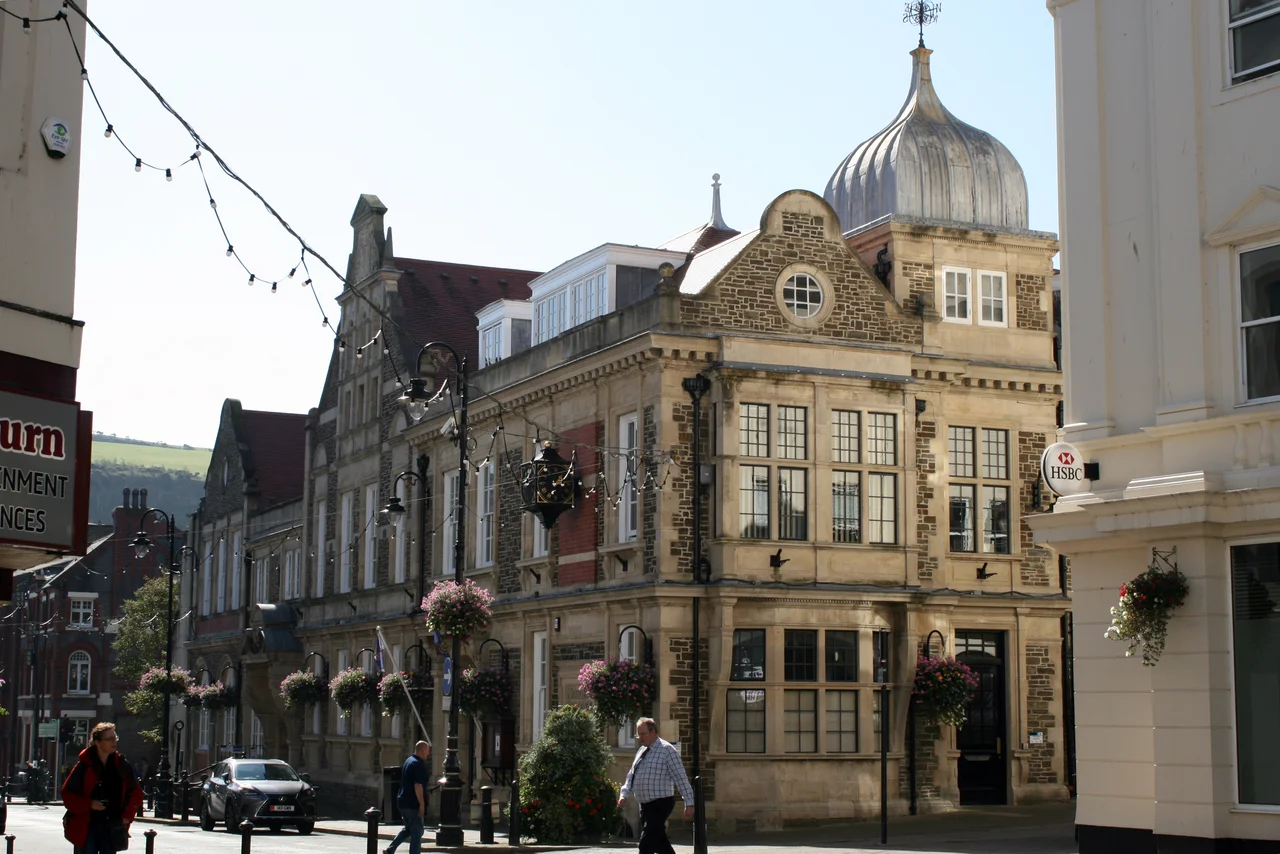

Douglas City Hall
On 20 March 2024, Queen Camilla walked into a Renaissance Revival building on Ridgeway Street in Douglas, met the civic leaders gathered to greet her, and formally conferred city status on the town that had spent the previous century calling the same building its town hall. The change had been announced in 2022, as part of the Platinum Jubilee of Elizabeth II, but it took two more years for the letters patent to be presented in person. The building itself - eleven asymmetrical bays of rubble masonry, designed in 1897 by Ardron & Dawson of Westminster, opened by the mayor on 10 May 1900 - has not changed. The name on the door has.
Before This Was a Town Hall
Douglas grew quickly in the second half of the nineteenth century, swelled by the tourists who arrived by steamer to enjoy the new seaside holiday. By 1860 the town had grown large enough to need its own elected commissioners, who were duly appointed and given an office in a single-storey neoclassical building in St Barnabas Square. That earlier town hall was modest - three symmetrical bays of ashlar stone with a Doric-columned porch, inscribed simply Commissioners' Office. The other two bays were fenestrated with sash windows in slightly recessed arches. It had been built at least as early as the early nineteenth century, and was probably never intended for civic use at all. By the 1890s it was hopelessly inadequate. The Douglas Municipal Corporation Act 1895 created an elected town council in place of the old commissioners, and the new council moved fast: by 1897 they had picked a site on the west side of Ridgeway Street and started building.
Ardron and Dawson Build a Town Hall
The new building was designed by the firm of Ardron & Dawson of Westminster in the Renaissance Revival style - more elaborate than the older Doric-columned office, more international in its references, more ambitious for a town that fancied itself the equal of the great Victorian seaside resorts. Gradwell and Co. of Barrow-in-Furness built it in rubble masonry at a final cost of £25,708. Alderman Samuel Webb, then mayor of Douglas, opened it on 10 May 1900. The eleven-bay frontage is asymmetrical: the left-hand four bays formed the public library, the right-hand seven the town hall proper. Each section has its own round-headed pedimented opening, sash and round-headed windows, and gables surmounted by ornamental features. The two left-hand bays carry a gable with an oculus - a circular window of the kind Renaissance architects loved. The whole composition is a small island's statement that it understood what serious civic architecture looked like.
Inside the Council Chamber
Upstairs, on the first floor, the council chamber runs 47 feet long and 32 feet wide. It is panelled in wood, and the ceiling - an arched ornate composition designed by Warings of London, the same firm that became Waring & Gillow and went on to furnish ocean liners and great country houses - still arches over the elected members when they meet. The ground floor was originally given over to the offices of council officers, the practical engine room of municipal life. The proportions reflect Victorian and Edwardian assumptions about what local government should feel like: airy public offices below, a grand chamber above, with the dignified furnishings made by craftsmen in distant English cities. An extensive programme of refurbishment in the early 1990s modernised the interior and added a projecting clock on the exterior, designed and made by Potts of Leeds - one of the famous English clockmakers.
From Town to City
Douglas had been the capital of the Isle of Man for centuries, but it had never been a city. In English usage, city status is a specific honour conferred by the monarch, traditionally on towns with cathedrals; in modern practice, it is given as a mark of distinction. The Platinum Jubilee of Elizabeth II in 2022 brought a wave of civic upgrades, and Douglas was among the towns granted city status by Letters Patent. Two years later, on 20 March 2024, Queen Camilla travelled to Douglas to formalise the change in person. She met civic leaders inside what had until then been called the Douglas Town Hall. By the time she left, it was Douglas City Hall. The building, the staff, the council chamber and the Potts clock remained exactly as they had been. The only thing that changed was the title - and the small but meaningful sense that an island capital had been recognised as the city it had quietly become.
From the Air
Located at 54.149 degrees north, 4.481 degrees west, geohash gcsu4, on Ridgeway Street in the centre of Douglas, on the eastern coast of the Isle of Man. The nearest airport is Isle of Man (Ronaldsway) Airport (EGNS / IOM) about 11 km to the south-west. Liverpool John Lennon (EGGP), Belfast City (EGAC) and Dublin (EIDW) lie within easy reach across the Irish Sea. From cruising altitude, look for Douglas as the largest urban area on the eastern side of the island, hugging the sweep of Douglas Bay, with the city hall set back from the seafront in the central commercial district behind the promenade.
Nearby Stories
- St Bees Lighthouse 15 km away
- Celtic Array 22 km away
- Kirkmaiden 23 km away
- Isle of Whithorn 23 km away
- Seascale Lifeboat Station 31 km away
- German submarine U-1024 36 km away
- SS Georgetown Victory 40 km away
- Blackpool Illuminations 56 km away