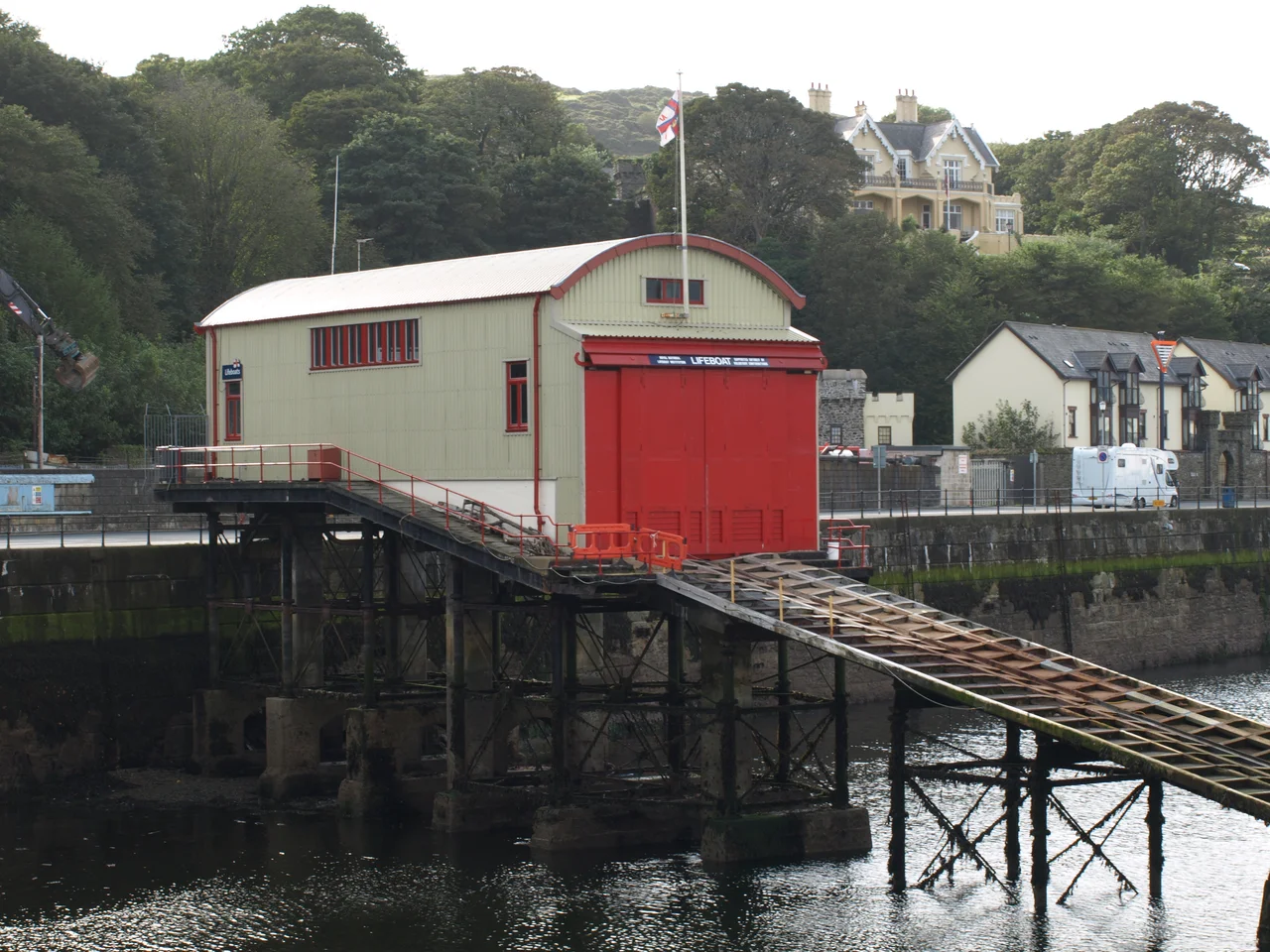

Douglas Lifeboat Station
On the night of 20 November 1830, Sir William Hillary was 59 years old. He had founded the Royal National Institution for the Preservation of Life from Shipwreck six years earlier, weathered previous rescues in which he had already received two Gold Medals, and was, by any reasonable measure, allowed to stay ashore. Instead, when the Royal Mail steamer St George was driven onto Conister Rocks in Douglas Bay, he climbed aboard the lifeboat True Blue with coxswain Isaac Vondy, 14 crew, and two volunteers, and went to get the crew off. After two hours of rowing through violent seas, the boat finally got alongside. Hillary and three other men were washed overboard, recovered to the boat, and Hillary finished the rescue with six broken ribs. The RNLI's third Gold Medal went to him. This is the station those people built.
Before the Institution Existed
Douglas had a lifeboat before there was a national institution to run one. In 1802, John Murray, 4th Duke of Atholl and then Governor of the Isle of Man, paid 130 pounds for an 8-oared, 25-foot boat he named Atholl. There is no record of her ever performing a rescue, which is not the same as saying she never did one, and in any case she was kept on an open beach and washed away in a storm of December 1814. The Manx maritime instinct, in other words, predated the institution that would eventually formalise it. By 1822, the wreck of HMS Vigilant on Conister Rock had made the case undeniable: Hillary led a volunteer rescue using local boats and pulled 97 men from the sea. Two years later he wrote to the new RNIPLS asking for a proper lifeboat station at Douglas, and in October 1825 the 20-foot lifeboat Nestor arrived from William Plenty of Newbury, the first boat ever ordered by what would become the RNLI.
True Blue
The most famous of Douglas's early boats was True Blue, in service from the late 1820s until 1851. Her record includes the St George rescue described above, the salvage launch to the Glasgow boat Eclipse in January 1830 with a boat that was not yet finished, and a long string of less dramatic services that won her crew an extraordinary collection of medals. Coxswain Isaac Vondy, the man who held the tiller through most of these calls, received the RNLI Silver Medal for the St George rescue alongside volunteer William Corlett. Lieutenant Robert Robinson of the Royal Navy, also aboard that night, was awarded the Gold Medal. These were not formal sailors employed by the institution. They were fishermen, harbour pilots, naval officers on leave, and ordinary Douglas men who lived near enough to the pier to be summoned when the maroons fired.
The Modern Station
Today the station sits at Battery Pier on Douglas Head, just below the lighthouse and the headland's small cluster of memorials. The boats have evolved through every generation of RNLI design, from rowed wooden lifeboats to steam, then motor, then the Mersey-class Ruby Clery, retired on 30 November 2025, and now the all-weather Trent-class boat Betty Huntbatch, which arrived on 9 August 2025 for crew training. The Tyne-class Sir William Hillary, named for the founder, also served at Douglas in earlier decades, a quiet acknowledgement of the line that runs from the 1822 rescue through every shout the station has answered since. Three memorials to Hillary stand in the city: one in St George's Church where he is buried, one on Loch Promenade, and one on Douglas Head where he commissioned the Tower of Refuge in 1832.
The Tower in the Bay
The small castellated structure visible offshore from Douglas Head is not decorative whimsy. It is the Tower of Refuge, built by Hillary in 1832 on the Conister Rocks that had wrecked the Vigilant and the St George and any number of vessels less famous. Stocked with provisions and shelter, it was designed to give shipwrecked sailors somewhere to wait out a storm if they could reach it. The tower is now one of the city's most photographed landmarks, sitting like a tiny mid-bay castle at high tide. It also serves as a permanent monument to the man who decided that good intentions were not enough, and that the only way to save sailors was to build the institution that would go and get them.
From the Air
Douglas Lifeboat Station is at Battery Pier on Douglas Head, at 54.145 degrees north, 4.470 degrees west. From altitude, locate Douglas Bay and the harbour breakwater; the lifeboat station sits at the southern end of the harbour entrance, with Douglas Head Lighthouse just above on the cliff. The Tower of Refuge, the most striking feature in the bay, is just offshore. Nearest airport: Isle of Man Airport at Ronaldsway (ICAO: EGNS), 9 nautical miles southwest. Sea state and visibility around this headland are frequently challenging; the station's reason for existing is precisely the conditions that make low-level visual identification difficult.
Nearby Stories
- St Bees Lighthouse 15 km away
- Celtic Array 22 km away
- Kirkmaiden 23 km away
- Isle of Whithorn 23 km away
- Seascale Lifeboat Station 31 km away
- German submarine U-1024 36 km away
- SS Georgetown Victory 40 km away
- Blackpool Illuminations 56 km away