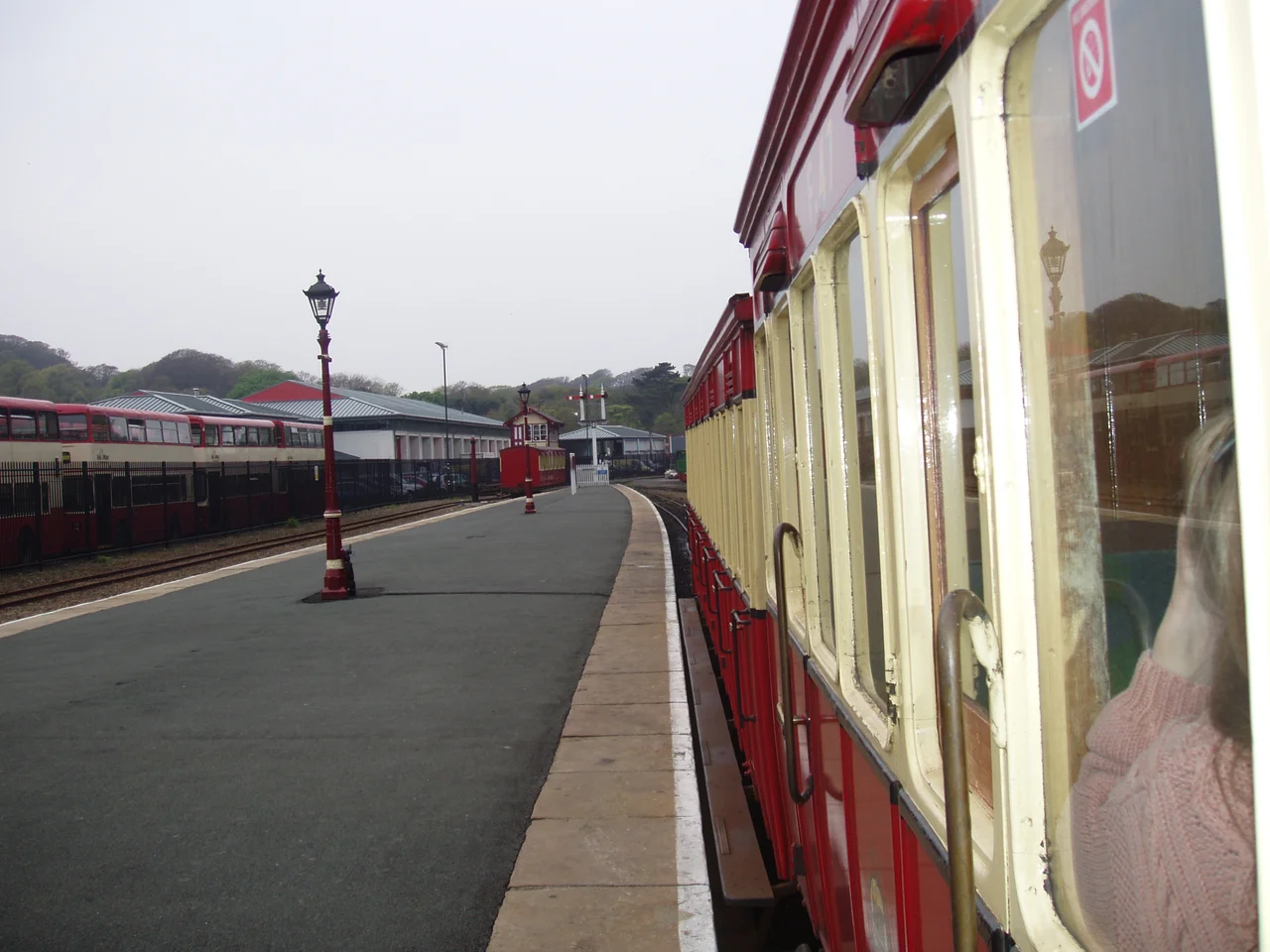

Douglas Railway Station
Steam still rises from the platform here. The whistle still echoes off the gilt-topped turrets of the entrance archway. The locomotive sliding into Platform 1 was built in the 1870s and is, give or take a rebuild, the same engine that hauled holidaymakers in cloth caps to Port Erin a century and a half ago. Douglas Railway Station is one of those rare survivors where the rolling stock and the buildings are nearly contemporary, both finished by Victorian engineers who assumed neither would still be in service in 2026. Both, somewhat improbably, are.
Built on a Reclaimed Lake
The station sits at the landward end of North Quay, on a site that until 1872 was marshland. The clue is in the address: Lake Road. The Isle of Man Railway Company bought the site that year, diverted the River Douglas to the southern side to ease construction, and opened a wooden station building 70 feet by 30 with a zinc tiled roof. Trains ran to Peel from 1873. The Port Erin line followed in 1874, with the Foxdale and Ramsey extensions arriving later. By the mid-1880s the modest wooden station was already inadequate, and a major rebuild began in 1887 using red Ruabon brick shipped from Wales. The grand archway of gilt-topped turrets and clock tower facing Peel Road and Athol Street dates from this campaign, as do the iron and glass platform canopies installed in 1909.
The Dutton Signal Box
Tucked between the carriage shed and the workshops is one of British railway history's small treasures: a signal box built in 1892 by Dutton and Co. of Worcester. Its 36-lever frame is a unique survivor of the drink-handle type, in which the catch handle and the lever handle are the same piece, and its three-quarter glazed top section with integral fireplace looks almost identical to Dutton boxes installed about the same time on the Great Northern Railway in Ireland. The signalman could see the whole yard from up there. Telephones did not arrive until 1925, after an overrun accident the previous August suggested whistle codes were no longer sufficient. The box was retired in stages between 1970 and 1980, relocated forward in 1998 when the new transport headquarters were built, and now stands quietly out of service, opened occasionally during transport festivals and tended by members of the Isle of Man Steam Railway Supporters' Association.
Rationalisation
In 1979 the station was halved. With only the Port Erin line still operating, the Peel and Ramsey services having closed in 1968, the goods yard, the Port Erin platforms, and most of the canopies were removed. The old island platform structure was demolished, the trackwork rationalised, and much of the southern yard turned into a car park. What had once been a four-platform terminus with goods sheds, carriage sidings, and a manure siding became a single working platform serving one line. The 1990 to 1991 interior refit won an Ian Allan Heritage Award for best preserved station in the British Isles and installed a restaurant called Greens, the island's first dedicated vegetarian eatery, in the old booking hall. A further refit in 2016 stripped the upper floors, installed a lift and accessible toilets, and rebranded the cafe as The Tickethall. The booking hall is now a gift shop. A replica of the original Edwardian ticket window remains in the wall as a deliberate ghost.
Still Steaming
What survives is still extraordinary. The locomotive shed, machine shop, and carpenters' shop in their rubble-stone buildings of the 1890s still service the fleet, with overhead lifting gear capable of pulling boilers off frames for maintenance and a static beam engine and wheel lathes in place. The platform's cast iron lamp standards, electric now but echoing the gas originals that pre-dated 1909, were installed during the 1991 refurbishment. Two semaphore signals from the Festiniog Railway in Wales, fitted in 2005, mark the end of the platform. Once a year, during the TT race period, a commuter service runs between Douglas and Port Erin to bypass road closures. For the rest of the season, mid-March to early November, the railway functions as a working museum that happens to also be useful: passengers travel because they want the journey, and that, more than any preservation order, is what has kept the Victorian engines under steam.
From the Air
Douglas Railway Station sits at 54.148 degrees north, 4.486 degrees west, at the landward end of North Quay just south of the central commercial district. From altitude, look for the red brick station building and the parallel single track running southwest into the central valley toward Castletown and Port Erin. The harbour is immediately to the east. Nearest airport: Isle of Man Airport at Ronaldsway (ICAO: EGNS), 9 nautical miles southwest, with the railway line passing within a few miles of the airport boundary. Weather around Douglas is frequently marine: low cloud and stratus can hide the harbour entrance from above.
Nearby Stories
- St Bees Lighthouse 15 km away
- Celtic Array 22 km away
- Kirkmaiden 23 km away
- Isle of Whithorn 23 km away
- Seascale Lifeboat Station 31 km away
- German submarine U-1024 36 km away
- SS Georgetown Victory 40 km away
- Blackpool Illuminations 56 km away