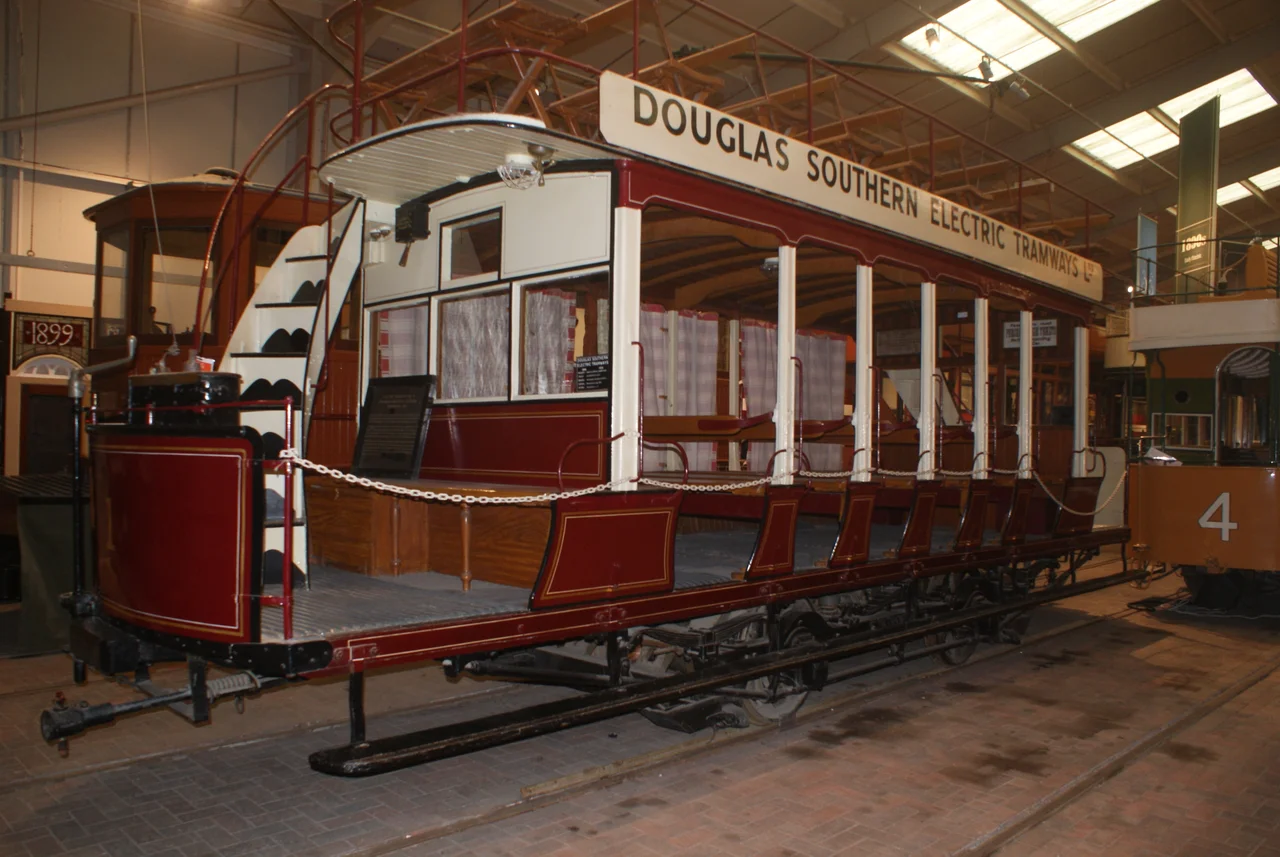

Douglas Southern Electric Tramway
The journey, one early film reviewer noted, was a white-knuckle ride. Imagine sitting on the upper deck of an open-topped tram, varnished knifeboard seats arranged back-to-back, striped curtains snapping in the wind, and a single track threading along the edge of a cliff above the Irish Sea. Now imagine the rails laid right into the roadway, the tram swaying around bends that have no guardrail, viaducts that span gullies where the surf is just visible far below. This is what the Douglas Southern Electric Tramway offered between 1896 and 1939: a three-and-a-half-mile thrill ride from Douglas Head to the seaside resort of Port Soderick, sold as scenic transport but secretly a roller coaster.
How It Worked
The tramway opened in 1896, operated by the New General Traction Company, running standard gauge double-deck cars along the dramatic Marine Drive that hugs the cliffs south of Douglas Head. The line was single track with passing places, and all stops were on the seaward side because cars only had doors on that side. At each end of the route, short inclined railways carried passengers up and down between the clifftop tramway and the destinations below. At Douglas Head the funicular dropped you to the harbour. At Port Soderick another incline lowered you to the resort's beach and pleasure gardens. The arrangement was elegantly Victorian: chain together a series of engineering tricks and the customer barely notices that they have just descended a hundred feet of cliff.
The Fleet
At its peak, the line had eight motor cars and eight matching trailers, all double-deckers in maroon livery with gold trim and fleet lettering, white uprights, varnished knifeboard seats, and the distinctive striped curtains that became the tramway's visual signature. The colour scheme barely changed in 43 years of operation. The double-decking, the open tops, and the cliff-edge route made the ride spectacular and surprisingly exposed; on cold or wet days the lower deck became fashionable, and on sunny ones the upper deck commanded a view that almost no other tramway in the world could match. A 1902 film of the journey, made by the early film pioneers Mitchell and Kenyon and now preserved at the British Film Institute, captures both the scenery and the unhurried lurch of the cars.
Two Wars, One Closure
The line shut for both world wars. After the First World War it reopened. After the Second it did not. By 1955 most of the track had been lifted and the infrastructure scrapped. The reasons were the usual late-tram litany: changing holiday tastes, road competition, capital costs of repair, and the very specific problem that Marine Drive itself was beginning to fail. Landslides had always been part of the cliff's character, and without ongoing maintenance the road became increasingly dangerous. Douglas Corporation tried a bus service along the route in the 1960s, but further rockfalls killed it off too. Today parts of Marine Drive remain open to cars, but the stretch north of Little Ness, where the tramway's sheds and powerhouse once stood, is now a pedestrian-only path.
What Survives
Walk south from Douglas Head along Marine Drive and the tramway's ghost is everywhere. The castellated entrance arch at the Douglas end is intact, and its landside arch still shows where the overhead cable for the trams attached to the stonework, a small detail that reveals the whole hidden electrical system. The sheds, workshops, and power station at Little Ness have been filled in and paved as a car park. The footpath now forms part of Raad ny Foillan, the 164-kilometre Way of the Gull coastal trail around the island, created in 1986. One tram survived. Motor car number 1 was rescued from the abandoned depot, moved in 1956 to London and the British Transport Museum, transferred when that museum closed to the Science Museum, and has been on long-term loan since 1975 to the National Tramway Museum at Crich in Derbyshire. It sits indoors now, complete with its striped curtains, two hundred miles from the sea and the cliffs it used to skim.
From the Air
The former tramway ran along the cliffs from Douglas Head south to Port Soderick. Its midpoint coordinates are approximately 54.144 degrees north, 4.471 degrees west. From altitude, identify Marine Drive as a thin line running south from Douglas Head along the cliff edge, terminating near Port Soderick. The Manx Radio mast and Douglas Head Lighthouse mark the northern end. Nearest airport: Isle of Man Airport at Ronaldsway (ICAO: EGNS), about 7 nautical miles south. The route parallels some of the island's most photogenic coastline, with sheer cliffs dropping to the Irish Sea.
Nearby Stories
- St Bees Lighthouse 15 km away
- Celtic Array 22 km away
- Kirkmaiden 23 km away
- Isle of Whithorn 23 km away
- Seascale Lifeboat Station 31 km away
- German submarine U-1024 36 km away
- SS Georgetown Victory 40 km away
- Blackpool Illuminations 56 km away