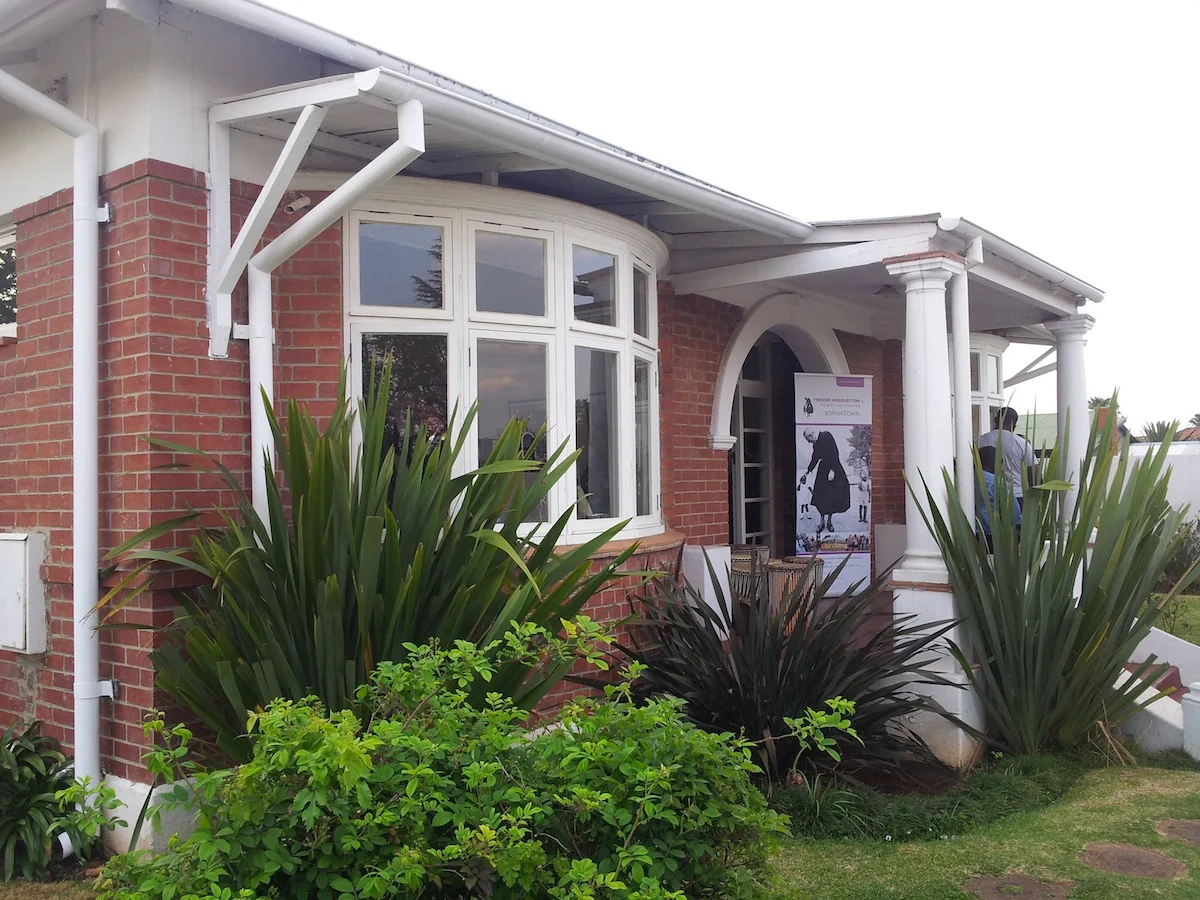

Dr Xuma House
He named it Empilweni, the place of life. When Alfred Bitini Xuma completed his red-brick house in 1935, Sophiatown was one of the few corners of Johannesburg where Black South Africans could own the land beneath their homes, and Xuma built well: a mansion by the standards of the neighbourhood, spread across two stands while his neighbours made do with terraces and rooms. Twenty years later the apartheid state set out to wipe Sophiatown off the map. When the bulldozers had finished, almost nothing remained. Xuma's house was one of only two left standing, a single survivor of a community of tens of thousands.
The Man Who Built It
Xuma was a figure of firsts. Born in 1893 in the Eastern Cape, he became one of the first Black South Africans to qualify as a medical doctor, training in the United States and Europe before returning home to practise. From 1940 to 1949 he served as president-general of the African National Congress, rebuilding a struggling organisation and laying groundwork that a younger generation would inherit. He shared Empilweni with his second wife, Madie Hall Xuma, an American educator who became the first president of the ANC Women's League. Xuma designed his home to do double duty: an L-shaped plan let one wing serve as his residence while the other held his consulting rooms, facing Edward Road, so that the community could reach a doctor when few other Black neighbourhoods could. The interior matched the man's standing, with pressed-steel ceilings, klompie-brick fireplaces, and polished timber floors and picture rails, a quietly dignified home for a leader who moved easily between a surgery, a clinic, and the negotiating tables of national politics.
Sophiatown Before the Fall
Sophiatown was to Johannesburg what District Six was to Cape Town: crowded, poor, musical, and fiercely alive. It produced writers, jazz musicians, and a culture that refused to be small. It was also, to the architects of apartheid, an intolerable thing, a place where Black residents held freehold title in a city meant to be carved by colour. Under the Natives Resettlement Act of 1954, the government declared the area a white zone and began forced removals. Around 65,000 people were torn from their homes in the mid-1950s, loaded onto trucks, and resettled in Meadowlands and Soweto. The houses were demolished behind them. The state renamed what it built on the rubble Triomf, the Afrikaans word for triumph.
The House That Refused to Fall
Xuma held out longer than most. By the late 1950s, after nearly everyone else had been moved, he too was forced from the home he had lived in for almost a quarter of a century. But the house itself survived the demolitions, one of only two structures in all of Sophiatown to outlast the removals of its Black owners and tenants. It stood through the decades of Triomf, an Afrikaner suburb built over a buried neighbourhood, an inconvenient witness to what had been erased. As the home of a man who reorganised the ANC and helped coordinate the early opposition to racial discrimination, it is a milestone of the liberation struggle hiding in plain sight on a quiet residential street.
Sophiatown Reborn
In 2006 the authorities restored the neighbourhood's original name, and Sophiatown, on paper at least, was reborn. Xuma's house remained a private residence until 2008, when it opened to the public as the Sophiatown Heritage and Cultural Centre. Declared a national monument in 1998 and a heritage site in 1999, it now serves a purpose its builder might have appreciated: a place where the story of a vanished community is kept alive for those who never saw it. The pressed-steel ceilings, the klompie-brick fireplaces, the polished timber floors all remain. Empilweni still stands, still the place of life, holding the memory of everything around it that did not.
From the Air
Dr Xuma House stands in Sophiatown, west of central Johannesburg, at 26.176 degrees south, 27.983 degrees east, in the dense residential grid once renamed Triomf. The single-storey brick house is not visible as a distinct landmark from altitude; use the Sophiatown street grid and its position roughly 7 km west of the Johannesburg central business district as the navigational reference, with a recommended viewing altitude of 1,500 to 2,500 feet AGL. The nearest major airport is OR Tambo International (FAOR), about 30 km to the east; Lanseria International (FALA) lies roughly 25 km to the northwest, and Rand Airport (FAGM) is about 25 km to the southeast. Johannesburg sits at roughly 1,750 metres on the Highveld; expect afternoon thunderstorms in the summer wet season (November to March) and clear but often hazy mornings in the dry winter.
Nearby Stories
- Pelindaba 4.6 km away
- TauTona Mine 6.3 km away
- Zonderwater POW camp 18 km away
- Kweneng' Ruins 25 km away
- Battle of Bronkhorstspruit 40 km away
- Royal Bafokeng Nation 41 km away
- Secunda CTL 72 km away
- Sun City 91 km away